Illiquidity Premium and Credit Risk in Brazilian Receivables Investment Funds (FIDCs): Theoretical Foundations, Regulatory Architecture and a Measurement Agenda (RCMOS - Revista Científica Multidisciplinar O Saber)
SaveSummary
- Brazilian Receivables Investment Funds (FIDCs) reached R$ 741,1 bilhões in net equity over the twelve months ending November 2025, registering a growth of 22,5%.p.2
- The total number of FIDC investor accounts expanded from 147,3 mil to 333,7 mil, while retail general investor accounts increased from 2,4 mil to 34,3 mil following the implementation of CVM Resolution No. 175.p.2
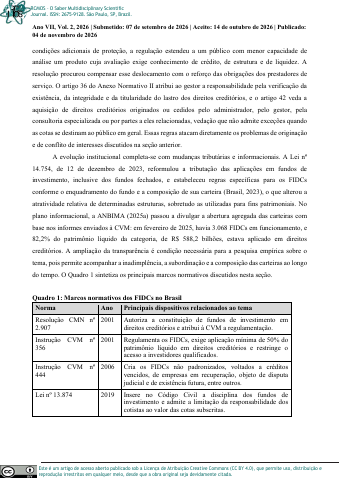
- By February 2025, there were 3.068 operating FIDCs in Brazil, with 82,2% of the category's R$ 588,2 bilhões in net assets allocated to credit rights.p.7
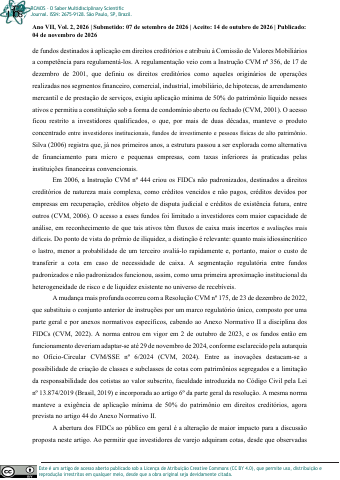
- Brazilian regulations maintain a requirement that FIDCs allocate a minimum of 50% of their net equity to credit rights.p.6
- The number of FIDC management firms grew from 372 to 426 between December 2024 and November 2025, with total issuances reaching R$ 90,1 bilhões over that timeframe.p.15
- Monte Carlo simulations of FIDC structures with 15% subordination showed that senior quotas attained their target return with 99% confidence across all tested credit scenarios.p.10
Key insights
- The spread of FIDC quotas over the benchmark CDI rate combines three distinct unobservable components: expected credit loss, systematic credit risk premium, and an illiquidity premium.p.2
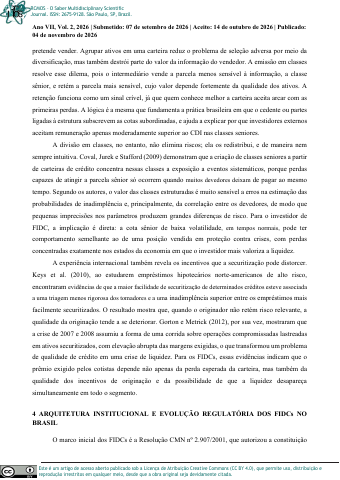
- Tranching receivables into senior and subordinated quotas does not eliminate systemic risk, but rather concentrates tail-risk exposure in senior classes during severe macro downturns.p.5
- CVM Resolution No. 175 opened FIDCs to retail investors while introducing protected segregated subclasses, limited liability, and strict manager liability for collateral verification.p.6
- Model-based quota pricing and delayed recognition of credit provisions create return smoothing and serial autocorrelation, which artificially inflates conventional Sharpe ratios and understates true risk.p.12
- Using the liquid and virtually risk-free CDI as a benchmark inappropriately attributes risk and illiquidity premia to fund manager alpha.p.13
- High nominal risk-free yields with daily liquidity in Brazil increase the opportunity cost of capital, requiring a higher illiquidity premium compared to low-rate international markets.p.9
- Dynamic protection mechanisms like accelerated amortization and early liquidation triggers turn the effective maturity of senior quotas into a random variable correlated with the credit cycle.p.12
- Empirical assessment of FIDC performance requires econometric desmoothing, lagged market factor loadings, and explicit controls for fund redemption horizons and closed-end structures.p.15
Pages
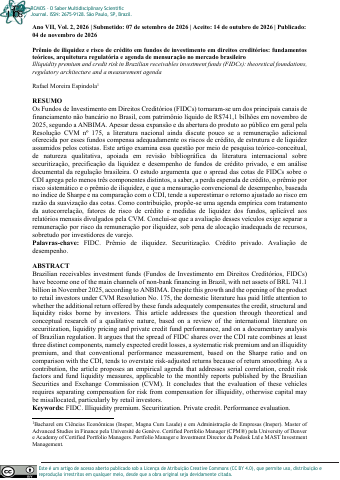 p.1
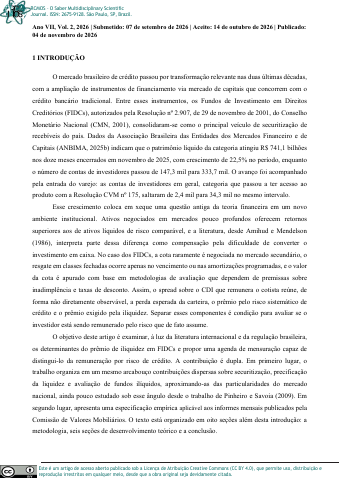 p.2
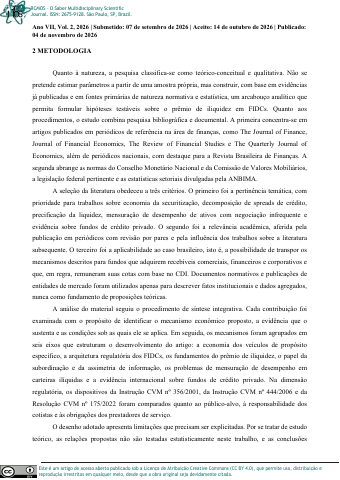 p.3
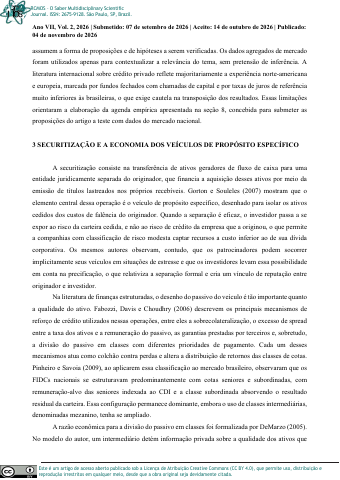 p.4
 p.5
 p.6
 p.7
 p.8
 p.9
 p.10
 p.11
 p.12
 p.13
 p.14
 p.15
 p.16
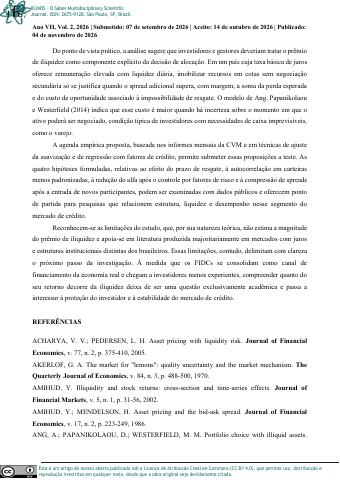 p.17
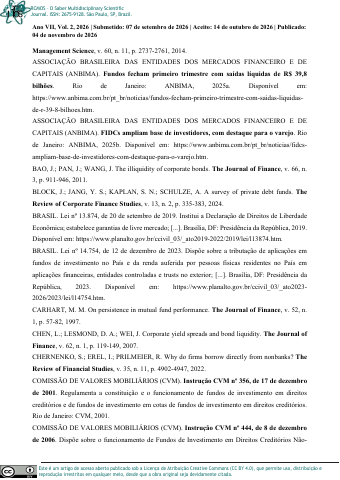 p.18
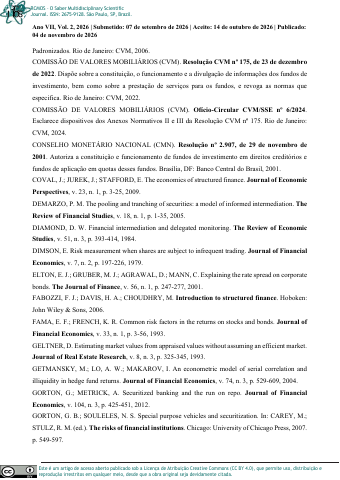 p.19
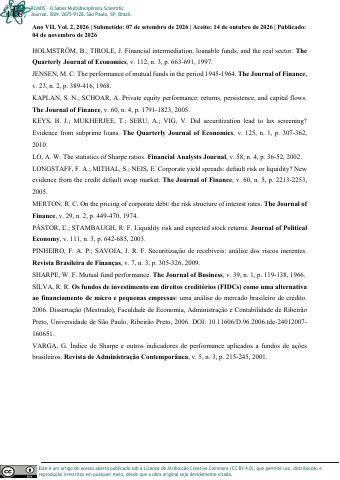 p.20
Funders mentioned
Topics and entities
Summary and figures generated from the document and checked automatically: every number shown appears on the cited page. Publishers can request removal.