Funding Justice: A Conceptual Model of Investor Behaviour in Litigation Crowdfunding (Advanced International Journal for Research)
SaveSummary
- Litigation crowdfunding operates as a retail-facing extension of third-party litigation funding (TPLF), enabling individuals to finance legal claims via donations or return-seeking models across platforms like CrowdJustice and LexShares.p.2
- An empirical study of 565 successfully funded donation-based campaigns on CrowdJustice showed that human-rights, environmental, and judicial-review cases attracted the highest number of campaigns.p.3
- An analysis of 413 crowdfunded judicial-review campaigns demonstrated that crowdfunding allows locally oriented actors to use legal mobilisation for broader social change.p.3
- A dataset of 500 legal-category campaigns on GiveSendGo revealed an overall funding shortfall, with politically controversial disputes raising substantially more than family or criminal law cases.p.3
- A market-level analysis of more than two million GoFundMe campaigns showed that personal-injury advertising positively affects accident-related donation crowdfunding, acting as a liquidity complement.p.3
- The conceptual model establishes a triadic relationship among funder, litigant, and platform and articulates eight core theoretical propositions.p.1
Key insights
- Litigation crowdfunding differs from conventional entrepreneurial crowdfunding because returns depend on binary, court-adjudicated legal outcomes rather than continuous founder execution.p.2
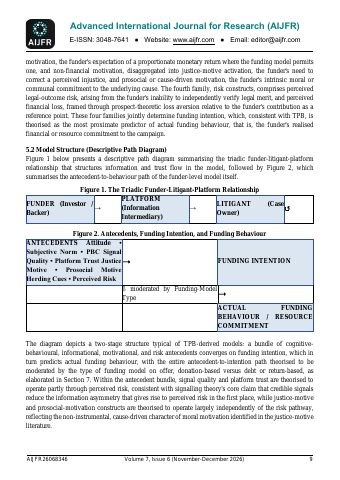
- The conceptual framework models the funder-litigant-platform dynamic as a triadic structure driven by information asymmetry, credibility signalling, and platform vetting.p.8
- Litigant signal quality, such as recognised legal representation and procedural milestones, indirectly increases funding intention by enhancing platform and litigant trust.p.10
- Justice-motive activation functions as an independent motivational driver of funding intention that operates separately from expected financial return.p.10
- Social proof and herding cues exert a stronger influence on funding intention when a funder's capacity to independently evaluate legal merit decreases.p.10
- Perceived legal-outcome risk and potential financial loss negatively impact funding intention, but this deterrent is attenuated by platform trust and visible herding cues.p.10
- The funding model type acts as a key moderator: justice and prosocial motives dominate donation-based campaigns, whereas signal quality and trust dominate return-based campaigns.p.10
- In the Indian legal ecosystem, third-party litigation funding is judicially recognised but lacks dedicated statutory regulation, leaving retail funders heavily reliant on unverified signals.p.12
Pages
 p.1
 p.2
 p.3
 p.4
 p.5
 p.6
 p.7
 p.8
 p.9
 p.10
 p.11
 p.12
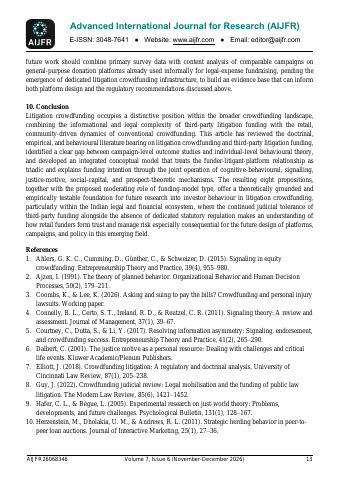 p.13
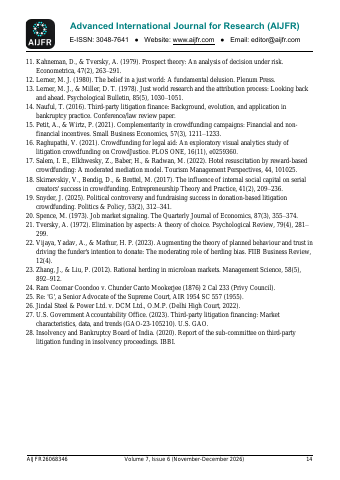 p.14
Funders mentioned
Topics and entities
Summary and figures generated from the document and checked automatically: every number shown appears on the cited page. Publishers can request removal.