Foreign Investment and Indian Clean Energy Transition: An Empirical Assessment (Zenodo)
SaveWhat changed
−0.2652
Error-correction coefficient (share of disequilibrium corrected per year, approximately 26.5%) p.10
Summary
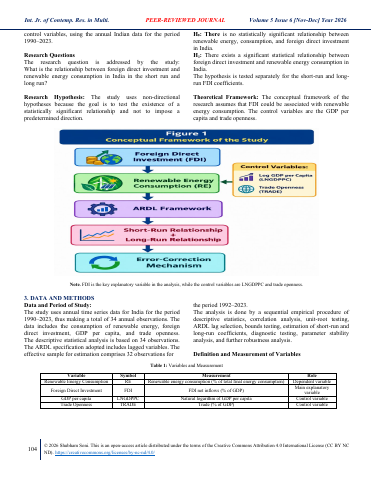
- The study tests the short-run and long-run link between foreign direct investment and renewable energy consumption in India using annual data for 1990–2023.p.1
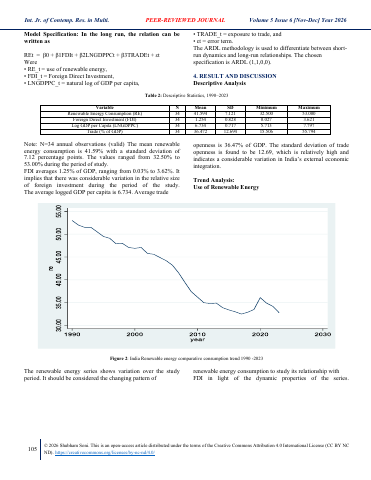
- Mean renewable energy consumption is 41.59% with a standard deviation of 7.12 percentage points.p.4
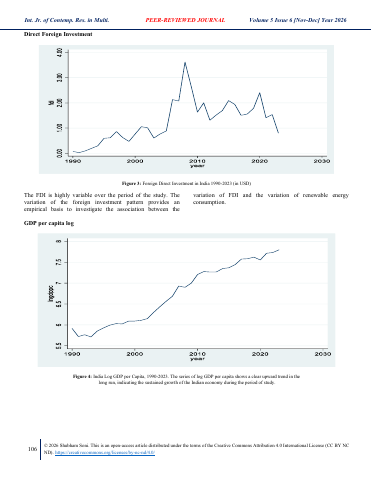
- FDI averages 1.25% of GDP, ranging from 0.03% to 3.62%.p.4
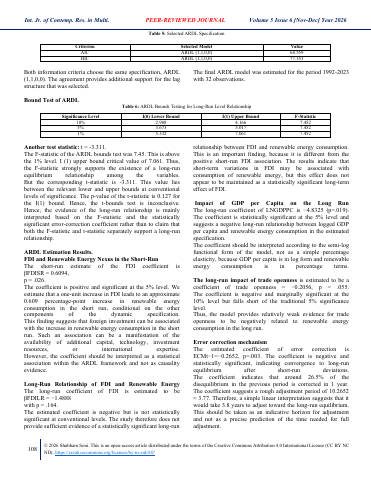
- The ARDL bounds F-statistic of 7.45 is above the 1% I(1) upper bound critical value of 7.061, supporting a long-run equilibrium relationship.p.7
- The error-correction coefficient of −0.2652 (p = .003) implies that approximately 26.5% of disequilibrium is corrected in one year.p.10
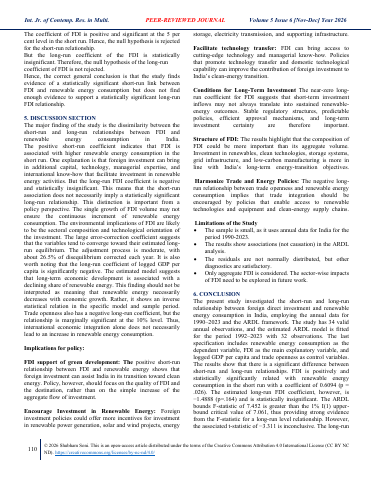
- The FDI coefficient is positive and significant at the 5 per cent level in the short run, but the long-run coefficient is statistically insignificant.p.9
Key insights
- FDI is positively and significantly associated with renewable energy consumption in the short run at the 5 per cent level.p.9
- The long-run FDI coefficient is statistically insignificant, so the null hypothesis of no long-run relationship is not rejected.p.9
- The ARDL bounds F-statistic of 7.45 exceeds the 1% I(1) upper bound of 7.061.p.7
- The t-bounds test, with a t-statistic of -3.311, is inconclusive.p.7
- The error-correction coefficient of −0.2652 (p = .003) indicates a strong tendency to return to long-run equilibrium.p.10
- The long-run coefficient of log GDP per capita is −4.8325 (p=.019).p.7
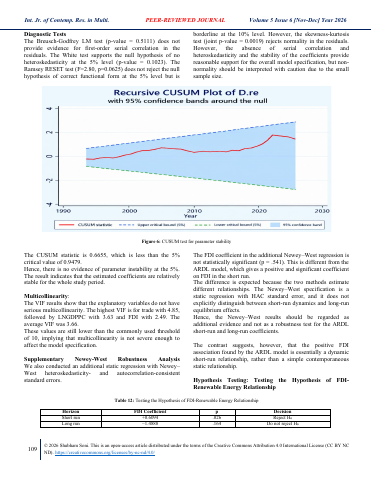
- The CUSUM statistic of 0.6655 is below the 5% critical value of 0.9479, so there is no evidence of parameter instability.p.8
- The FDI coefficient in the additional Newey–West regression is not statistically significant (p = .541).p.8
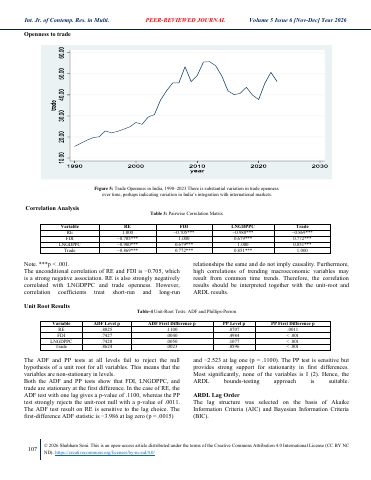
- The unconditional correlation between renewable energy consumption and FDI is −0.705.p.6
Pages
 p.1
 p.2
 p.3
 p.4
 p.5
 p.6
 p.7
 p.8
 p.9
 p.10
 p.11
Funders mentioned
Topics and entities
Summary and figures generated from the document and checked automatically: every number shown appears on the cited page. Publishers can request removal.