Explainable Artificial Intelligence (XAI) in the Banking Sector: A Review of Techniques for Transparent Credit, Fraud and Compliance Decisions (Advances in Economics Management and Political Sciences)
SaveSummary
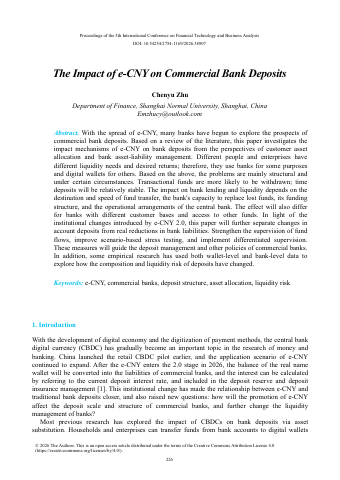
- Banks use complex machine learning models such as neural networks, random forests and gradient boosting for credit scoring, loan approval, fraud detection, risk assessment and anti-money laundering, and many operate as black boxes.p.1
- The review covers inherently interpretable models, post-hoc techniques such as LIME and SHAP, and counterfactual explanations that tell customers what would change a decision.p.1
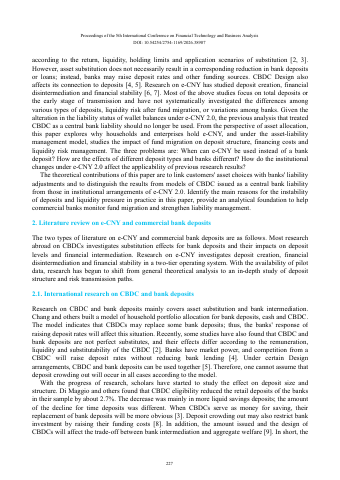
- Explanations can be global or local, and can be feature attributions, example-based or counterfactual.p.2
- Equality of opportunity requires equal true-positive rates across groups, offering a measurable fairness criterion for lending.p.2
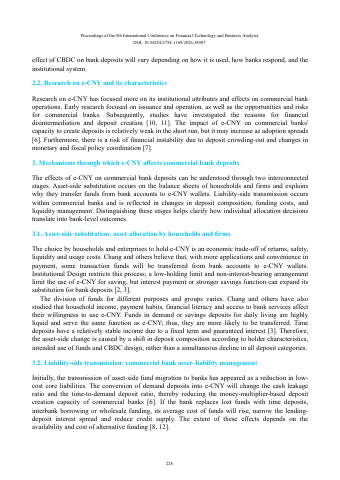
- The paper proposes a layered XAI architecture in which explanation and governance are integral parts of the banking decision pipeline.p.3
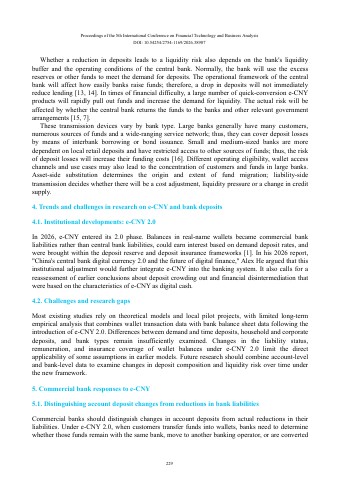
- The EU AI Act classifies credit scoring as high-risk.p.4
Key insights
- Explanations from different methods can disagree, and there is no standard for choosing among them.p.3
- The stability and faithfulness of explanations are rarely validated in production banking systems.p.3
- Explanations designed for data scientists are often unsuitable for customers or branch staff.p.3
- Fraud and anti-money-laundering models raise explanation challenges distinct from credit scoring and are less studied.p.3
- In the proposed design an interpretable scorecard serves as a benchmark and fallback alongside a high-performance model such as gradient boosting.p.3
- Customers should receive plain-language reasons and steps for improvement, while auditors and regulators access full documentation and logs.p.4
- SHAP and TreeSHAP are rated high for stability and suit credit and fraud models, while LIME is rated low to medium.p.4
- Future work includes standardized explanation quality metrics and privacy-preserving explanations.p.4
Pages
 p.1
 p.2
 p.3
 p.4
 p.5
 p.6
Topics and entities
Summary and figures generated from the document and checked automatically: every number shown appears on the cited page. Publishers can request removal.