Economic Assessment of Pollution Impact on Formation of Sustainable Financing Strategies for Enterprises (Financial and credit activity problems of theory and practice)
SaveWhat changed
UAH −3.14 million UAH million
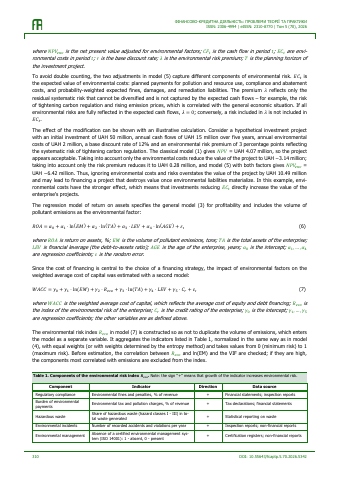
Illustrative NPV of project after environmental costs only p.6
Summary
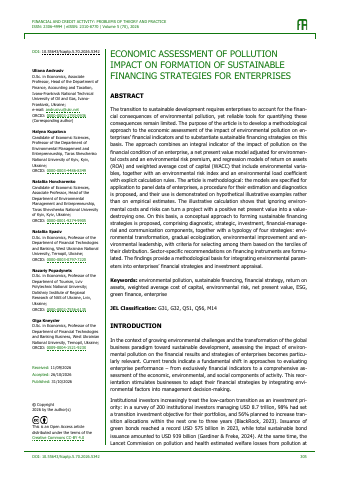
- The article is methodological: it develops an approach to assess the impact of environmental pollution on enterprises' financial indicators and to substantiate sustainable financing strategies.p.1
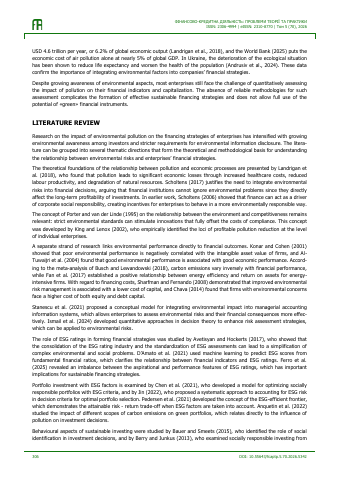
- Pollution is cited as costing USD 4.6 trillion per year, or 6.2% of global economic output.p.2
- The World Bank (2025) puts the economic cost of air pollution alone at nearly 5% of global GDP.p.2
- In an illustrative project (UAH 50 million initial investment, 12% base discount rate), the classical NPV is UAH 4.07 million.p.6
- Taking into account only the environmental costs reduces the illustrative project value to UAH −3.14 million.p.6
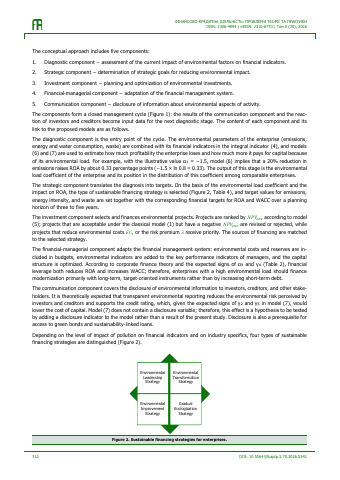
- The conceptual approach includes five components, from diagnostic to communication, forming a closed management cycle.p.8
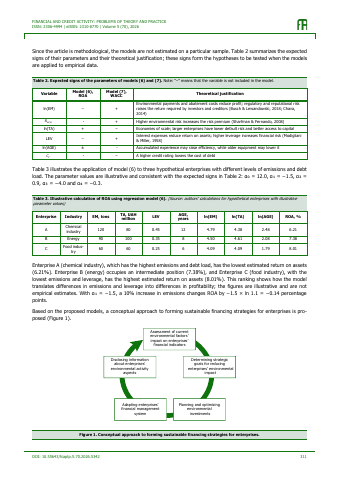
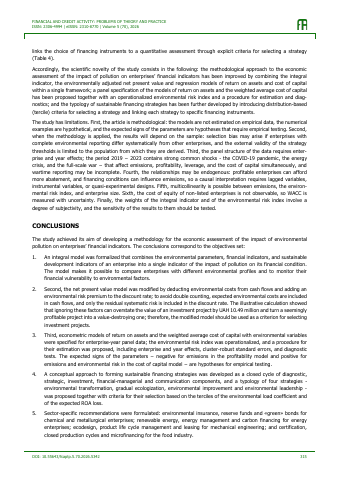
- The article states that its models are not estimated on empirical data and its numerical examples are hypothetical.p.11
Key insights
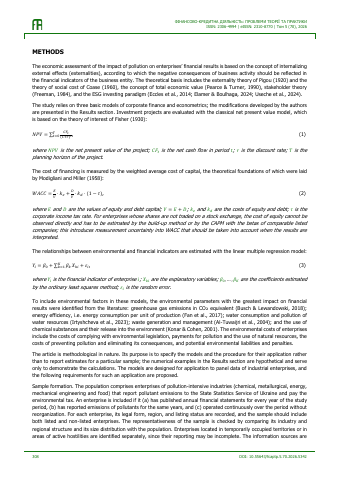
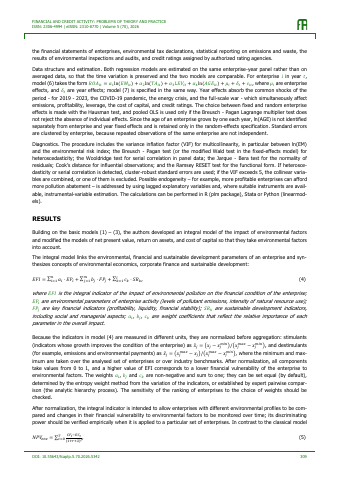
- Models combine an integral pollution indicator, an environmentally adjusted NPV, and regression models of ROA and WACC.p.1
- Most enterprises lack reliable methodologies to quantify the impact of pollution on their financial indicators.p.2
- The environmental risk premium reflects only residual systematic risk not captured in expected cash flows.p.6
- With the illustrative value of the coefficient, a 20% reduction in emissions raises ROA by about 0.33 percentage points.p.8
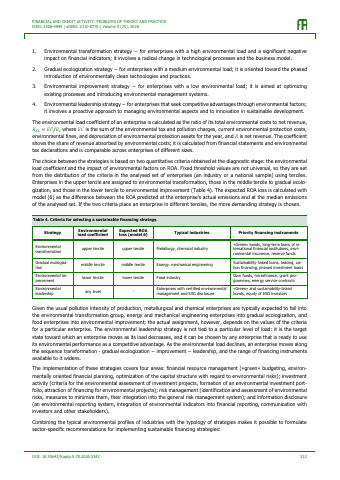
- Four sustainable financing strategies are defined, from environmental transformation to environmental leadership.p.9
- The environmental load coefficient is calculated as the ratio of total environmental costs to net revenue.p.9
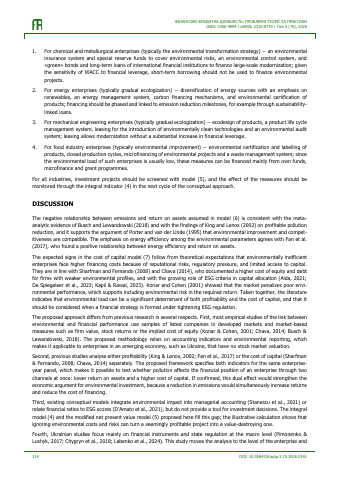
- For chemical and metallurgical enterprises, green bonds and long-term loans are suggested, and short-term borrowing should not finance environmental projects.p.10
- Leasing allows modernization of mechanical engineering enterprises without a substantial increase in financial leverage.p.10
Pages
 p.1
 p.2
 p.3
 p.4
 p.5
 p.6
 p.7
 p.8
 p.9
 p.10
 p.11
 p.12
 p.13
 p.14
Topics and entities
Summary and figures generated from the document and checked automatically: every number shown appears on the cited page. Publishers can request removal.