Do Financial Performance, Market Activity, and Capital Structure Drive Corporate Sustainability Performance? Evidence from Indonesia's Energy Sector (Indonesian Interdisciplinary Journal of Sharia Economics (IIJSE))
SaveSummary
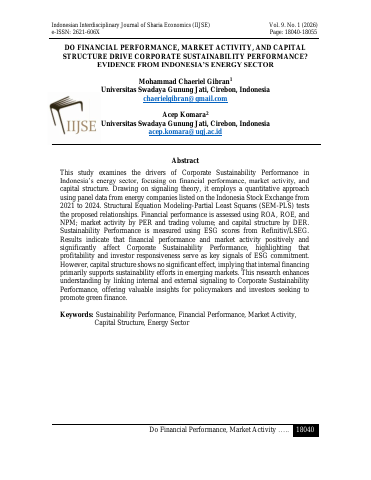
- The study uses panel data from energy companies listed on the Indonesia Stock Exchange from 2021 to 2024.p.1
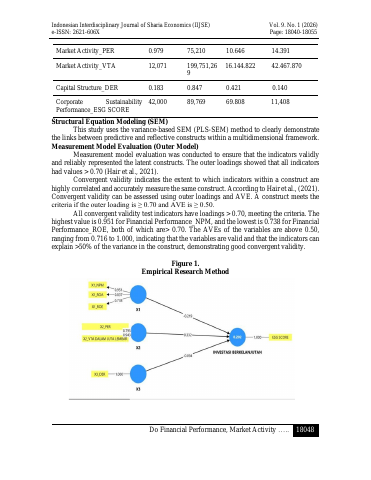
- Nine energy companies met the criteria, yielding 36 samples.p.7
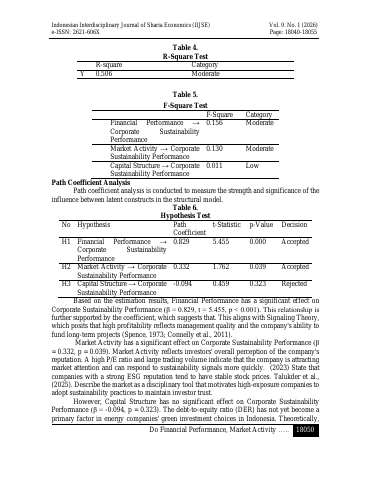
- Financial performance has a significant positive effect on sustainability performance (β = 0.829, t = 5.455).p.11
- Market activity has a significant positive effect (β = 0.332, p = 0.039).p.11
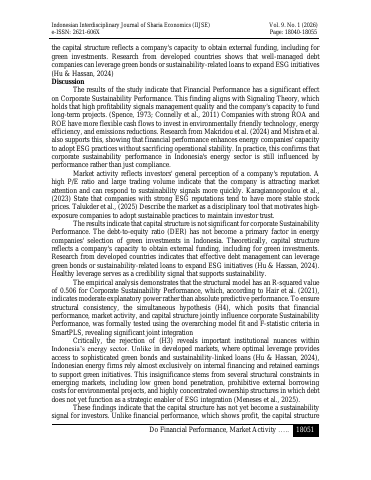
- Capital structure has no significant effect (path coefficient -0.094, p = 0.323).p.11
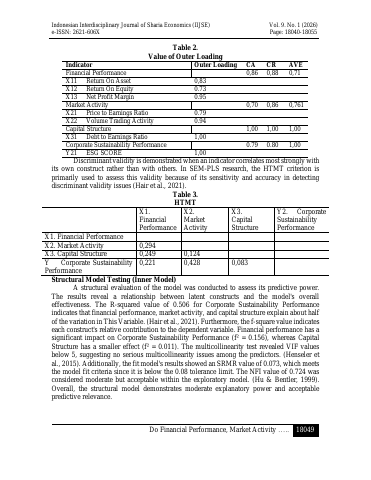
- The model's R-squared for Corporate Sustainability Performance is 0.506.p.11
Key insights
- Profitability and investor responsiveness act as key signals of ESG commitment in Indonesia's energy sector.p.1
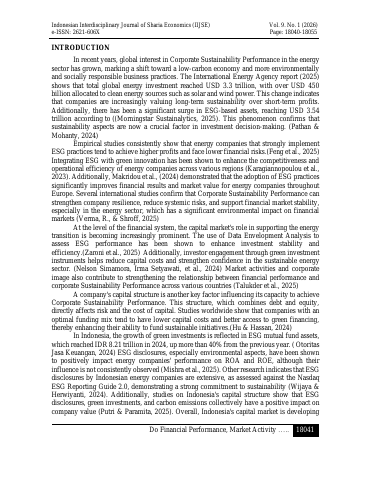
- Global energy investment reached USD 3.3 trillion, with over USD 450 billion allocated to clean energy.p.2
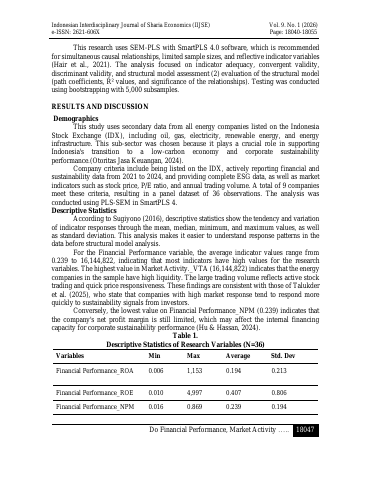
- Testing used bootstrapping with 5,000 subsamples.p.8
- Hypothesis H1 on financial performance was accepted.p.11
- Hypothesis H3 on capital structure was rejected.p.11
- Internal financing appears to support sustainability efforts in emerging markets more than debt does.p.1
Pages
 p.1
 p.2
 p.3
 p.4
 p.5
 p.6
 p.7
 p.8
 p.9
 p.10
 p.11
 p.12
 p.13
 p.14
 p.15
 p.16
Topics and entities
Summary and figures generated from the document and checked automatically: every number shown appears on the cited page. Publishers can request removal.