Digital Financial Innovation and the Growth Performance of Small and Medium-Sized Enterprises: Evidence from Kenya (Zenodo)
SaveSummary
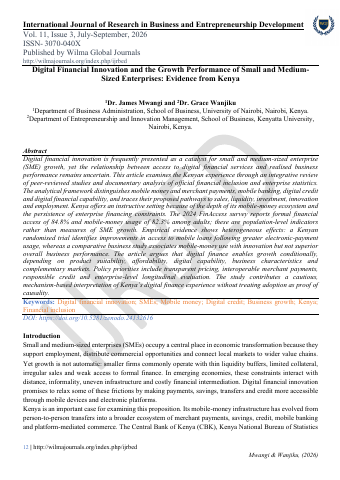
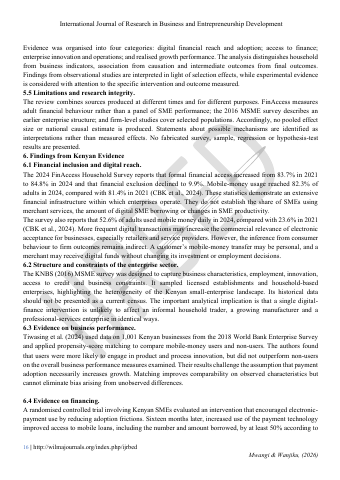
- The 2024 FinAccess survey records that formal financial access reached 84.8% and mobile-money usage reached 82.3% among Kenyan adults.p.1
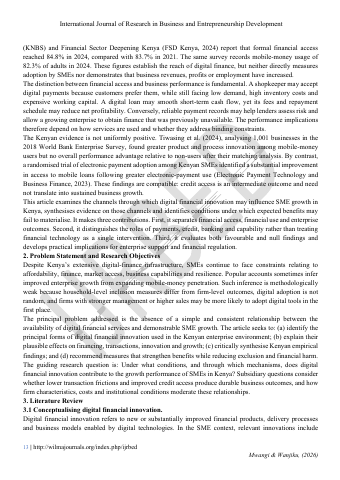
- Daily adult mobile-money usage in Kenya expanded to 52.6% in 2024, up from 23.6% in 2021.p.5
- A matched analysis of 1,001 Kenyan businesses from the 2018 World Bank Enterprise Survey links mobile-money use to innovation, but finds no overall performance advantage.p.5
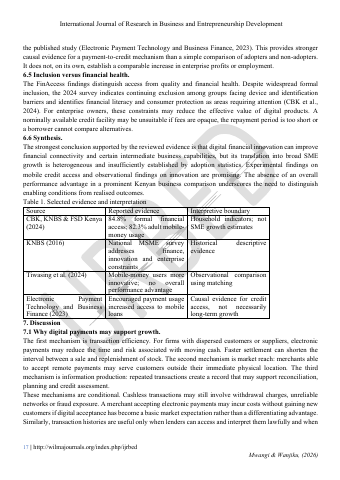
- A Kenyan randomized trial reveals that increased electronic-payment usage led to improved access to mobile loans.p.6
- Financial exclusion among Kenyan adults declined to 9.9% according to the 2024 FinAccess Household Survey.p.5
Key insights
- High population-level financial inclusion indicators do not directly measure SME growth, adoption, or business performance.p.2
- Mobile money adoption promotes product and process innovation in SMEs, yet does not guarantee higher net profitability or business growth.p.2
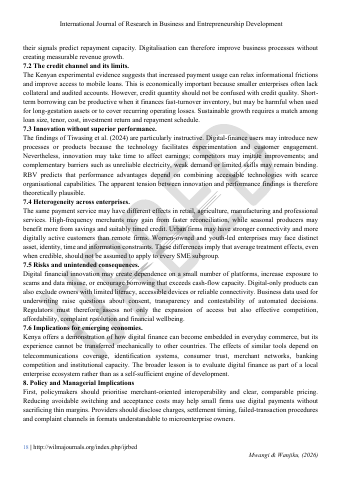
- Transaction data and digital payment usage relax information asymmetry, improving small enterprise access to short-term mobile credit.p.7
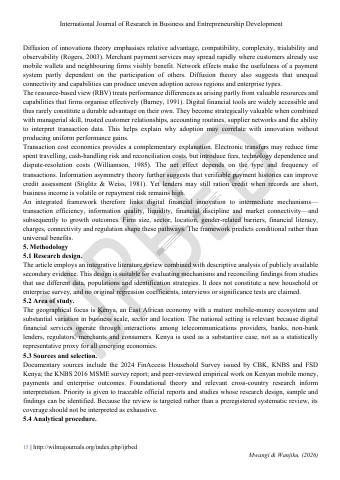
- Digital financial tools provide strategic value primarily when paired with managerial skills, customer trust, and robust accounting routines.p.4
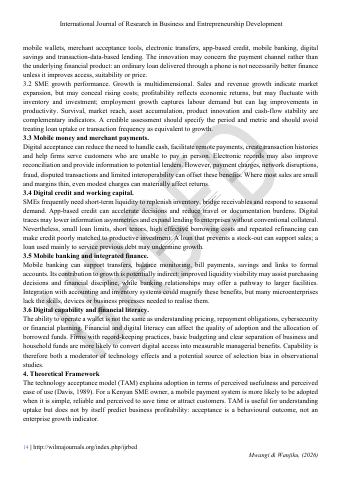
- Short tenor, small loan limits, and high effective fees can make app-based credit poorly matched to long-term enterprise investments.p.3
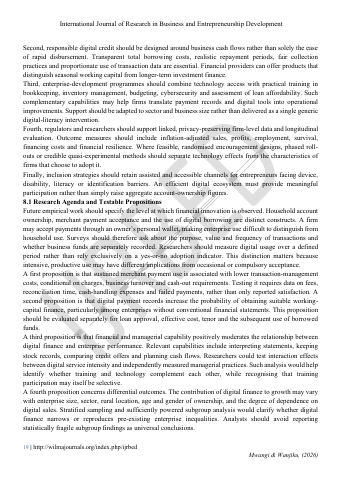
- Evaluating digital finance impact requires longitudinal firm-level research to separate technology effects from pre-existing firm characteristics.p.9
Pages
 p.1
 p.2
 p.3
 p.4
 p.5
 p.6
 p.7
 p.8
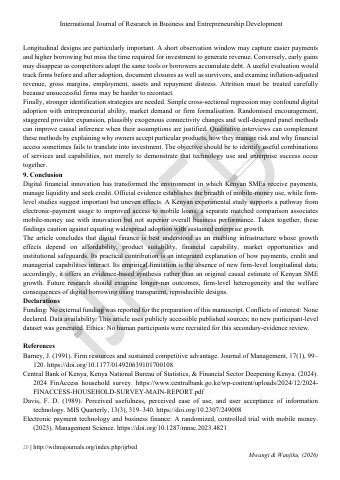 p.9
 p.10
Funders mentioned
Topics and entities
Summary and figures generated from the document and checked automatically: every number shown appears on the cited page. Publishers can request removal.