Decision-Making Perspectives on the Risks of Financial Digitalization Among Individual Respondents (Decision Making Advances)
Summary
- A quantitative questionnaire survey conducted in autumn 2025 gathered responses from 1,109 participants to explore financial digitalization risk perceptions.p.6
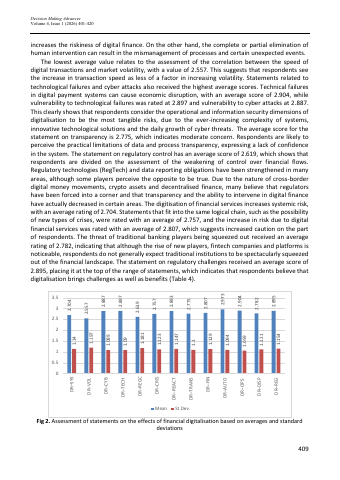
- The overall evaluation of financial digitalization risk statements yielded an aggregate mean score of 2.804 on a 4-point scale.p.8
- Respondents rated the excessive automation of digital finance without human oversight as the highest risk factor, with a mean score of 2.973.p.8
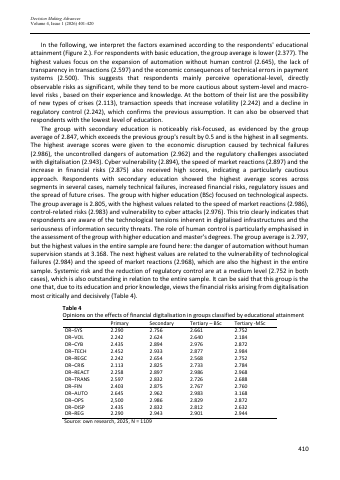
- Among educational levels, secondary-educated respondents showed the highest risk sensitivity with a group average of 2.847.p.10
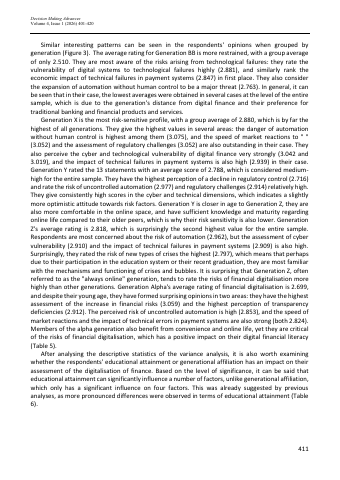
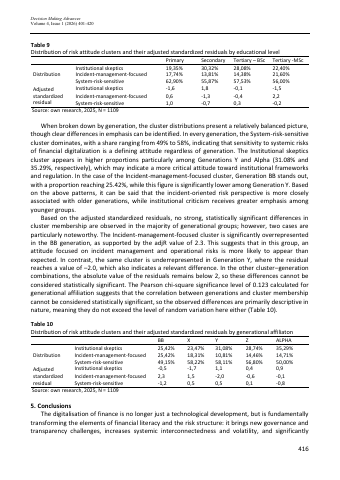
- Generation X exhibited the highest overall risk sensitivity among age cohorts with a group average score of 2.880.p.11
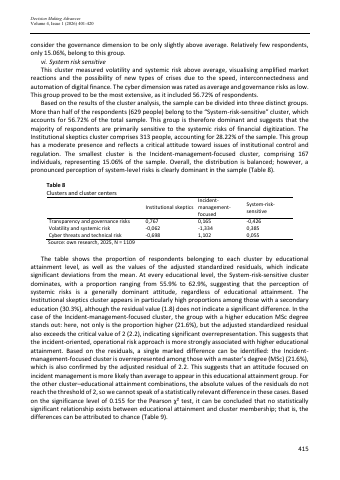
- Cluster analysis identified the System-risk-sensitive group as the largest cluster, comprising 56.72% of respondents (629 people).p.15
Key insights
- The survey scale demonstrated high internal reliability with a Cronbach's Alpha indicator of 0.908.p.8
- Excessive automation without human supervision was perceived as the most critical risk in digital finance with a score of 2.973.p.8
- Transaction speed affecting market volatility was assigned the lowest risk score among evaluated statements at 2.557.p.9
- Respondents holding a Master's degree assigned the sample's highest individual risk rating of 3.168 to unmonitored automation.p.10
- Generation X registered the highest overall generational risk sensitivity score at 2.880.p.11
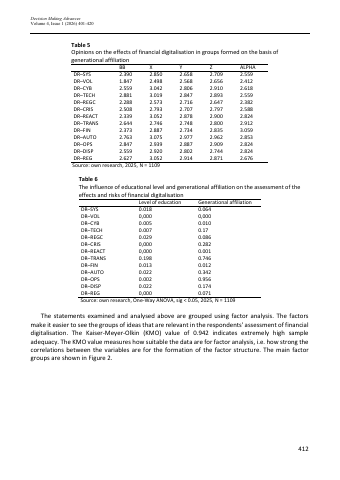
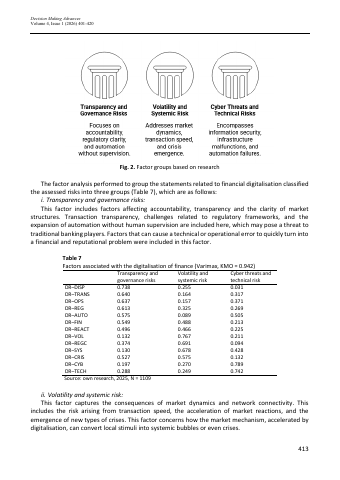
- Factor analysis grouped digital financial risks into three categories with a Kaiser-Meyer-Olkin value of 0.942.p.12
- The System-risk-sensitive cluster represents the dominant attitude in the sample, covering 56.72% of respondents.p.15
- Master's degree holders were significantly overrepresented in the Incident-management-focused cluster with an adjusted residual of 2.2.p.15
Pages
 p.1
 p.2
 p.3
 p.4
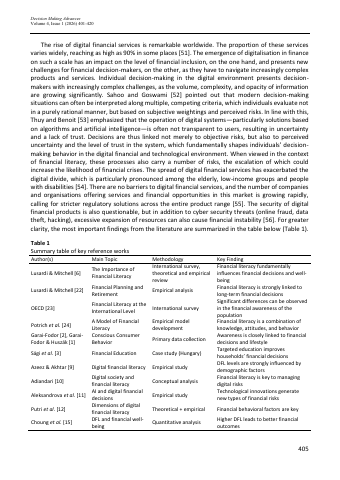 p.5
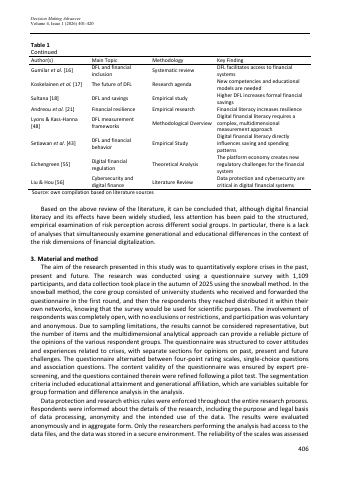 p.6
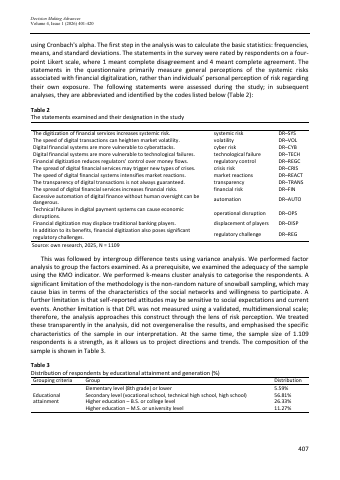 p.7
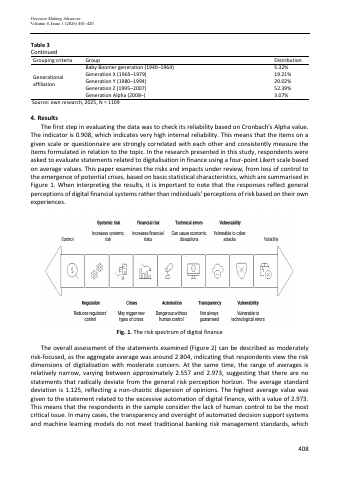 p.8
 p.9
 p.10
 p.11
 p.12
 p.13
 p.14
 p.15
 p.16
 p.17
 p.18
 p.19
 p.20
Topics and entities
Summary and figures generated from the document and checked automatically: every number shown appears on the cited page. Publishers can request removal.