De-dollarization: Drivers, Institutional Constraints, and the Evolution of the International Monetary System (Advances in Economics Management and Political Sciences)
SaveSummary
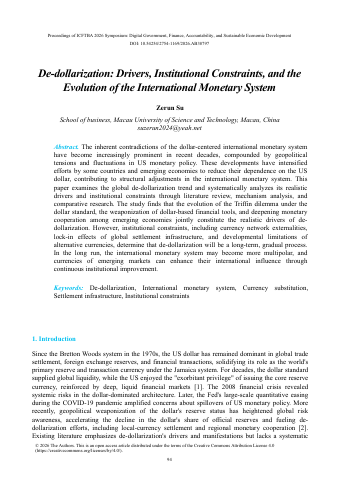
- The paper identifies the Triffin dilemma under the dollar standard, the weaponization of dollar-based financial tools and deepening monetary cooperation among emerging economies as the drivers of de-dollarization.p.1
- It argues that currency network externalities, settlement-infrastructure lock-in and the limits of alternative currencies make de-dollarization a long-term, gradual process.p.1
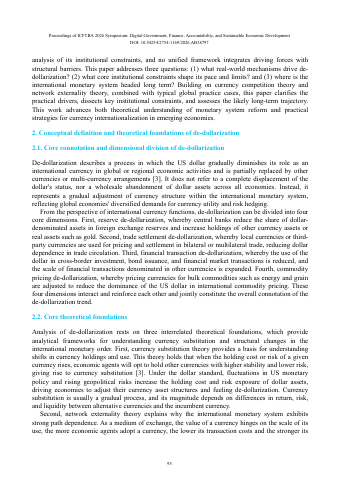
- De-dollarization is defined as the dollar gradually diminishing its role as an international currency, not a complete displacement of its status.p.2
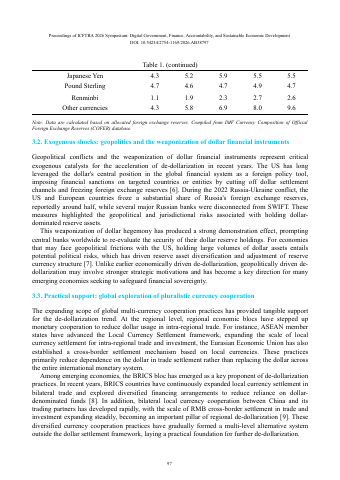
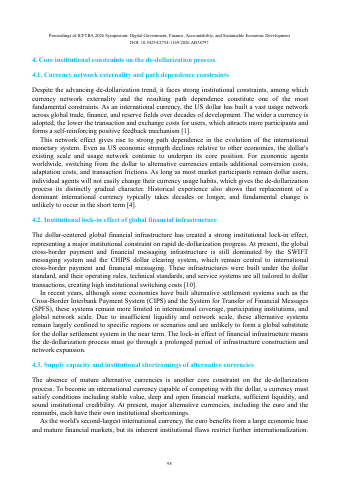
- During the 2022 Russia-Ukraine conflict, the US and European countries reportedly froze around half of Russia's foreign exchange reserves, and several major Russian banks were disconnected from SWIFT.p.4
- Historical experience shows that replacing a dominant international currency typically takes decades or longer.p.5
- The euro lacks a common safe asset, and the renminbi's capital account is not yet fully liberalized, limiting both as alternatives.p.6
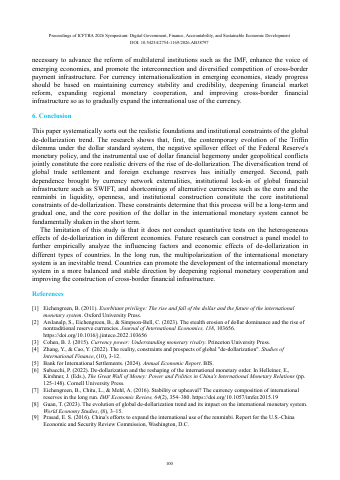
- The paper concludes that the international monetary system may become more multipolar, with the dollar's core position remaining for a long time.p.7
Key insights
- The inherent contradictions of the dollar-centered system, geopolitical tension and US monetary policy have intensified efforts to reduce dollar dependence.p.1
- De-dollarization is a gradual adjustment of currency structure rather than a wholesale abandonment of dollar assets.p.2
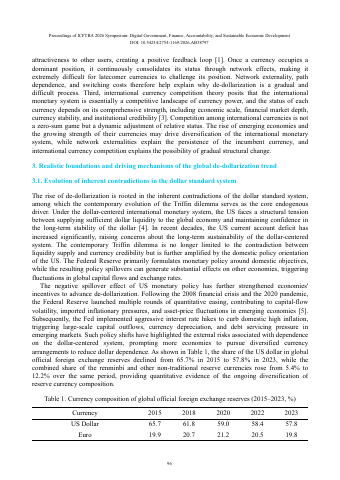
- Network externality, path dependence and switching costs explain why de-dollarization is gradual and difficult.p.3
- Sanctions and the freezing of reserves in 2022 prompted central banks to re-evaluate the security of their dollar reserve holdings.p.4
- Switching from the dollar to other currencies entails conversion costs, adaptation costs and transaction frictions.p.5
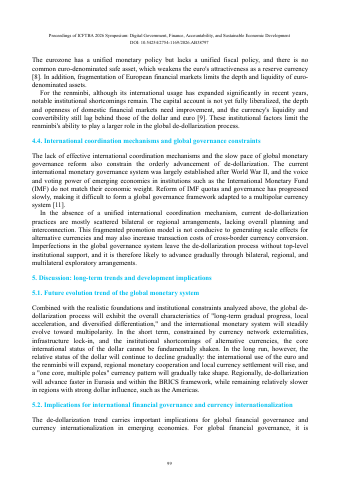
- Fragmentation of European financial markets limits the depth and liquidity of euro-denominated assets.p.6
- Slow reform of IMF quotas and governance makes it hard to build a framework suited to a multipolar currency system.p.6
- Current de-dollarization practices are mostly scattered bilateral or regional arrangements.p.6
- Emerging economies should maintain currency stability, deepen financial market reform and expand regional monetary cooperation to internationalize their currencies.p.7
Pages
 p.1
 p.2
 p.3
 p.4
 p.5
 p.6
 p.7
 p.8
Funders mentioned
Topics and entities
Summary and figures generated from the document and checked automatically: every number shown appears on the cited page. Publishers can request removal.