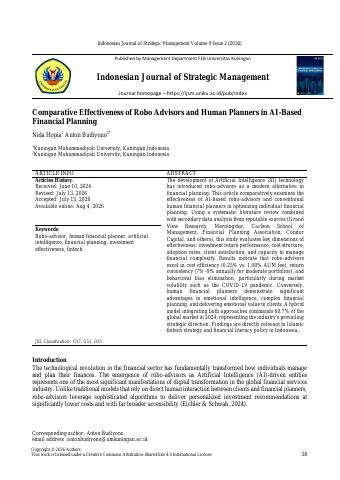
Comparative Effectiveness of Robo Advisors and Human Planners in AI-Based Financial Planning (Indonesian Journal of Strategic Management)
Summary
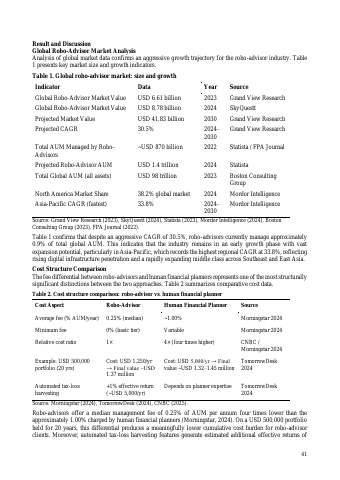
- The global robo-advisor market value reached $8.78 billion in 2024 and is projected to reach $41.83 billion by 2030 at a CAGR of 30.5%.p.4
- Robo-advisors offer a median management fee of 0.25% of AUM per year, which is four times lower than the ~1.00% fee charged by human financial planners.p.4
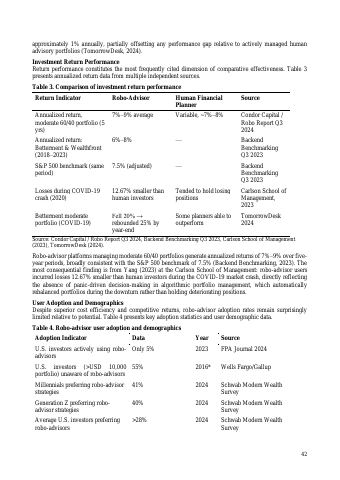
- Algorithmic decision-making enabled robo-advisor users to incur losses 12.67% smaller than human investors during the COVID-19 market crash in 2020.p.5
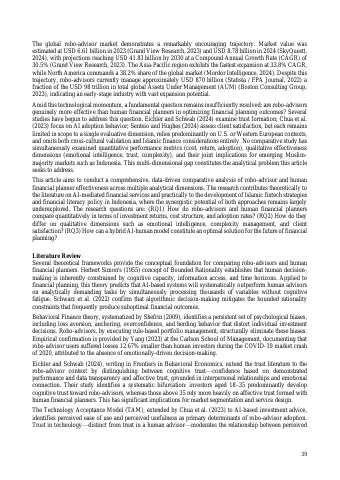
- Only 5% of U.S. investors actively used robo-advisors in 2023, despite 41% of Millennials and 40% of Generation Z preferring automated investment strategies in 2024.p.5
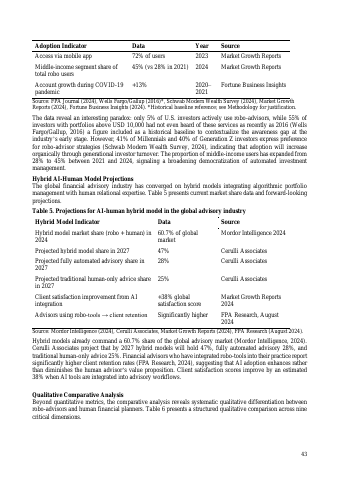
- The hybrid AI-human advisory model commanded a 60.7% share of the global financial advisory market in 2024.p.6
- Integrating AI tools into financial advisory workflows improves global client satisfaction scores by +38%.p.6
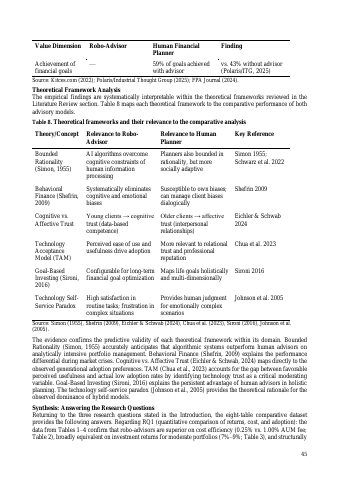
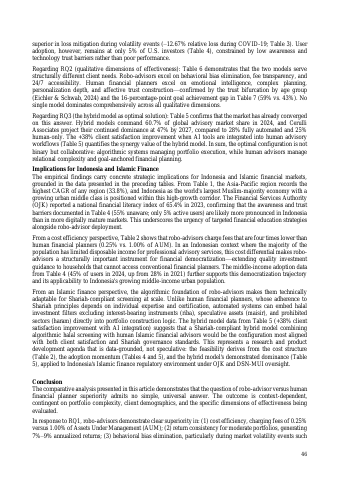
- Clients working with human financial planners achieve 59% of their financial goals compared to 43% for those without professional guidance.p.10
Key insights
- The global robo-advisor market is projected to grow from $8.78 billion in 2024 to $41.83 billion by 2030 at a 30.5% CAGR.p.4
- Robo-advisors maintain a 0.25% median annual fee on Assets Under Management compared to approximately 1.00% for human financial planners.p.4
- Automated tax-loss harvesting generates an estimated +1% in additional effective returns annually.p.4
- Rule-based rebalancing allowed robo-advisor users to sustain 12.67% smaller losses than human investors during the 2020 market crash.p.5
- Active adoption among U.S. investors stood at only 5% in 2023, even as 41% of Millennials favored robo-advisor strategies.p.5
- Middle-income investors expanded their share of the total robo-advisor user base from 28% in 2021 to 45% in 2024.p.6
- Hybrid models combining robo and human advice represented 60.7% of the global market in 2024.p.6
- By 2027, hybrid advisory is projected to capture 47% of the market, while fully automated advice takes 28% and traditional human-only advice drops to 25%.p.6
- Financial advisory practices integrating AI tools experience a +38% increase in global client satisfaction scores.p.6
Pages
 p.1
 p.2
 p.3
 p.4
 p.5
 p.6
 p.7
 p.8
 p.9
 p.10
 p.11
Topics and entities
Summary and figures generated from the document and checked automatically: every number shown appears on the cited page. Publishers can request removal.