Buffering Overhead Shocks: How Digital Payments Moderate Energy Costs and Labor Productivity in Informal Enterprises in Cambodia (Acta Innovations)
SaveSummary
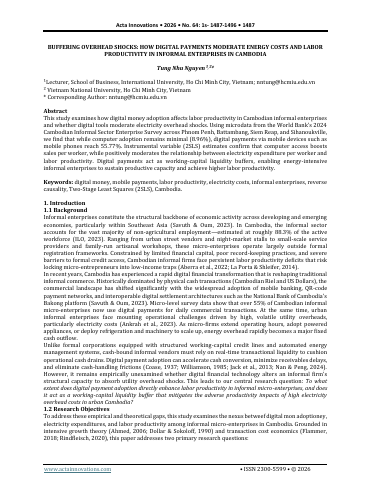
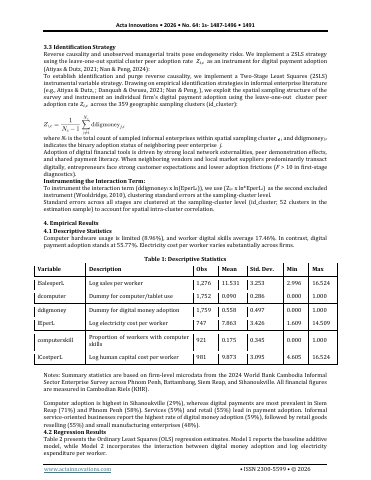
- Computer adoption among Cambodian informal enterprises is minimal at 8.96%, while digital payments via mobile devices reach 55.77%.p.1
- The informal sector accounts for roughly 88.3% of the active workforce in Cambodia.p.1
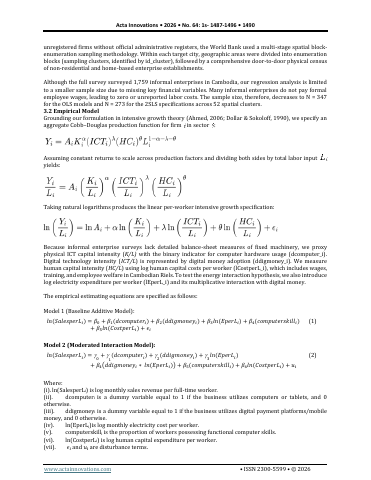
- The full survey covered 1,759 informal enterprises; regression samples are N = 347 for OLS and N = 273 for 2SLS across 52 spatial clusters.p.4
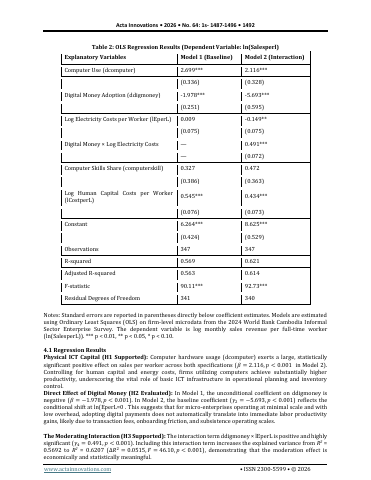
- In OLS Model 2, computer use has a coefficient of 2.116 and the digital money and electricity cost interaction is 0.491.p.6
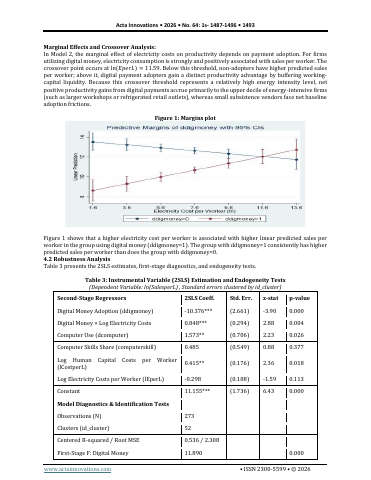
- The crossover point at which digital payment adopters gain a productivity advantage occurs at ln(EperL) of about 11.59.p.7
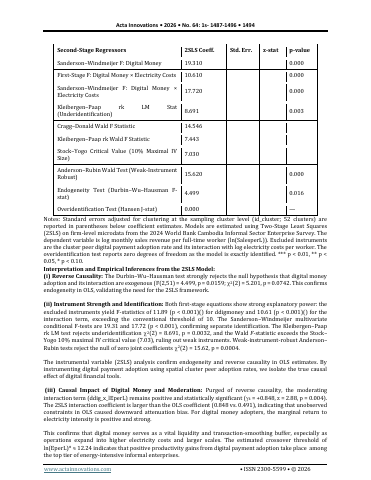
- 2SLS estimates give an interaction coefficient of 0.848 and a computer use coefficient of 1.573.p.7
Key insights
- Computer hardware use has a large, significant positive effect on sales per worker (2.116 in Model 2).p.6
- In Model 1, the unconditional coefficient on digital money adoption is negative (-1.978).p.6
- Above the crossover threshold, digital payment adopters gain a productivity advantage by buffering working-capital liquidity.p.7
- Net gains from digital payments accrue mainly to the upper decile of energy-intensive firms, while small subsistence vendors face adoption frictions.p.7
- The Durbin-Wu-Hausman test (F = 4.499) confirms endogeneity in OLS, supporting the 2SLS approach.p.8
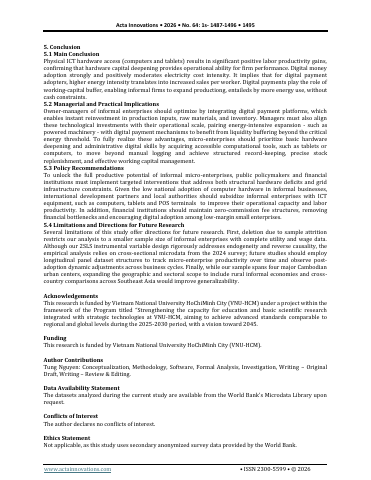
- Digital payments act as a working-capital buffer, letting informal firms expand production with more energy use without cash constraints.p.9
Pages
 p.1
 p.2
 p.3
 p.4
 p.5
 p.6
 p.7
 p.8
 p.9
 p.10
Funders mentioned
Topics and entities
Summary and figures generated from the document and checked automatically: every number shown appears on the cited page. Publishers can request removal.