Blockchain and ESG Transparency: The Mediating Role of Trust and the Moderating Role of Regulatory Support (Acta Innovations)
Summary
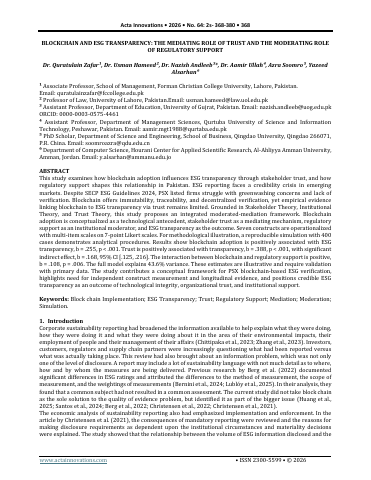
- The study evaluates how blockchain adoption impacts ESG transparency using a simulated sample of 400 cases.p.1
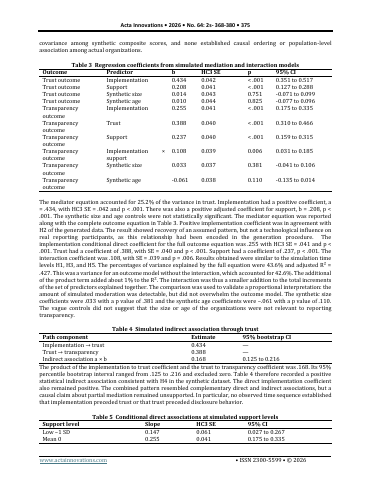
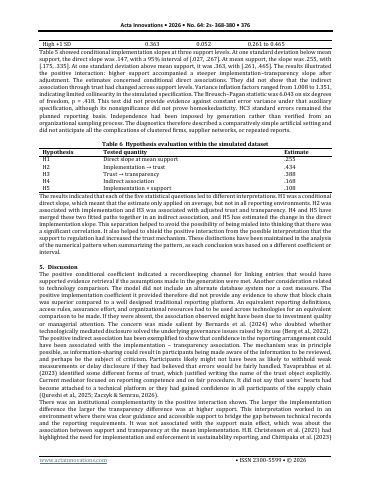
- Blockchain adoption is positively associated with ESG transparency with a direct effect coefficient of b = .255, p < .001.p.1
- Stakeholder trust acts as a mediator with a positive association of b = .388, p < .001 and a significant indirect effect of b = .168, 95% CI [.125, .216].p.1
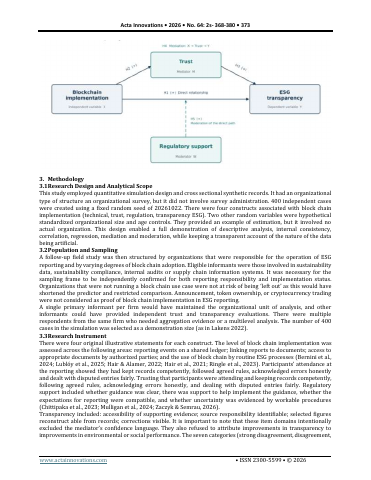
- Regulatory support positively moderates the direct relationship between blockchain adoption and ESG transparency with an interaction coefficient of b = .108, p = .006.p.1
- The full regression model explains 43.6% of the variance in ESG transparency.p.1
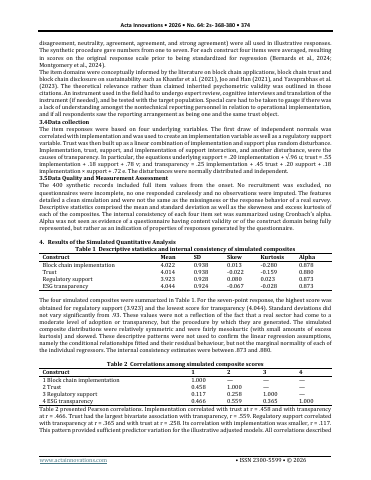
- Synthetic data generation was performed using a fixed random seed of 20261022 across 400 independent cases.p.6
Key insights
- Blockchain implementation directly correlates with higher ESG transparency (b = .255, p < .001) under mean regulatory support.p.8
- Trust in the ESG reporting mechanism directly increases transparency with a coefficient of b = .388 (p < .001).p.8
- Regulatory support strengthens the direct link between blockchain adoption and ESG transparency (b = .108, p = .006).p.8
- The mediator model accounts for 25.2% of the variance in trust, driven by implementation (b = .434) and regulatory support (b = .208).p.8
- The complete outcome equation achieves an adjusted R² of .427 compared to 42.6% without the interaction term.p.8
- Adding the interaction term between blockchain implementation and regulatory support increases overall explained variance by 1%.p.8
Pages
 p.1
 p.2
 p.3
 p.4
 p.5
 p.6
 p.7
 p.8
 p.9
 p.10
 p.11
 p.12
 p.13
Topics and entities
Summary and figures generated from the document and checked automatically: every number shown appears on the cited page. Publishers can request removal.