Best Practices and Challenges among Thriving, Stagnant, Closed, and Failed Business Start-Ups (Journal of Entrepreneurship & Business Strategies)
SaveSummary
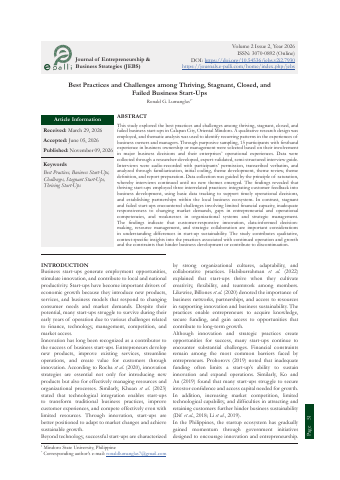
- A qualitative study with 15 participants explored best practices and challenges of start-ups in Calapan City, Oriental Mindoro, using purposive sampling and thematic analysis.p.2
- Thriving start-ups employed three interrelated practices: integrating customer feedback, basic data tracking for timely decisions, and partnerships within the local business ecosystem.p.2
- Thriving start-ups gather customer feedback through chats, comments and after-sales follow-up.p.5
- Small businesses replace poorly selling products quickly and test new products in small quantities before scaling up.p.6
- Partnerships gave access to investors, suppliers and advisors, and helped reach new customers through referrals and shared promotions.p.7
- Limited funding restricted research and development, and shortage of budget meant innovations were not fully implemented.p.8
- Owners are advised to formalize feedback and data tracking, including a weekly 30-minute review of sales and customer comments.p.10
Key insights
- Customer-embedded innovation relies on simple feedback channels such as chats, comments and direct conversations after delivery.p.5
- Because capital is limited, products are tested in small amounts first and poor performers are removed quickly.p.6
- Partnerships with suppliers can bring better pricing and access to new products.p.7
- Word-of-mouth from partners and customers is a strong and low-cost form of promotion.p.7
- Micro businesses operate on limited daily income prioritized for rent, inventory and utilities, so upgrading tools or products becomes secondary.p.8
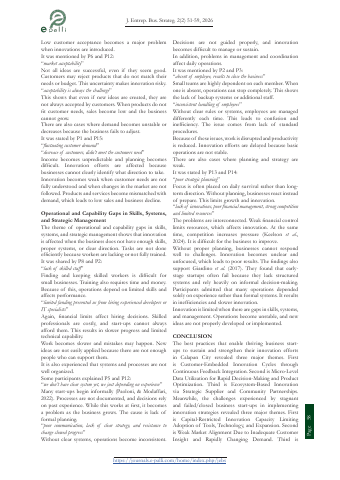
- Low customer acceptance and fluctuating demand make innovation risky for stagnant and failed start-ups.p.9
- Dependence on a few team members means one absence can stop operations completely.p.9
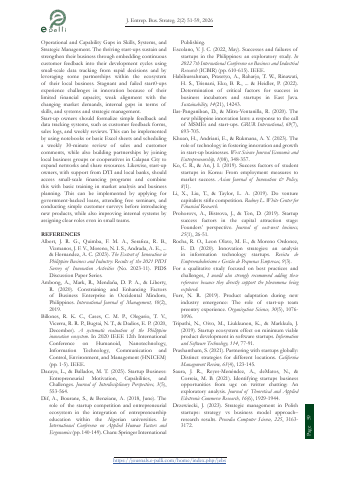
- Stagnant and failed start-ups face limited financial capacity, weak alignment with market demands, and gaps in skills, systems and strategic management.p.10
Pages
 p.1
 p.2
 p.3
 p.4
 p.5
 p.6
 p.7
 p.8
 p.9
 p.10
Funders mentioned
Topics and entities
Summary and figures generated from the document and checked automatically: every number shown appears on the cited page. Publishers can request removal.