Bankability of Large-Scale US Electricity Infrastructure Projects: A Review of Lender Requirements Credit Risks and Financing Structures (International Journal For Multidisciplinary Research)
SaveSummary
- The synthesis defines bankability in project finance as a lender judgment that cash flow can service debt under credible downside cases, separating bankability from pure profitability.p.2
- FERC has issued regulatory frameworks including Order No. 841, Order No. 2023, and Order No. 1920 to address storage participation, generator interconnection, and regional transmission planning.p.11
- Lower financing costs and limited-recourse project finance structures have contributed materially to cost reductions and deployment for renewable energy assets.p.8
- Key development and construction parameters such as fixed-price EPC contracts, permits, land rights, and interconnection documents serve as critical conditions precedent for closing infrastructure debt.p.3
- Financial models determine debt capacity primarily through metrics such as the debt-service coverage ratio (DSCR), loan-life coverage ratio (LLCR), leverage caps, and debt yield tests.p.4
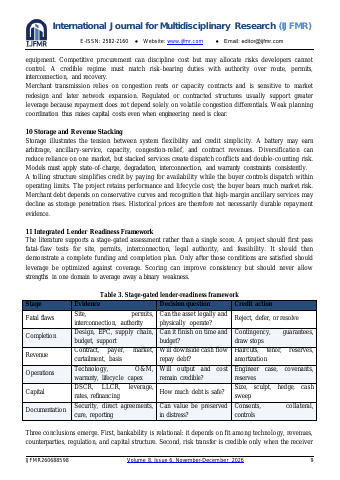
- A stage-gated lender-readiness framework evaluates fatal flaws, completion, revenue, operations, capital structure, and documentation sequential checkpoints.p.9
Key insights
- Bankability requires that project cash flow can service debt under downside cases and that material residual risks are assigned to parties capable of absorbing them.p.2
- Two projects utilizing identical equipment can have vastly different leverage and pricing based on their underlying contractual systems.p.3
- Interconnection positions represent both a technical dependency and a financial option on network capacity, where queue position alone does not guarantee economic deliverability.p.5
- Contracted long-term power purchase agreements (PPAs) improve debt capacity, whereas merchant energy assets require lower leverage and shorter amortization schedules.p.4
- Transmission infrastructure differs fundamentally from generation assets because debt repayment relies primarily on regulatory cost recovery and cost allocation rather than a single offtake contract.p.1
- Revenue stacking in energy storage creates credit complexity due to potential dispatch conflicts and double-counting risks.p.9
- The financial value of a tax credit is defined by its expected net proceeds after timing, discounts, and compliance risks rather than its statutory face amount.p.7
- Standardized lender-readiness frameworks must preserve strict fatal-flaw thresholds so that high metrics in one domain cannot offset binary deal failures.p.9
Pages
 p.1
 p.2
 p.3
 p.4
 p.5
 p.6
 p.7
 p.8
 p.9
 p.10
 p.11
 p.12
Funders mentioned
Topics and entities
Summary and figures generated from the document and checked automatically: every number shown appears on the cited page. Publishers can request removal.