Artificial Intelligence-Driven Transformation of Banking Services: Examining Its Influence on Customer Trust, Satisfaction, and Loyalty (Insights (Bhalwal) International Journal of Humanities Management and Social Sciences)
Summary
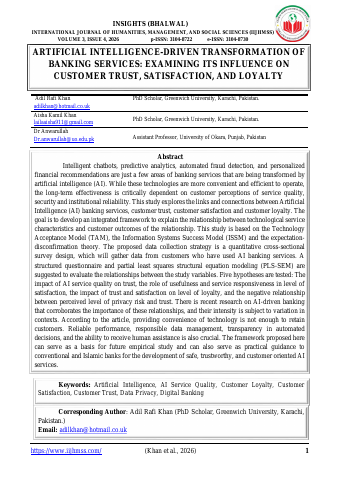
- The conceptual framework formulates 5 hypotheses to examine how AI banking service quality, usefulness, and privacy risk influence trust, satisfaction, and loyalty.p.1
- Prior research on AI-powered neo-banking service quality in India evaluated data from 439 consumers using PLS-SEM.p.5
- A 2026 digital banking study of 385 users identified perceived usefulness and AI acceptance as key factors driving customer satisfaction.p.5
- Study inclusion criteria require digital banking users to be at least 18 years old and to have used an identifiable AI feature within the past 6 months.p.8
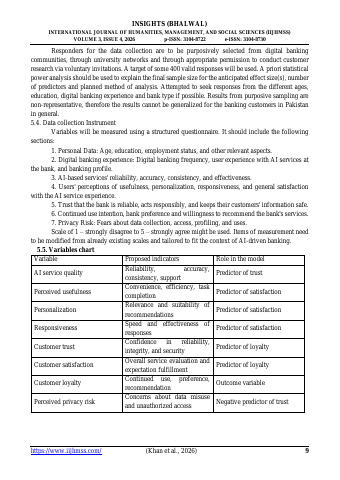
- The quantitative cross-sectional research methodology targets a sample of 400 valid responses via purposive sampling.p.9
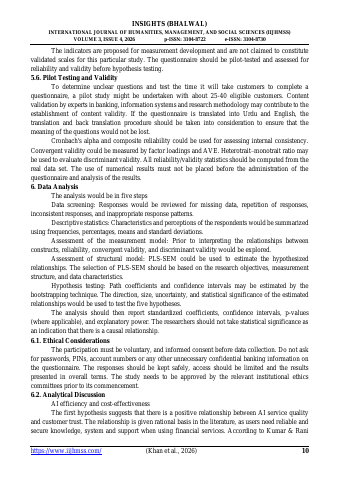
- The proposed data collection instrument includes a planned pilot test with 25-40 eligible customers to refine item clarity and completion time.p.10
Key insights
- Providing technological convenience alone is insufficient for retaining bank customers without reliable performance, responsible data management, and human assistance.p.1
- Bank for International Settlements survey data shows that households feel less comfortable with AI than with humans for financial services due to data privacy concerns.p.2
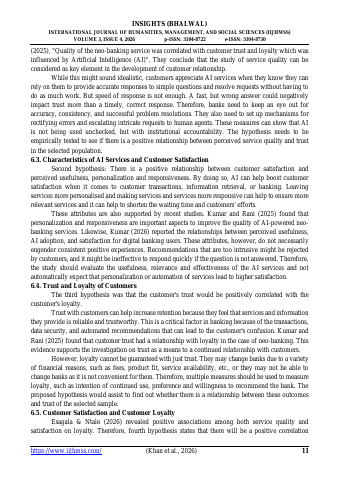
- Customer satisfaction with an AI chatbot does not automatically convert a client into a loyal customer of the financial institution.p.3
- Digital banking service quality relies on core dimensions including reliability, information accuracy, accessibility, responsiveness, and problem resolution.p.5
- Perceived privacy risk in AI banking stems from customer fears regarding excessive data collection, unauthorized access, profiling, and financial data misuse.p.6
- Rapid automated responses that contain errors can damage customer trust more severely than delayed but accurate human-supported solutions.p.11
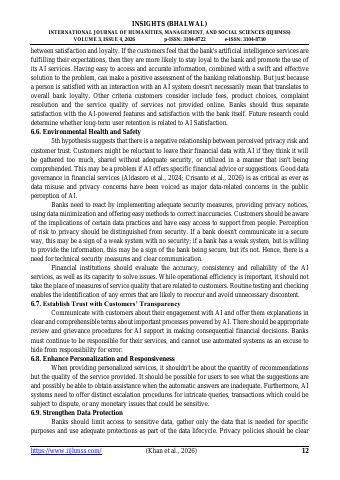
- Financial institutions must maintain clear escalation paths to transition complex, disputed, or sensitive financial transactions from AI to human staff.p.12
Pages
 p.1
 p.2
 p.3
 p.4
 p.5
 p.6
 p.7
 p.8
 p.9
 p.10
 p.11
 p.12
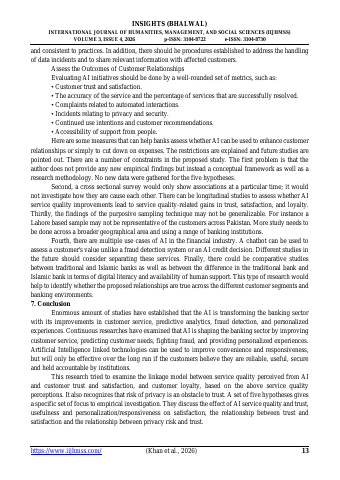 p.13
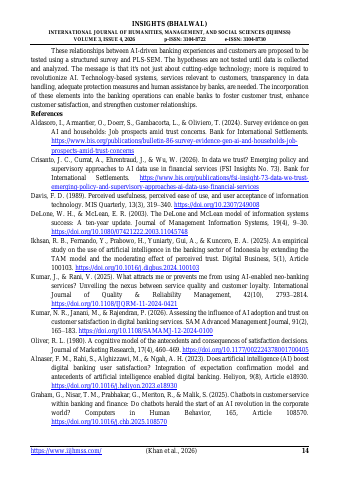 p.14
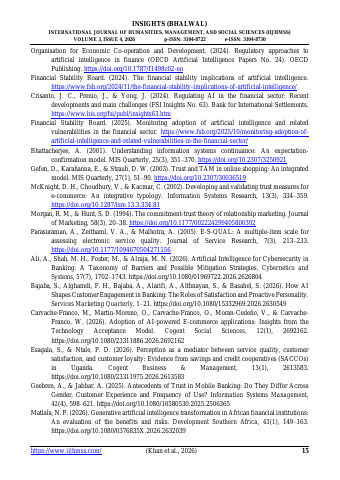 p.15
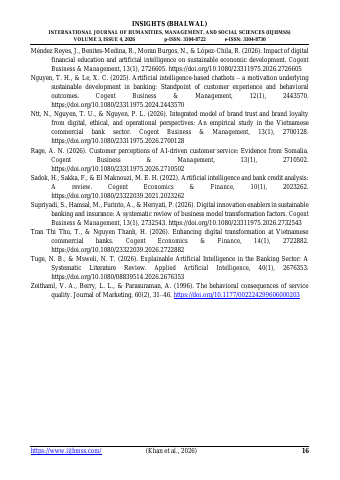 p.16
Topics and entities
Summary and figures generated from the document and checked automatically: every number shown appears on the cited page. Publishers can request removal.