A Signal–Trust–Intention Framework for Retail Investor Behavior in Malaysia's Equity Crowdfunding Market (Journal of Economic Finance Research and Review)
SaveSummary
- The study addresses the Participation Paradox, explaining why increased institutional strengthening does not consistently produce sustained retail investor participation in equity crowdfunding.p.1
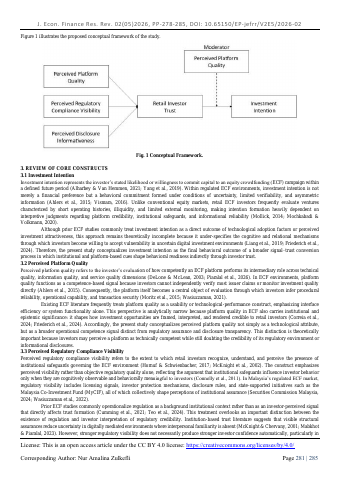
- The proposed Signal–Trust–Intention framework integrates Signaling Theory, Trust Theory, and the Elaboration Likelihood Model to explain investor behavior under uncertainty.p.2
- Retail investor trust acts as a central mediator between signal perceptions (platform quality, regulatory compliance visibility, disclosure informativeness) and investment intention.p.3
- Financial literacy is conceptualized as a cognitive boundary condition that moderates the translation of investor trust into behavioral investment intention.p.3
- Institutional safeguards and co-investment schemes like MyCIF should be simplified and rendered cognitively visible to non-expert retail investors.p.7
Key insights
- Institutional signals are not directly converted into investment actions but are cognitively filtered through trust formation and investor capability.p.1
- Single-theory approaches like the Theory of Planned Behavior have limited explanatory power under high uncertainty and informational opacity.p.2
- Platform quality operates as a competence-based signal that helps investors infer operational capability and transaction security.p.4
- Disclosure effectiveness relies on interpretive clarity and decision relevance rather than sheer objective disclosure volume.p.5
- The Participation Paradox occurs when institutional visibility exceeds behavioral persuasiveness and fails to build actionable trust.p.6
- Financial literacy strengthens the behavioral conversion of trust into investment action rather than merely increasing participation propensity.p.7
Pages
 p.1
 p.2
 p.3
 p.4
 p.5
 p.6
 p.7
 p.8
Topics and entities
Summary and figures generated from the document and checked automatically: every number shown appears on the cited page. Publishers can request removal.