Uneven Pathways to Financial Inclusion: Physical and Digital Infrastructure in Cambodia, 2008-2023 (Advanced International Journal of Multidisciplinary Research)
SaveSummary
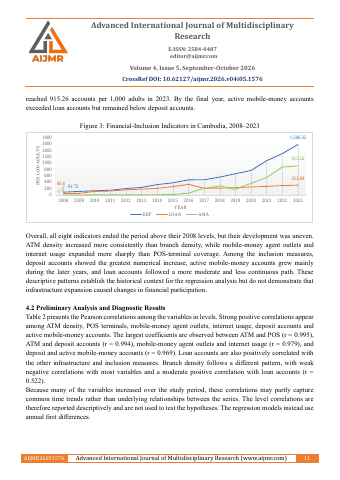
- Deposit accounts rose from 91.72 to 1,586.32 accounts per 1,000 adults, the largest numerical increase among inclusion indicators.p.10
- Loan accounts increased more moderately, from 48.60 to 311.89 per 1,000 adults.p.10
- Active mobile-money accounts reached 915.26 accounts per 1,000 adults in 2023.p.11
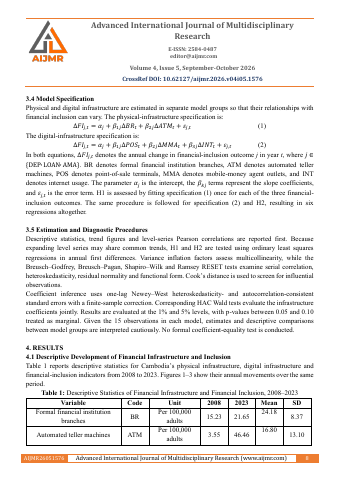
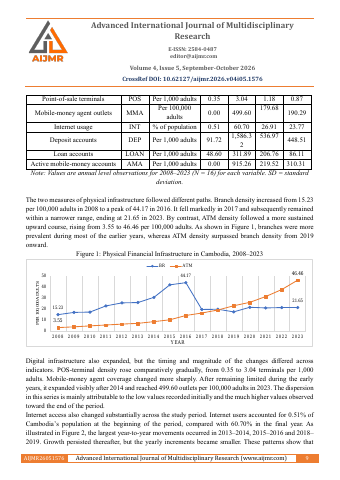
- ATM density rose from 3.55 to 46.46 per 100,000 adults, surpassing branch density from 2019 onward.p.9
- Branch density rose from 15.23 per 100,000 adults in 2008 to a peak of 44.17 in 2016 and ended at 21.65 in 2023.p.9
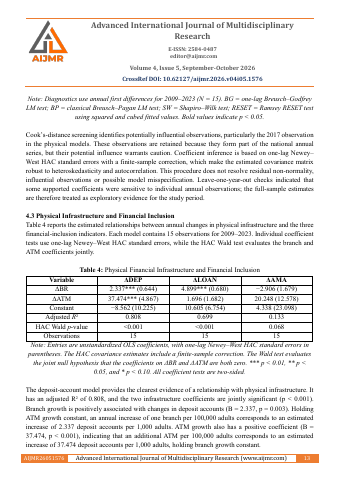
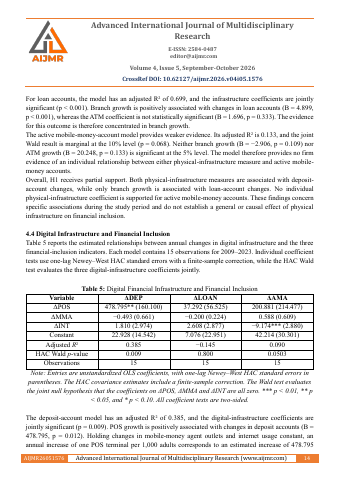
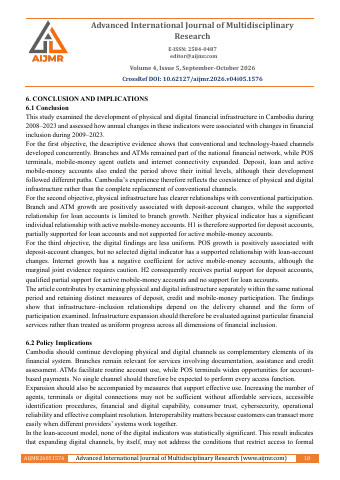
- Branch growth is positively associated with changes in loan accounts (B = 4.899, p < 0.001), while the ATM coefficient is not significant.p.14
Key insights
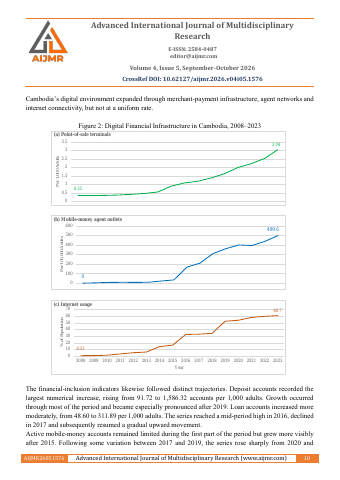
- POS-terminal density rose gradually from 0.35 to 3.04 terminals per 1,000 adults.p.9
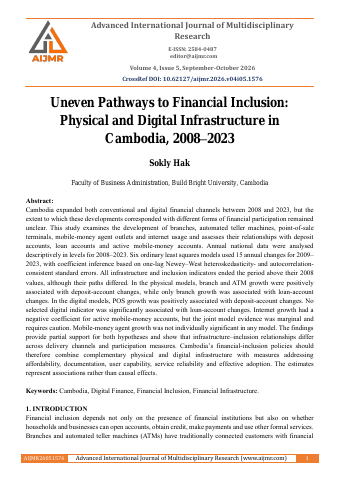
- Six regression models use 15 annual changes for 2009-2023.p.1
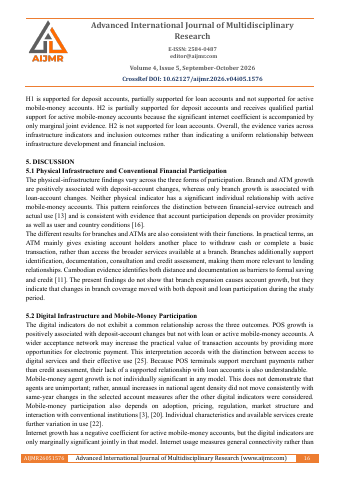
- Branch and ATM growth are positively associated with deposit-account changes, while only branch growth is associated with loan-account changes.p.1
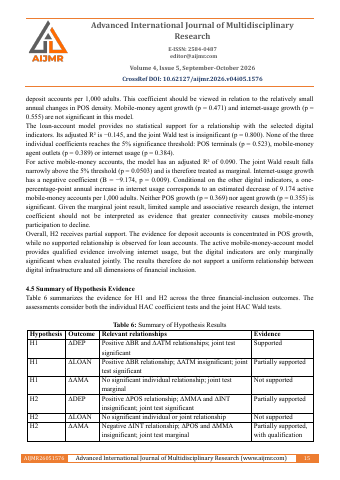
- No selected digital indicator is significantly associated with loan-account changes.p.1
- Internet-usage growth has a negative coefficient for active mobile-money accounts (B = -9.174, p = 0.009), but the joint evidence is marginal.p.15
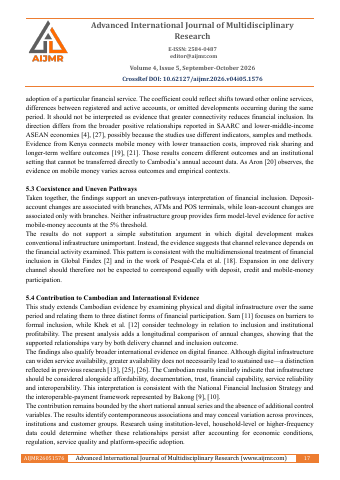
- The evidence does not support a simple substitution argument in which digital development makes conventional infrastructure unimportant.p.17
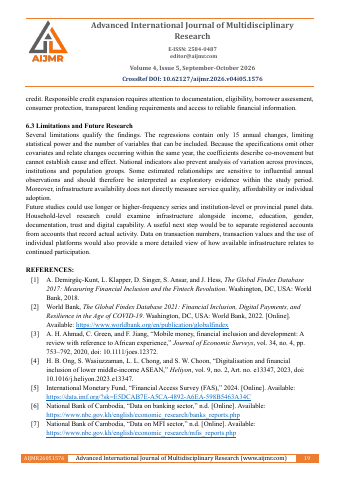
- Regressions contain only 15 annual changes, limiting statistical power and causal interpretation.p.19
Pages
 p.1
 p.2
 p.3
 p.4
 p.5
 p.6
 p.7
 p.8
 p.9
 p.10
 p.11
 p.12
 p.13
 p.14
 p.15
 p.16
 p.17
 p.18
 p.19
 p.20
 p.21
Funders mentioned
Topics and entities
Summary and figures generated from the document and checked automatically: every number shown appears on the cited page. Publishers can request removal.