The Introduction, Survival and Development of Public REITs in China (Advances in Economics Management and Political Sciences)
SaveSummary
- The first nine public REIT products began trading in China on 21 June 2021, raising approximately RMB 31.4 billion.p.1
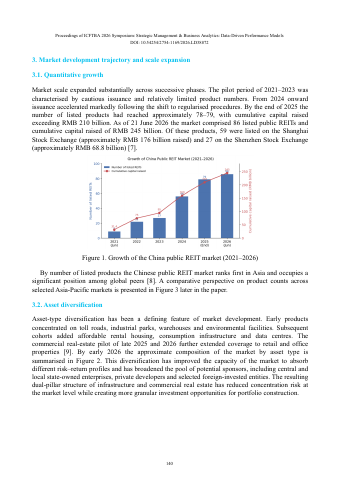
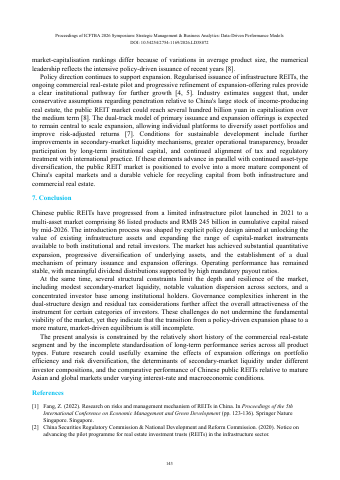
- By mid-June 2026, the Chinese public REIT market expanded to 86 listed products with cumulative capital raised reaching RMB 245 billion.p.1
- By the end of 2025, listed products reached approximately 78–79 with cumulative capital raised exceeding RMB 210 billion.p.3
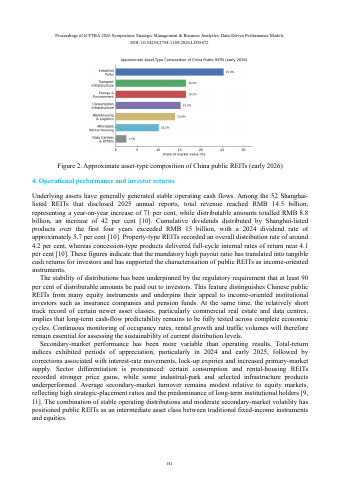
- Among 52 Shanghai-listed REITs disclosing 2025 annual reports, total revenue reached RMB 14.5 billion, representing a year-on-year increase of 71 per cent.p.4
- Distributable amounts for these Shanghai-listed REITs reached RMB 8.8 billion in 2025, marking a 42 per cent increase.p.4
- Shanghai-listed public REITs distributed over RMB 15 billion in cumulative dividends over their first four years, with a 2024 dividend rate of approximately 5.7 per cent.p.4
Key insights
- China's public REIT market launched in 2020 and grew to 86 listed products raising RMB 245 billion by mid-June 2026.p.1
- The initial launch on 21 June 2021 featured five products on the Shanghai Stock Exchange and four on the Shenzhen Stock Exchange.p.2
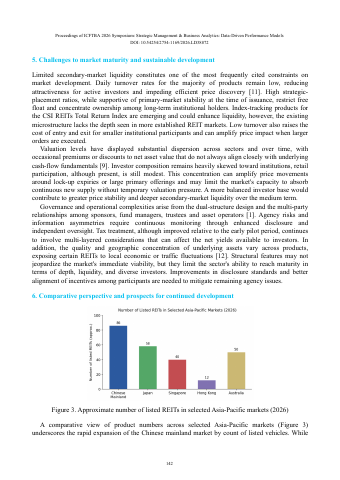
- By count of listed products, the Chinese public REIT market ranks first in Asia.p.3
- Chinese regulations mandate that at least 90 per cent of distributable amounts be paid out to investors.p.4
- In 2025, property-type REITs logged an overall distribution rate around 4.2 per cent, whereas concession-type products recorded full-cycle internal rates of return near 4.1 per cent.p.4
- Secondary-market liquidity remains a key constraint due to high strategic-placement ratios and concentration among long-term institutional holders.p.5
Pages
 p.1
 p.2
 p.3
 p.4
 p.5
 p.6
 p.7
Funders mentioned
Topics and entities
Summary and figures generated from the document and checked automatically: every number shown appears on the cited page. Publishers can request removal.