The Impact of International Ratings on Shaping the Investment Climate of Uzbekistan (American Journal of Economics and Business Management)
SaveSummary
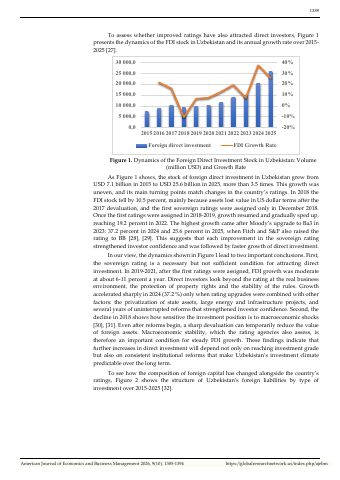
- The stock of foreign direct investment in Uzbekistan grew from USD 7.1 billion in 2015 to USD 25.6 billion in 2025.p.5
- FDI stock growth reached 37.2 percent in 2024 and 25.6 percent in 2025, after Moody's upgrade to Ba3 in 2023.p.5
- The Corruption Perceptions Index score increased from 19 in 2015 to 33 in 2023, then declined to 32 in 2024 and 31 in 2025.p.3
- All three rating agencies assess Uzbekistan at the BB level, two steps below investment grade.p.4
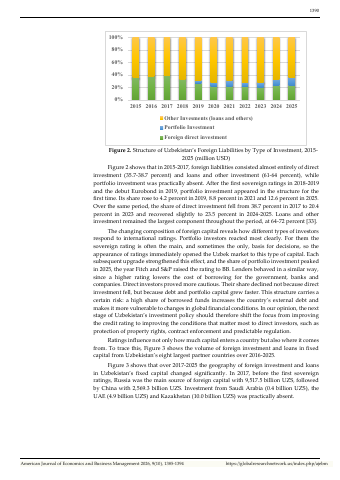
- The share of portfolio investment rose to 4.2 percent in 2019, 8.8 percent in 2021 and 12.6 percent in 2025.p.6
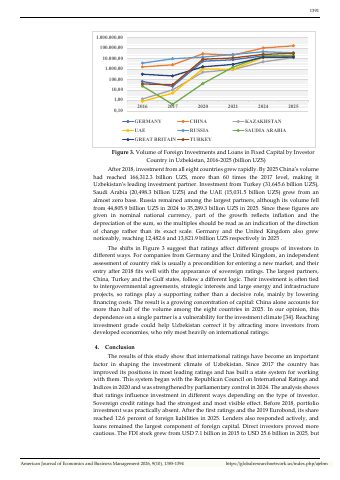
- China's investment reached 166,312.3 billion UZS by 2025, more than 60 times the 2017 level.p.7
- The Index of Economic Freedom rose from 51.5 in 2018 to 58.0 in 2025.p.3
Key insights
- Loans and other investment remained the largest component of foreign liabilities, at 64-72 percent.p.6
- The share of direct investment fell from 38.7 percent in 2017 to 20.4 percent in 2023.p.6
- In 2019-2021, after the first ratings, FDI growth was moderate at about 6-11 percent a year.p.5
- In 2018 the FDI stock fell by 10.5 percent after the 2017 devaluation.p.5
- Russia's volume fell from 44,805.9 billion UZS in 2024 to 35,289.3 billion UZS in 2025.p.7
- Turkey invested 31,645.6 billion UZS, Saudi Arabia 20,498.3 billion UZS and the UAE 15,031.5 billion UZS from an almost zero base.p.7
- The debut Eurobonds were placed in February 2019.p.4
- Sovereign ratings are a necessary but not sufficient condition for attracting direct investment.p.8
Pages
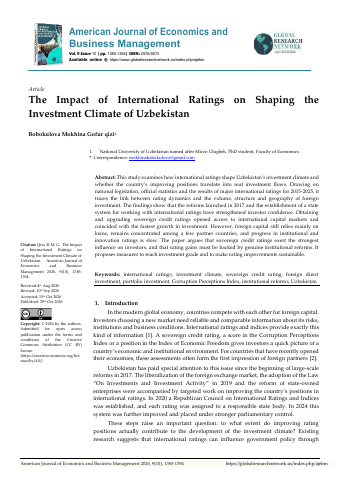 p.1
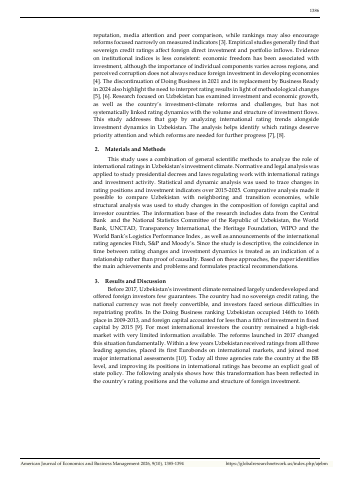 p.2
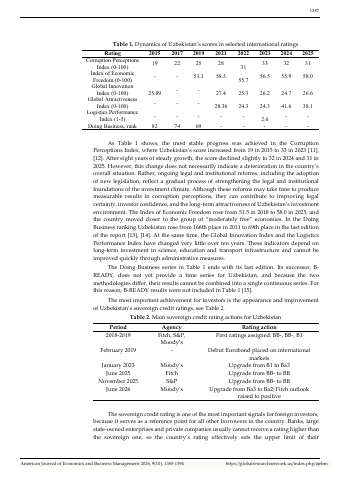 p.3
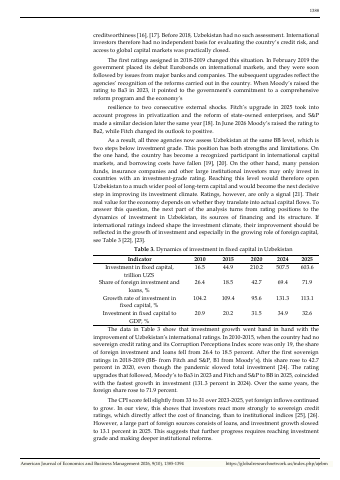 p.4
 p.5
 p.6
 p.7
 p.8
 p.9
 p.10
Funders mentioned
Topics and entities
Summary and figures generated from the document and checked automatically: every number shown appears on the cited page. Publishers can request removal.