The Assessment of Digital Banking on Financial Inclusion in Ethiopia: A Case Study of Selected Commercial Banks (European Journal of Economics)
Summary
- In 2022, financial inclusion reached 46% in Ethiopia, with the government targeting 70% account ownership by 2025.p.1
- Globally, 1.4 billion adults remain unbanked, and low-income countries exhibit account ownership levels below 30%.p.1
- The panel regression model applied in the study explains 88.9% of the total variation in financial inclusion across sampled private commercial banks.p.1
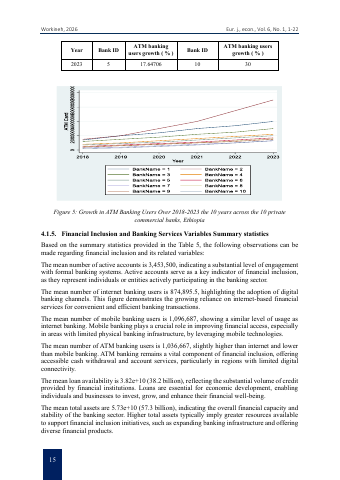
- Sampled private banks recorded a mean total asset value of 5.73e+10 (57.3 billion) and mean loan availability of 3.82e+10 (38.2 billion).p.15
- Fixed effect regression results show that a 1-unit increase in internet banking users increases financial inclusion by 0.68 units.p.18
- A 1-unit increase in ATM card users leads to a 0.762-unit increase in financial inclusion.p.18
Key insights
- Internet banking usage has a statistically significant positive effect on financial inclusion in Ethiopia's private banking sector.p.18
- ATM card adoption significantly drives financial inclusion, yielding a 0.762-unit increase in active accounts per unit increase in users.p.18
- Mobile banking usage does not exhibit a statistically significant positive effect on financial inclusion in the econometric model.p.19
- Total bank assets do not demonstrate a statistically significant impact on expanding financial inclusion.p.19
- Loan availability shows a statistically significant positive relationship with financial inclusion, featuring a coefficient of 0.000044.p.18
- The combined fixed effects econometric regression model explains 88.9% of the variation in financial inclusion metrics.p.19
Pages
 p.1
 p.2
 p.3
 p.4
 p.5
 p.6
 p.7
 p.8
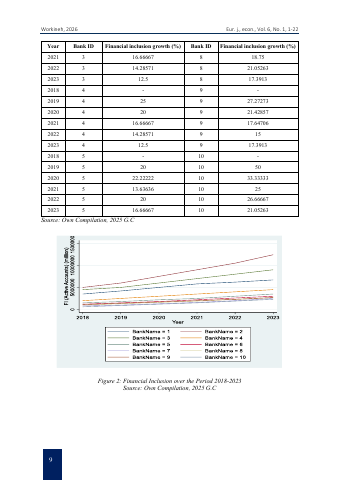 p.9
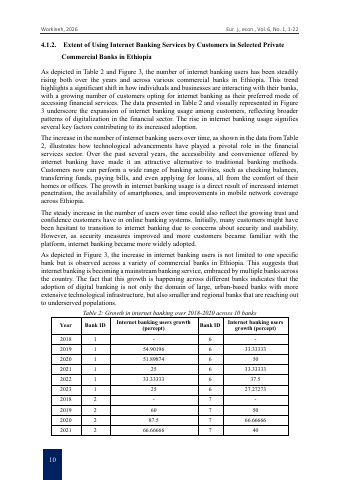 p.10
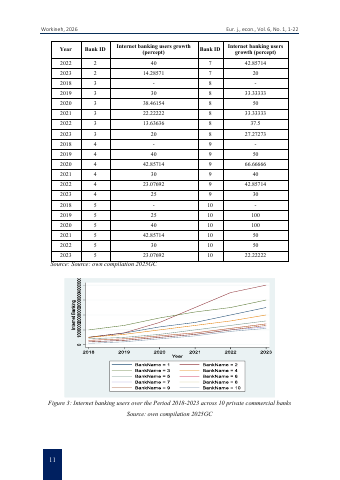 p.11
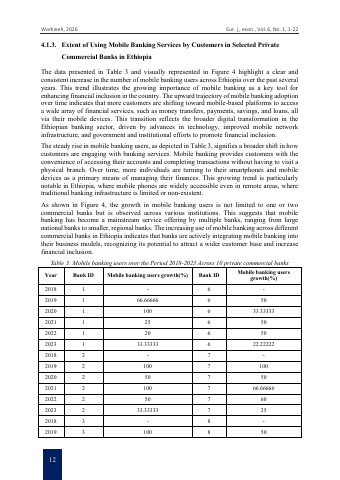 p.12
 p.13
 p.14
 p.15
 p.16
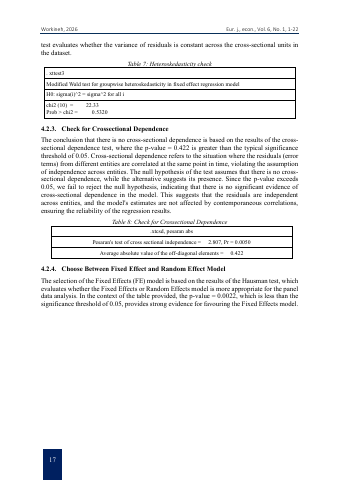 p.17
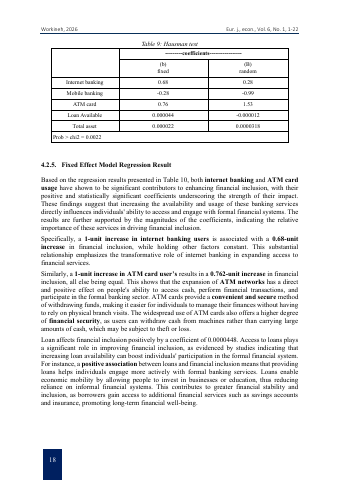 p.18
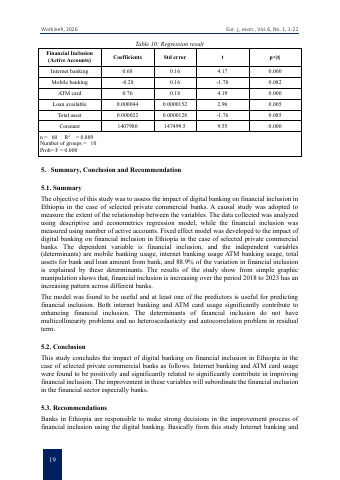 p.19
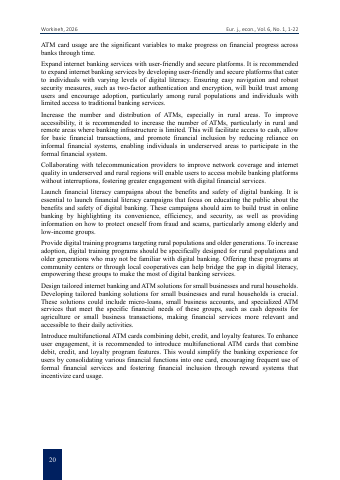 p.20
 p.21
 p.22
Topics and entities
Summary and figures generated from the document and checked automatically: every number shown appears on the cited page. Publishers can request removal.