Strategic Roadmap for Developing Islamic Finance in Uzbekistan: Empirical Analysis and Structural Reforms (International Bulletin of Applied Sciences and Technology)
Summary
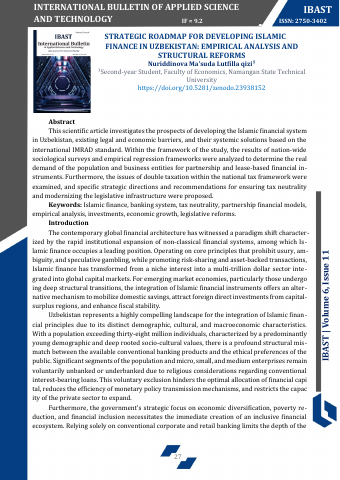
- Uzbekistan has a population exceeding thirty-eight million with a young demographic that experiences voluntary financial exclusion due to religious principles regarding conventional loans.p.1
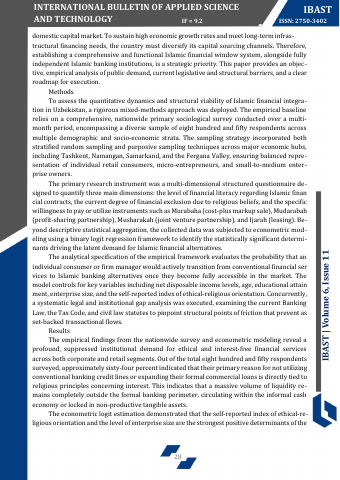
- A primary sociological survey was conducted across eight hundred and fifty respondents in key economic centers including Tashkent, Namangan, Samarkand, and the Fergana Valley.p.2
- Approximately sixty-four percent of surveyed respondents cite religious grounds as the main reason for avoiding conventional bank credit.p.2
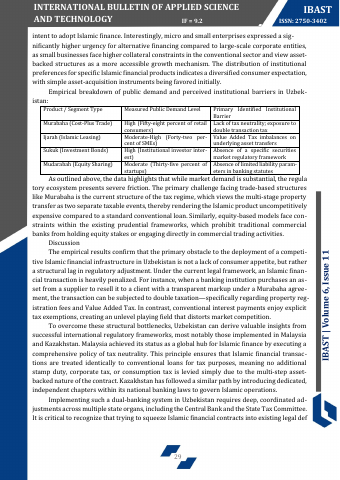
- Public demand for Murabaha trade contracts stands at fifty-eight percent among retail consumers, representing the most requested product.p.3
- Demand for Ijarah leasing reaches forty-two percent among small and medium enterprises, while thirty-five percent of startups express interest in Mudarabah equity sharing.p.3
- Existing tax structures cause double taxation on asset transfers, creating major regulatory friction for multi-stage Islamic finance contracts.p.3
Key insights
- Voluntary exclusion from conventional interest-bearing banking keeps significant domestic liquidity circulating within the informal cash economy.p.2
- Micro and small enterprises demonstrate higher urgency for alternative asset-backed financing than large corporate entities due to conventional collateral barriers.p.3
- Current legal and tax regulations heavily penalize Islamic finance by subjecting multi-step asset transactions to property registration fees and Value Added Tax.p.3
- Malaysia built its global Islamic finance presence by establishing strict tax neutrality so Islamic products incur no extra duties compared to conventional loans.p.3
- Implementing an effective dual-banking system in Uzbekistan requires coordinated legal changes across the Central Bank and the State Tax Committee.p.3
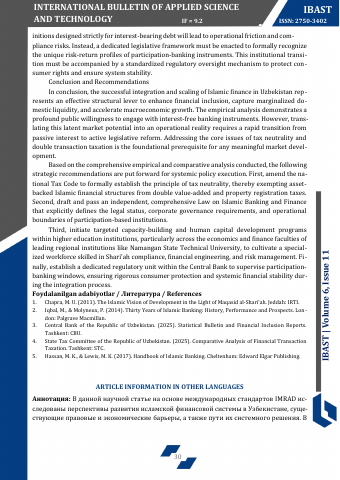
- Fitting participation-banking contracts into legal definitions designed for interest-bearing debt creates compliance and operational risks.p.4
- Amending the national Tax Code to grant tax neutrality is the key prerequisite for deploying competitive Islamic financial products.p.4
Pages
 p.1
 p.2
 p.3
 p.4
 p.5
Topics and entities
Summary and figures generated from the document and checked automatically: every number shown appears on the cited page. Publishers can request removal.