Private equity and large-scale investment in healthcare delivery systems: a scoping review (Journal of Evidence-Based Medical Research)
What changed
6.0% higher than independent practices
Cardiology Procedure Price Increase Post-PE Affiliation p.3
Summary
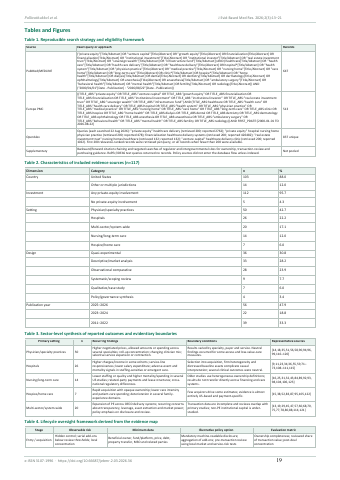
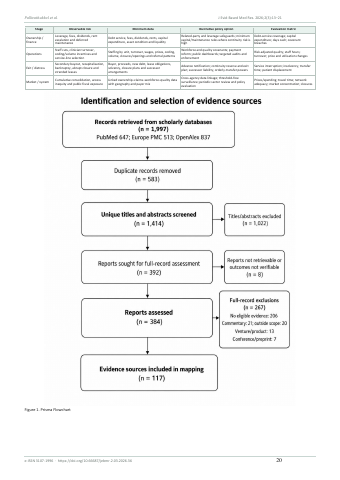
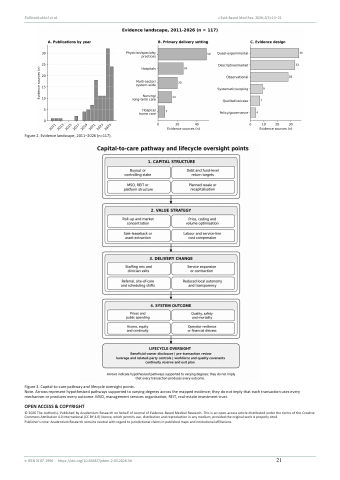
- Out of 1,997 records retrieved, the scoping review included a total of 117 evidence sources published between 2000 and 2026.p.1
- The literature is heavily concentrated geographically, with 103 sources (88.0%) focused on the United States.p.2
- Private equity featured in 112 of the 117 included evidence sources, accounting for 95.7% of the reviewed literature.p.2
- Physician and specialty practices represented the primary care setting in 42.7% of sources (50 sources).p.2
- Private equity affiliation was associated with 6.0% higher prices for cardiology and 10.0% higher prices for gastroenterology procedures compared to independent practice prices.p.3
- Acquisition of physician practices across dermatology, gastroenterology, and ophthalmology resulted in an 11.0% higher allowed amount per claim relative to control practices.p.3
Key insights
- Comparative evidence consistently links private equity affiliation to higher prices, allowed amounts, and spending across healthcare delivery sectors.p.3
- Quality outcomes associated with private equity ownership show adverse signals in hospital safety, nursing home staffing, and hospice care experience.p.1
- Research on private equity in healthcare delivery has expanded rapidly, with 47.9% of all mapped evidence sources published in 2025–2026.p.1
- Acquisitions of primary-care practices by private equity firms did not demonstrate significant changes in low-value service utilization.p.3
- Acquired practices frequently shift operational strategies by increasing advanced-practice-provider representation and adding selected high-margin services.p.3
- Reported provider-level financial earnings gains can coexist with higher costs for payers and diminished balance-sheet resilience.p.3
- Policy responses have overwhelmingly focused on upfront transaction disclosure rather than enforcing debt limits, staffing standards, or exit safeguards.p.3
- Significant empirical gaps remain regarding non-US healthcare systems and alternatives to private equity investment structures.p.2
Pages
 p.1
 p.2
 p.3
 p.4
 p.5
 p.6
 p.7
 p.8
 p.9
Topics and entities
Summary and figures generated from the document and checked automatically: every number shown appears on the cited page. Publishers can request removal.