National Security Functions of Uzbekistan's Banking System in Limiting the Political Consequences of International Financial Dependence (Ilgʻor iqtisodiyot va pedagogik texnologiyalar.)
SaveSummary
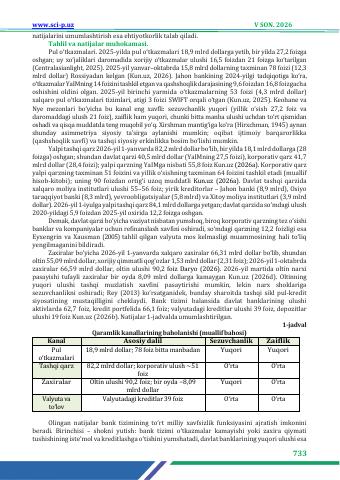
- Remittances to Uzbekistan reached $18.9 billion in 2025, up 27.2% in one year.p.3
- Foreign remittances rose from 16.5% to 21% of household income.p.3
- About 78% ($12.3 billion) of $15.8 billion in remittances in January-October 2025 came from Russia.p.3
- Gross external debt reached $82.2 billion on 1 January 2026, up $18.1 billion (28%) in a year.p.3
- Public external debt was $40.5 billion (27.5% of GDP) and corporate debt $41.7 billion (28.4%); gross debt was 55.8% of GDP.p.3
- More than 90% of international reserves consist of gold.p.2
Key insights
- Remittances are assessed as the riskiest dependence channel because annual growth of 27.2% and a 21% income share meet a single-source share above three quarters.p.3
- A 2024 World Bank study found remittances equalled 14% of GDP and prevented poverty from rising from 9.6% to 16.8%.p.3
- Corporate debt makes up about 51% of gross external debt and about 64% of its annual growth (author's calculation), and over 90% of it is long-term.p.3
- International financial institutions hold 55-56% of public external debt.p.3
- Remittances are the most dangerous dependence channel (78% from one source), and gold above 90% of reserves raises price sensitivity.p.4
- The banking system is argued to serve four national security functions: shock absorption, channel diversification, debt and currency risk management, and infrastructure security.p.4
Pages
 p.1
 p.2
 p.3
 p.4
 p.5
Topics and entities
Summary and figures generated from the document and checked automatically: every number shown appears on the cited page. Publishers can request removal.