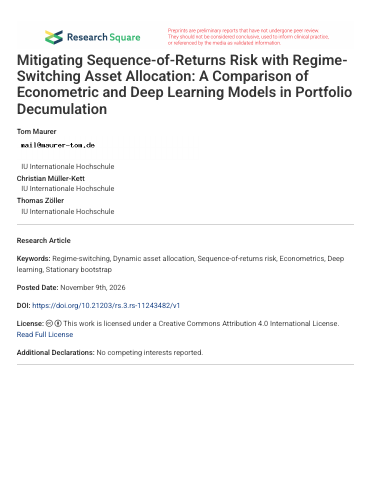
Mitigating Sequence-of-Returns Risk with Regime-Switching Asset Allocation: A Comparison of Econometric and Deep Learning Models in Portfolio Decumulation (Research Square)
SaveSummary
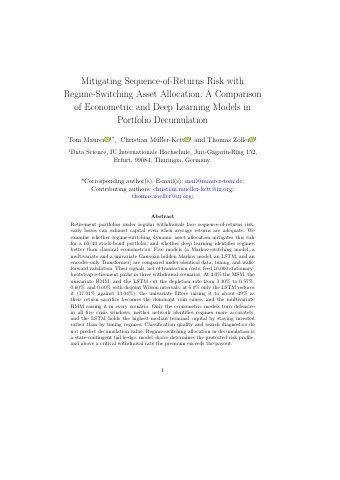
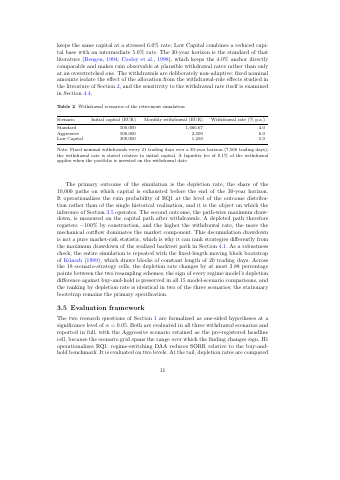
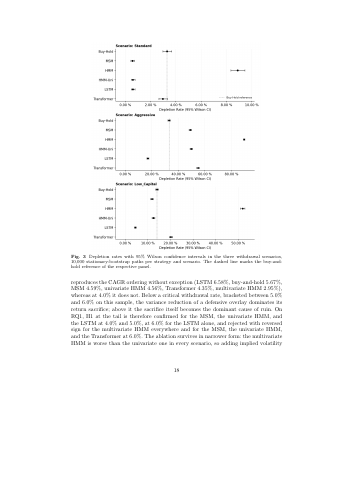
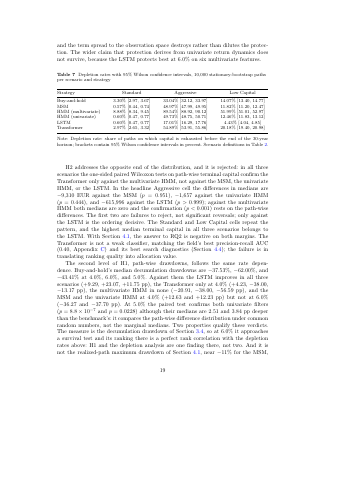
- At a 4.0% withdrawal rate the MSM, the univariate HMM and the LSTM cut the depletion rate from 3.30% to 0.57%, 0.60% and 0.60%.p.2
- At a 6.0% withdrawal rate only the LSTM reduces the depletion rate (17.01% against 33.04%).p.2
- Five regime models are validated in a walk-forward design with 26 folds spanning 25.7 out-of-sample years, feeding 10,000 stationary-bootstrap retirement paths per scenario.p.4
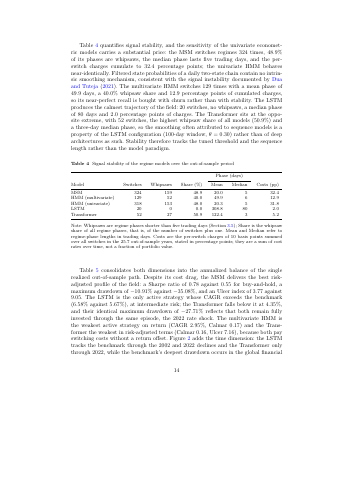
- The MSM switches regimes 324 times, while the LSTM produces the calmest signal with 20 switches and no whipsaws.p.15
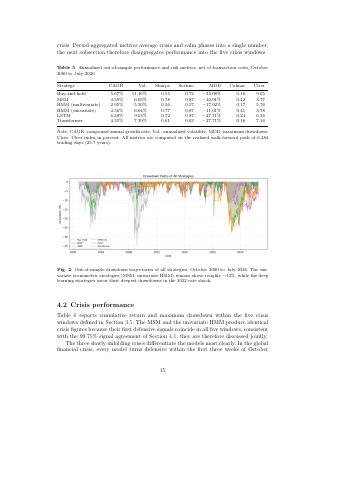
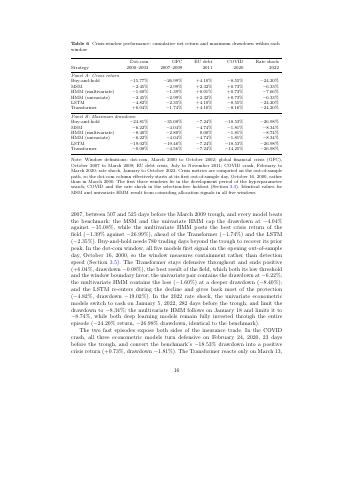
- Over the out-of-sample period the buy-and-hold maximum drawdown is −35.08% against −10.91% for the MSM.p.16
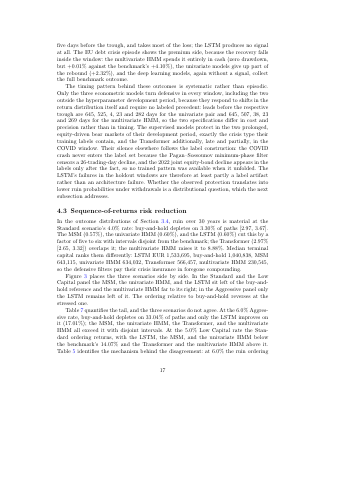
- The multivariate HMM depletes 89.54% of paths in the Aggressive scenario, worse than buy-and-hold at 33.04%.p.20
Key insights
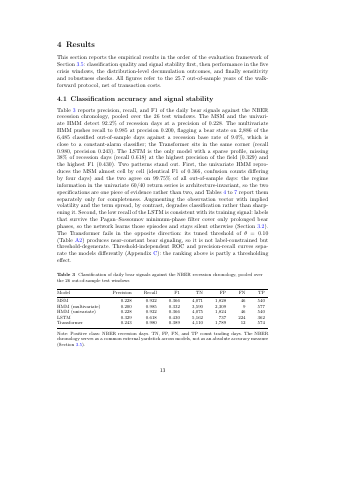
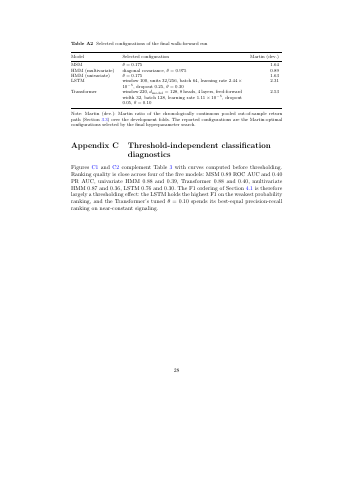
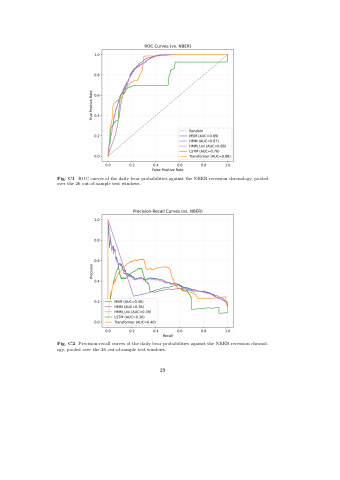
- The MSM and the univariate HMM detect 92.2% of recession days at a precision of 0.228.p.14
- The LSTM has the highest F1 (0.430) of the field despite missing many recession days.p.14
- In the global financial crisis the multivariate HMM posts the best crisis return of the field (−1.39% against −26.99% for buy-and-hold).p.17
- Only the econometric models turn defensive in every crisis window, because they respond to shifts in the return distribution itself.p.18
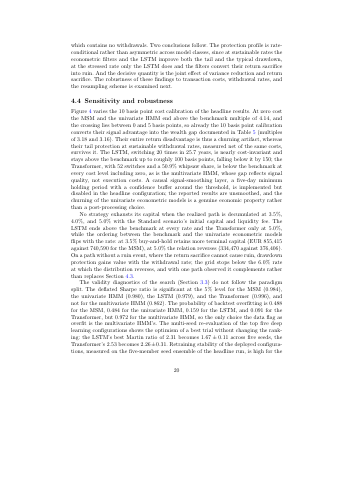
- The LSTM, switching 20 times in 25.7 years, is nearly cost-invariant and stays above the benchmark up to roughly 100 basis points of transaction costs.p.21
- In the Standard scenario the MSM and the univariate HMM turn 330 ruined paths per 10,000 into 57 and 60.p.23
- Because withdrawals are never indexed, their real value falls by about 45% over the 30-year horizon at an assumed 2% annual inflation rate.p.25
Pages
 p.1
 p.2
 p.3
 p.4
 p.5
 p.6
 p.7
 p.8
 p.9
 p.10
 p.11
 p.12
 p.13
 p.14
 p.15
 p.16
 p.17
 p.18
 p.19
 p.20
 p.21
 p.22
 p.23
 p.24
 p.25
 p.26
 p.27
 p.28
 p.29
 p.30
 p.31
 p.32
 p.33
 p.34
 p.35
 p.36
Funders mentioned
Topics and entities
Summary and figures generated from the document and checked automatically: every number shown appears on the cited page. Publishers can request removal.