Microcredit, Training and Rural Food Security in Burkina Faso: An Analysis of Complementarity (Research Square)
SaveKey number
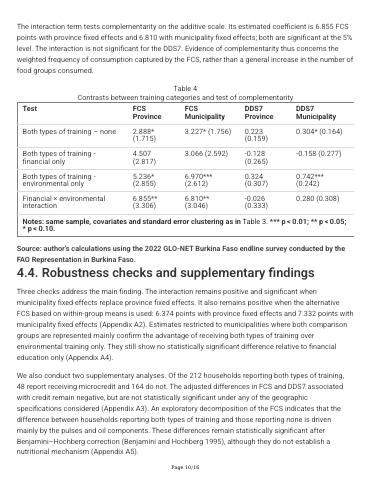
6.855 FCS points
Financial education × environmental training interaction (FCS, province fixed effects) p.10
Summary
- The study analyzes data from the 2022 GLO-NET Burkina Faso endline survey for 1 732 households in 166 villages.p.2
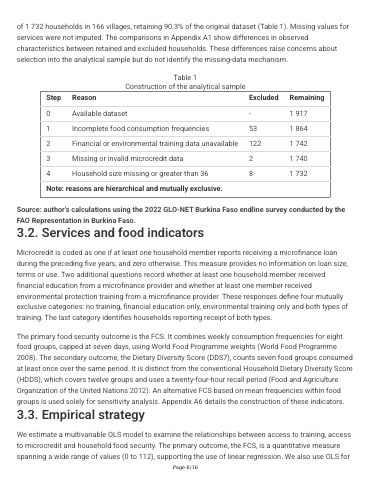
- The analytical sample retains 90.3% of the original dataset.p.6
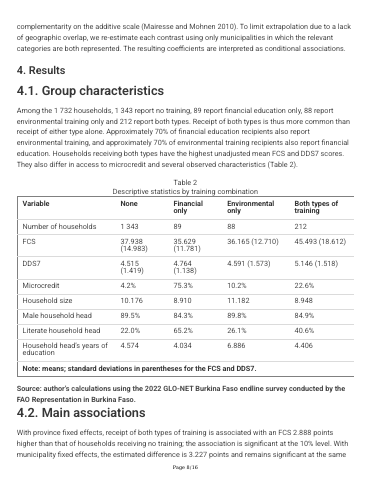
- Among the 1 732 households, 1 343 report no training, 89 financial education only, 88 environmental training only and 212 both types.p.8
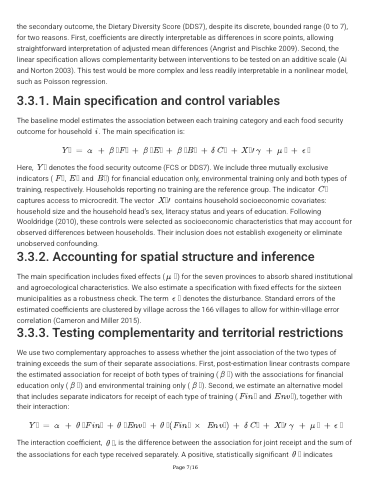
- The financial education × environmental training interaction is 6.855 FCS points with province fixed effects and 6.810 with municipality fixed effects.p.10
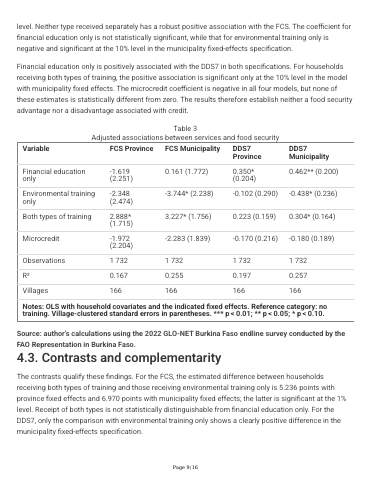
- The microcredit coefficient is negative in all four models, but none of the estimates is statistically different from zero.p.9
Key insights
- Receipt of both types of training is more common than receipt of either type alone.p.8
- Both types of training are associated with an FCS 2.888 points higher than no training in the province fixed-effects model.p.9
- Microcredit shows neither a food security advantage nor a disadvantage.p.9
- Evidence of complementarity concerns the FCS, not the number of food groups consumed (the interaction is not significant for DDS7).p.10
- The interaction stays positive with an alternative FCS: 6.374 points with province fixed effects and 7.332 with municipality fixed effects.p.10
- Microcredit access is 4.2% among households with no training and 75.3% among those with financial education only.p.8
Pages
 p.1
 p.2
 p.3
 p.4
 p.5
 p.6
 p.7
 p.8
 p.9
 p.10
 p.11
 p.12
 p.13
 p.14
 p.15
 p.16
Funders mentioned
Topics and entities
Summary and figures generated from the document and checked automatically: every number shown appears on the cited page. Publishers can request removal.