Institutional Investor Heterogeneity and Initial Public Offering Underpricing in China's Science and Technology Innovation Board: A Review (Journal of trends in financial and economics.)
Summary
- Bushee established a systematic classification of institutional investors using 3 types of indicators and 9 constructed variables.p.2
- Stable institutional investors reduced equity costs in Chinese high-tech firms from 2008 to 2017 more effectively than transactional investors.p.3
- Analysis of registration statements from 193 companies listed on the STAR Market from June 13, 2019, to January 31, 2021, revealed that redundant disclosures exacerbate underpricing.p.4
- A synthesis of 31 references evaluated Chinese IPO pricing efficiency across historical regulatory transformations.p.6
- Publicly available information accounts for only 35%-50% of observed IPO underpricing.p.7
- Empirical bidding data across 380 Chinese IPOs indicates that higher investor sentiment drives institutional participants to raise bid prices.p.7
- An examination of 2955 Chinese A-share listed stocks from 2003 to 2020 demonstrated that positive investor sentiment affects IPO underpricing via market turnover rate.p.9
Key insights
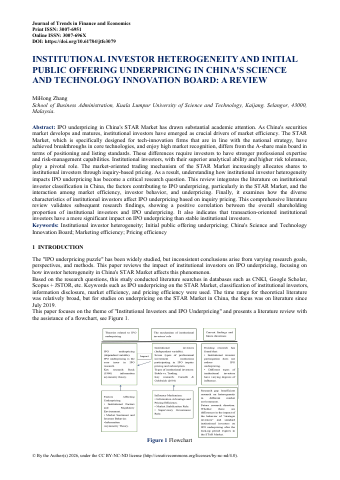
- Transaction-oriented institutional investors exert a more pronounced impact on IPO underpricing than long-term stable investors.p.1
- Pressure-resistant investors significantly enhance internal control effectiveness and firm investment efficiency compared to pressure-sensitive investors.p.3
- Registration-based IPO systems reduce post-listing speculation by accelerating the release of investor sentiment.p.4
- Patent ownership produces a strong signaling effect that effectively mitigates IPO underpricing for innovation-focused companies.p.5
- Registration system reforms enhance IPO pricing efficiency by elevating corporate disclosure quality and diminishing information asymmetry.p.6
- Low-price collusion among inquiry objects occurs when regulatory enforcement defaults to lenient supervisory conditions.p.7
- Removing first-day price fluctuation limits and introducing margin trading on the STAR Market curbs speculative sentiment.p.9
Pages
 p.1
 p.2
 p.3
 p.4
 p.5
 p.6
 p.7
 p.8
 p.9
 p.10
 p.11
 p.12
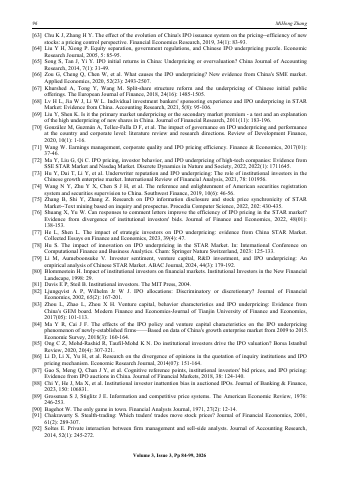 p.13
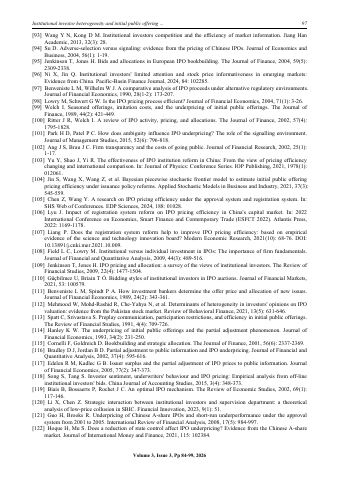 p.14
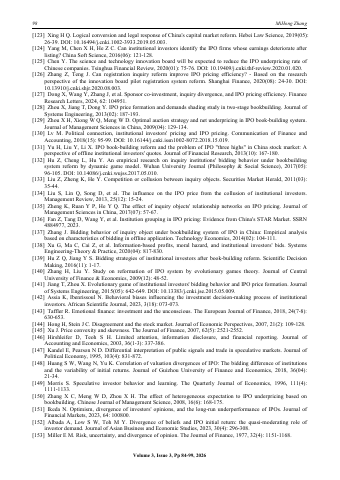 p.15
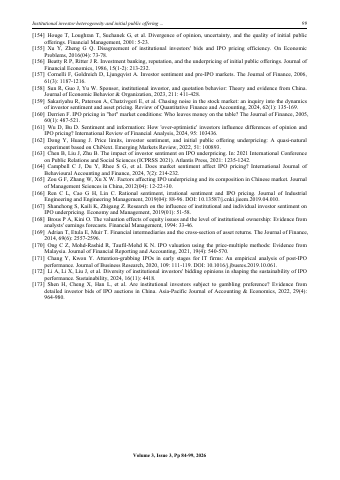 p.16
Topics and entities
Summary and figures generated from the document and checked automatically: every number shown appears on the cited page. Publishers can request removal.