Implementing Hifz al-Bi'ah in Central Bank Environmental Policies (Journal of Economic Business & Accounting Research)
SaveSummary
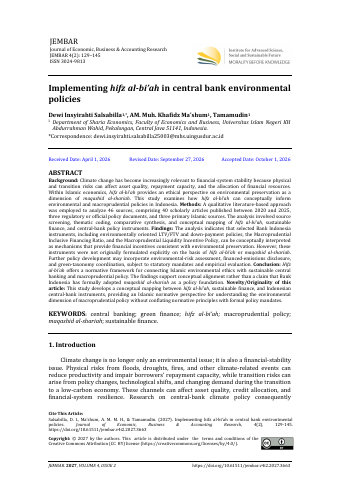
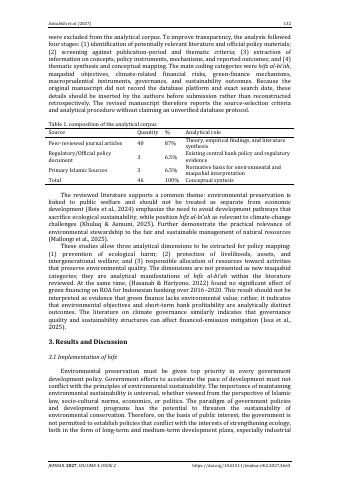
- A qualitative literature review analyzes 46 sources, including 40 scholarly articles published between 2020 and 2025, three regulatory or official policy documents and three primary Islamic sources.p.1
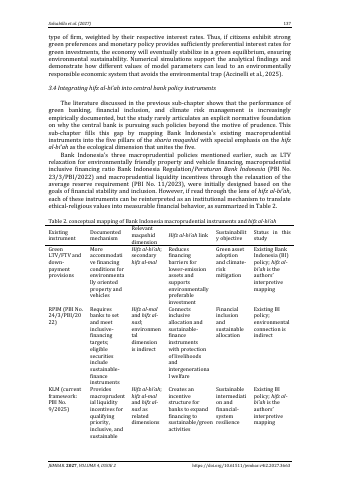
- Bank Indonesia's environmentally oriented LTV/FTV policies, RPIM and KLM can be conceptually read as mechanisms providing financial incentives consistent with environmental preservation.p.1
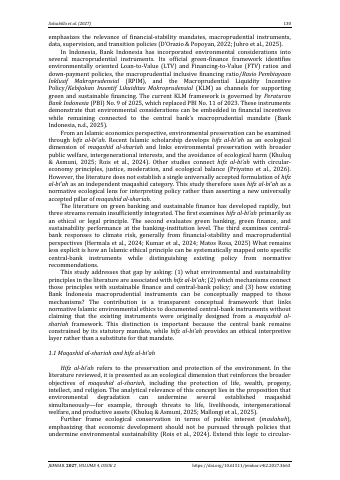
- The KLM framework is governed by PBI No. 9 of 2025, which replaced PBI No. 11 of 2023.p.2
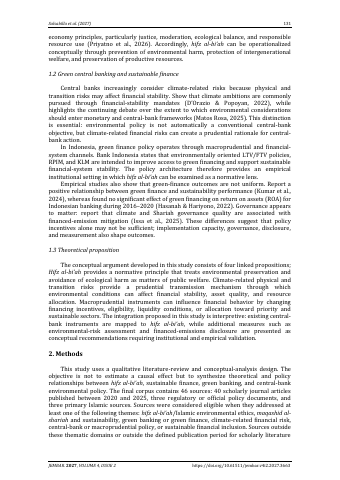
- One study found no significant effect of green financing on return on assets for Indonesian banking during 2016–2020.p.3
- Green financing reporting in Islamic banking only began in 2018.p.7
Key insights
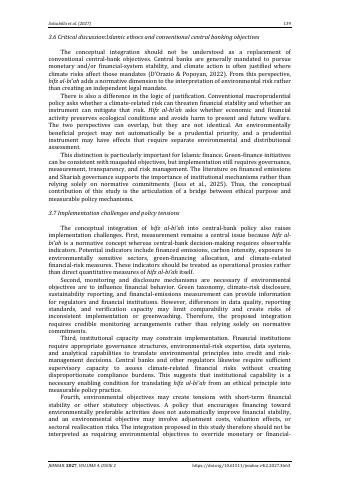
- Hifz al-bi'ah is used as a normative ecological lens rather than as an independent legal mandate for central banks.p.11
- Climate-related financial risks create a prudential rationale for central-bank action on environmental policy.p.3
- Green-finance outcomes are not uniform across studies, and benefits appear only when reporting and regulation are mature.p.7
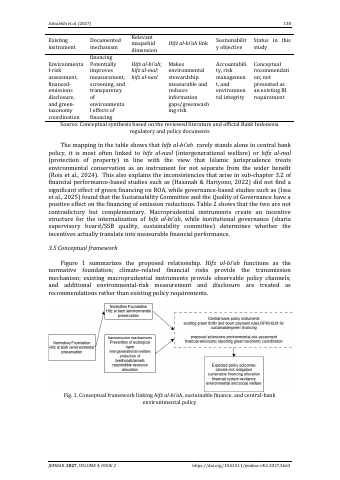
- Hifz al-bi'ah is most often linked to hifz al-nasl (intergenerational welfare) or hifz al-mal (protection of property) in central bank policy.p.10
- Macroprudential instruments create an incentive structure, while institutional governance determines whether it translates into outcomes.p.10
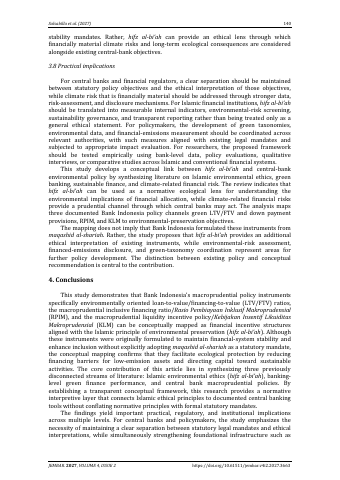
- Islamic financial institutions should turn hifz al-bi'ah into measurable internal indicators, environmental-risk screening and transparent reporting.p.12
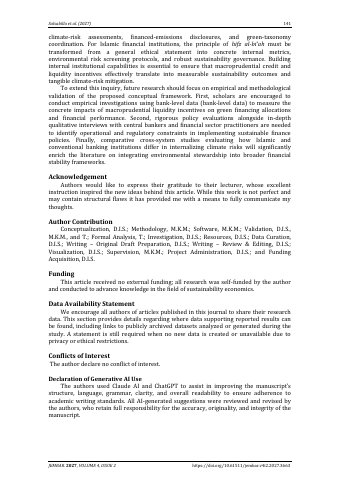
- Future research should test the framework with bank-level data, policy evaluations and cross-system comparisons.p.13
Pages
 p.1
 p.2
 p.3
 p.4
 p.5
 p.6
 p.7
 p.8
 p.9
 p.10
 p.11
 p.12
 p.13
 p.14
 p.15
 p.16
 p.17
Funders mentioned
Topics and entities
Summary and figures generated from the document and checked automatically: every number shown appears on the cited page. Publishers can request removal.