IFRS Adoption, Financial Transparency, and Investor Confidence: A Systematic Literature Review (Journal of Accounting Business Governance and Sustainability)
SaveSummary
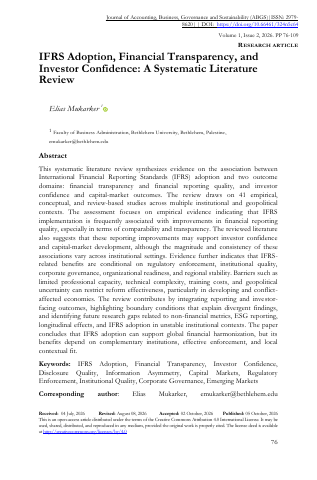
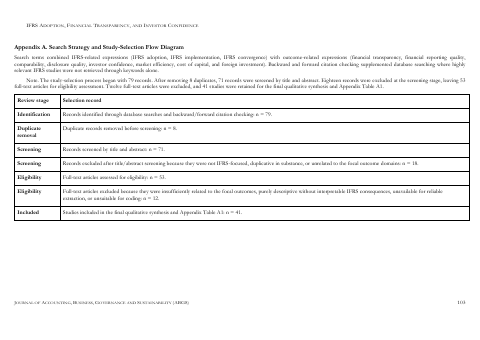
- The review draws on 41 empirical, conceptual and review-based studies across multiple institutional contexts.p.1
- IFRS adoption is frequently associated with better reporting quality, especially comparability and transparency.p.1
- Reported benefits are conditional on regulatory enforcement, institutional quality, corporate governance, organizational readiness and regional stability.p.1
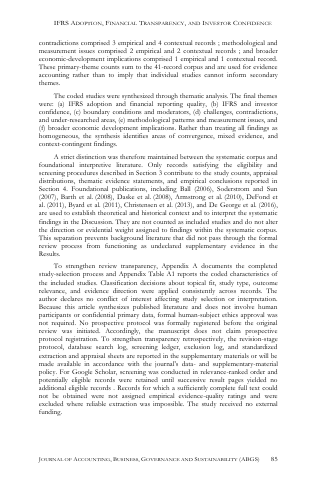
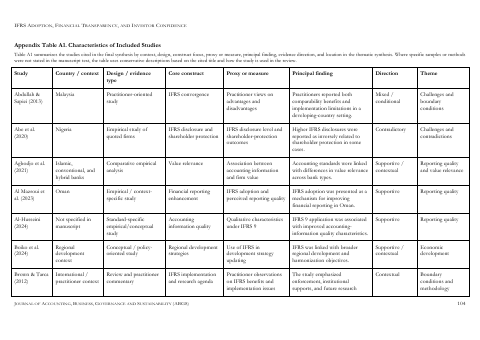
- The primary-theme counts sum to the 41-record corpus.p.10
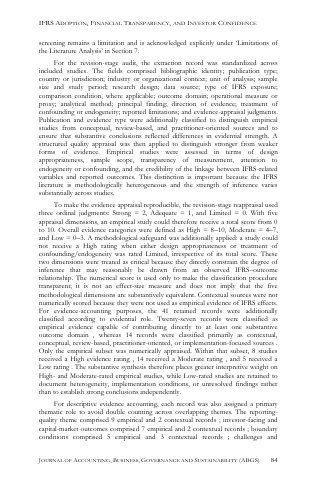
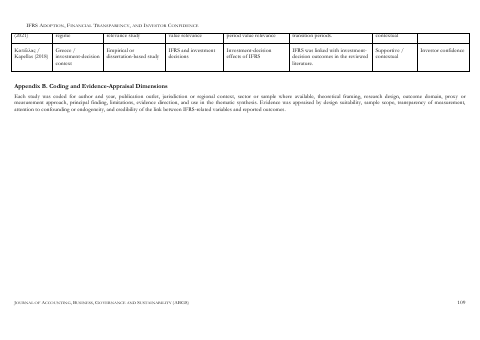
- Evidence appraisal used three ordinal judgments, Strong = 2, Adequate = 1 and Limited = 0, giving empirical studies a score from 0 to 10.p.9
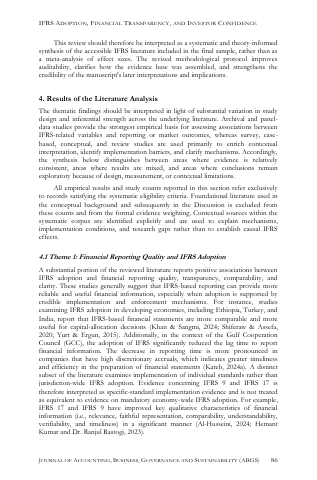
- The review is a systematic synthesis rather than a meta-analysis of effect sizes.p.11
Key insights
- The evidence for reporting quality and comparability is broader than the evidence directly measuring investor confidence.p.3
- Market outcomes such as liquidity, cost of capital, IPO outcomes, FPI or FDI should not automatically be read as direct evidence of investor trust.p.3
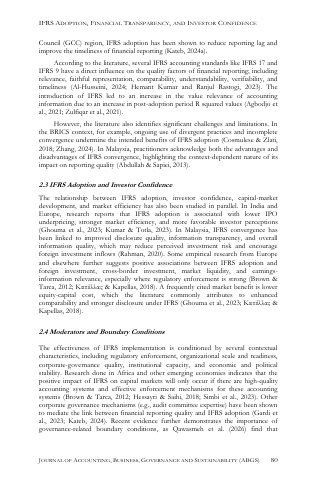
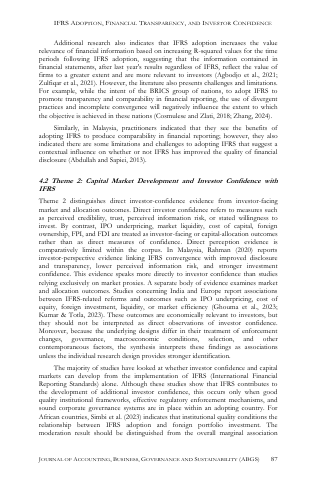
- IFRS 17 and IFRS 9 are reported to influence relevance, faithful representation, comparability and timeliness of reporting.p.5
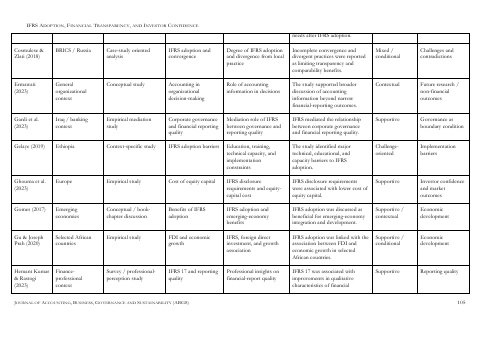
- In the BRICS context, divergent practices and incomplete convergence undermine the intended benefits of IFRS.p.5
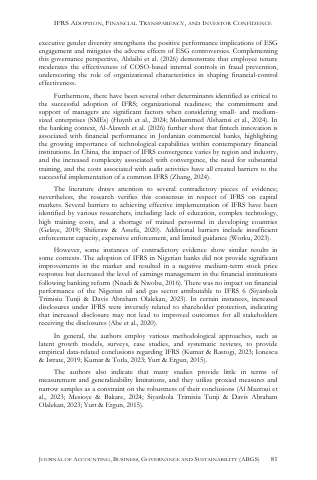
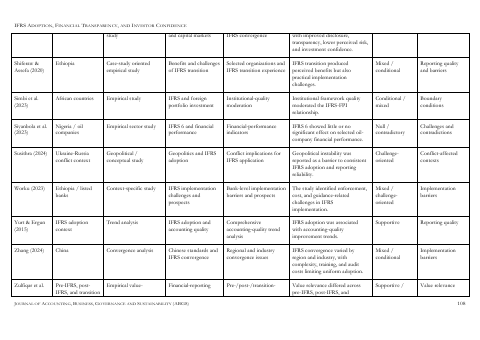
- Barriers in developing countries include lack of education, complex technology, high training costs and a shortage of trained personnel.p.6
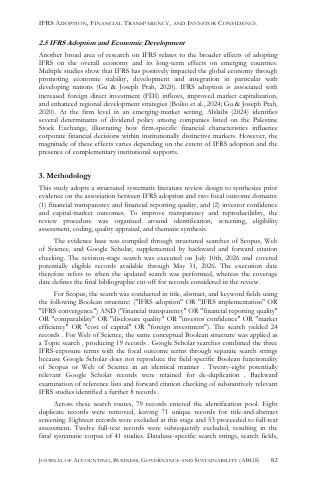
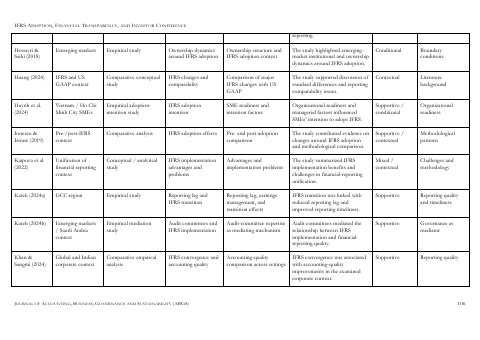
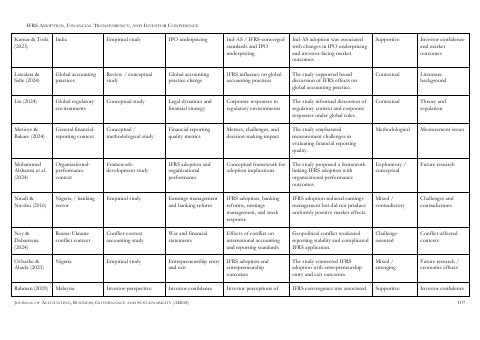
- In Nigerian banks, IFRS adoption had little to no significant market impact, though it helped reduce earnings management.p.14
- Increased IFRS disclosure was in some cases found to lower shareholder protection.p.14
- Identified gaps include ESG integration, long-term effects on entrepreneurs, and use of IFRS in conflict-affected regions.p.17
Pages
 p.1
 p.2
 p.3
 p.4
 p.5
 p.6
 p.7
 p.8
 p.9
 p.10
 p.11
 p.12
 p.13
 p.14
 p.15
 p.16
 p.17
 p.18
 p.19
 p.20
 p.21
 p.22
 p.23
 p.24
 p.25
 p.26
 p.27
 p.28
 p.29
 p.30
 p.31
 p.32
 p.33
 p.34
Funders mentioned
Topics and entities
Summary and figures generated from the document and checked automatically: every number shown appears on the cited page. Publishers can request removal.