Heptagonal Cross-Border Cooperation and SME Development in the Caucasus and Central Asia: Econometric Modeling of Growth Channels and Spatial Agglomeration (Transekonomika Akuntansi Bisnis dan Keuangan)
SaveSummary
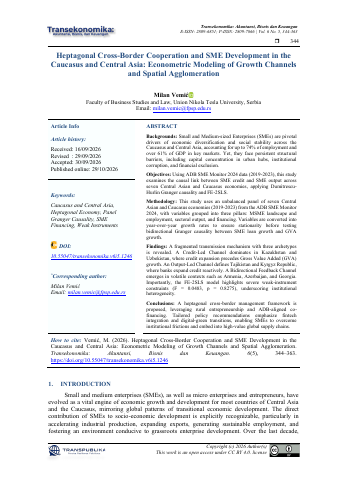
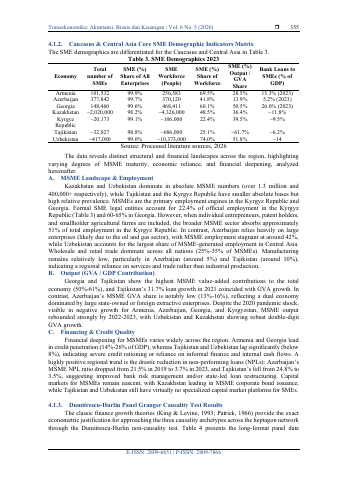
- SMEs account for up to 74% of employment and over 61% of GDP in key markets of the Caucasus and Central Asia.p.1
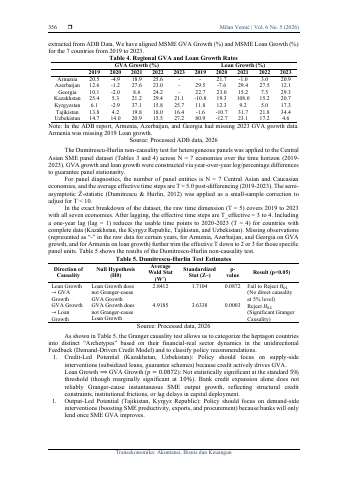
- The study uses ADB SME Monitor 2024 data (2019-2023) for seven economies.p.1
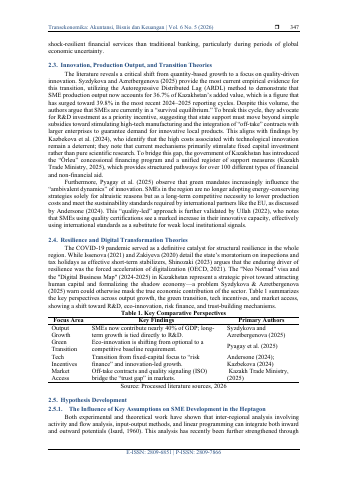
- Kazakhstan SME output accounts for 36.7% of added value, a figure that has surged toward 39.8% in the most recent reporting cycles.p.4
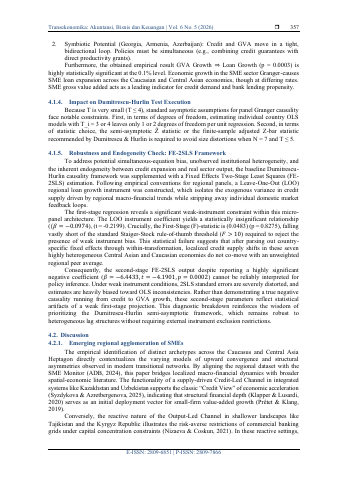
- GVA growth Granger-causes loan growth (p = 0.0003), making SME output a leading indicator for credit.p.14
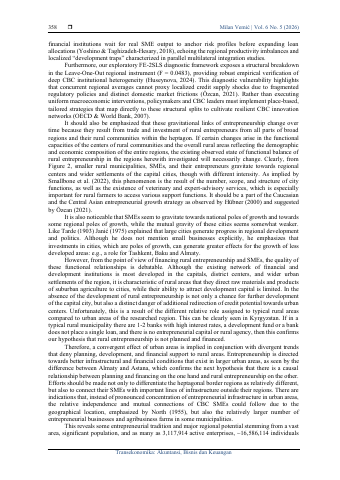
- The leave-one-out regional instrument fails in the FE-2SLS diagnostic (F = 0.0483).p.15
Key insights
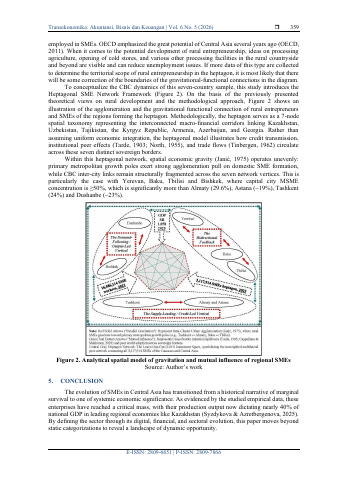
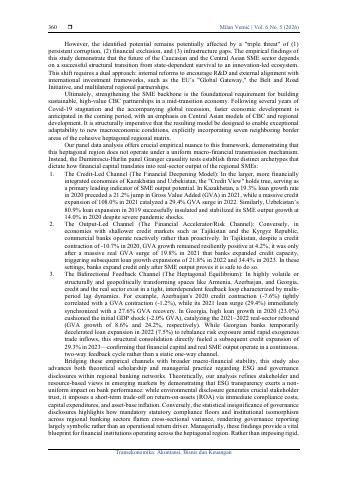
- The region does not operate under a uniform macro-financial transmission mechanism, and three distinct archetypes emerge.p.17
- SME gross value added acts as a leading indicator for credit demand and bank lending propensity.p.14
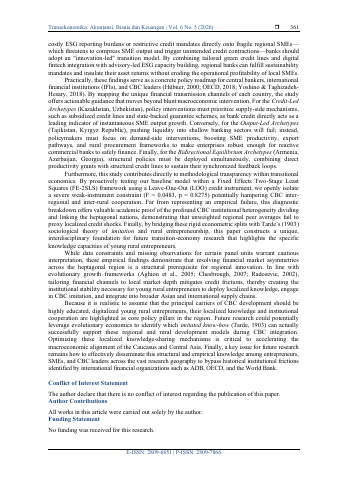
- Credit-led policy applies to Kazakhstan and Uzbekistan, where subsidized credit lines and state-backed guarantees are recommended.p.18
- For Tajikistan and the Kyrgyz Republic, pushing liquidity into shallow banking sectors is expected to fail and demand-side interventions are preferred.p.18
- A weak regional instrument shows that peer averages cannot proxy localized credit supply shocks.p.15
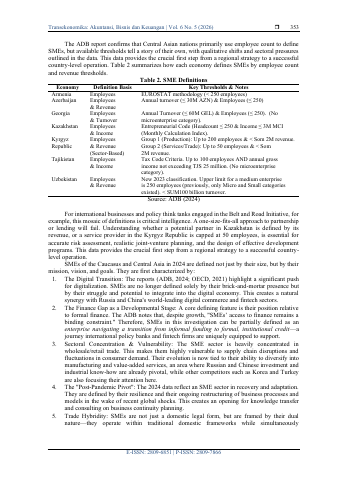
- SME definitions differ across economies, so a one-size-fits-all approach to partnership or lending will fail.p.10
- The sector remains threatened by corruption, financial exclusion and infrastructure gaps.p.17
Pages
 p.1
 p.2
 p.3
 p.4
 p.5
 p.6
 p.7
 p.8
 p.9
 p.10
 p.11
 p.12
 p.13
 p.14
 p.15
 p.16
 p.17
 p.18
 p.19
 p.20
Funders mentioned
Topics and entities
Summary and figures generated from the document and checked automatically: every number shown appears on the cited page. Publishers can request removal.