Green Transformation of Indonesian State-Owned Banks: Implementation of Green Banking 2024-2025 (Jurnal Ilmiah Manajemen dan Akuntansi)
SaveSummary
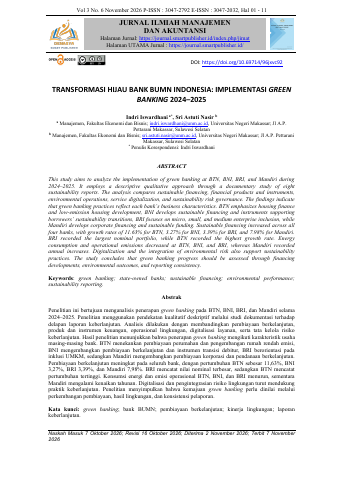
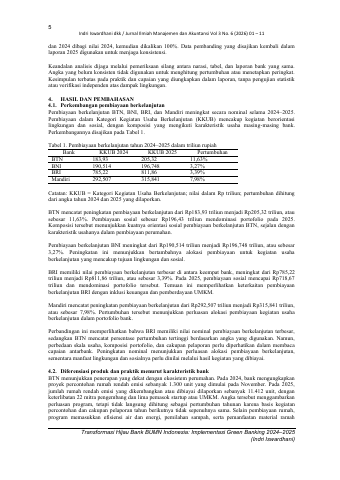
- Sustainable financing increased across all four banks, with growth rates of 11.63% for BTN, 3.27% for BNI, 3.39% for BRI, and 7.98% for Mandiri.p.1
- BRI recorded the largest nominal sustainable financing portfolio, while BTN recorded the highest growth rate.p.1
- The study compares BTN, BNI, BRI and Mandiri through a documentary analysis of eight sustainability reports.p.1
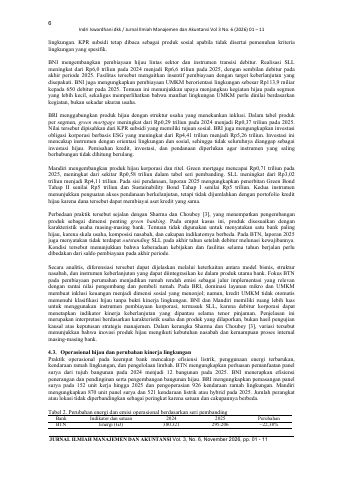
- BNI disclosed environmentally oriented MSME financing to 650 borrowers in 2025.p.6
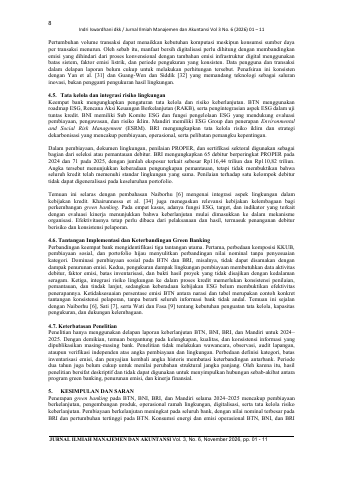
- BRI disclosed 65 PROPER-rated debtors in 2024 and 71 in 2025.p.8
Key insights
- Green banking practices reflect each bank's business characteristics: BTN stresses housing finance, BNI sustainable financing instruments, BRI MSME inclusion and Mandiri corporate financing and sustainable funding.p.1
- Sustainability-linked loans are treated as a transition instrument and are not automatically added to the green portfolio.p.4
- Social financing dominated BTN's sustainable portfolio in 2025, in line with its housing finance business.p.5
- BNI's sustainability-linked loans increased, with nine debtors at the end of 2025.p.6
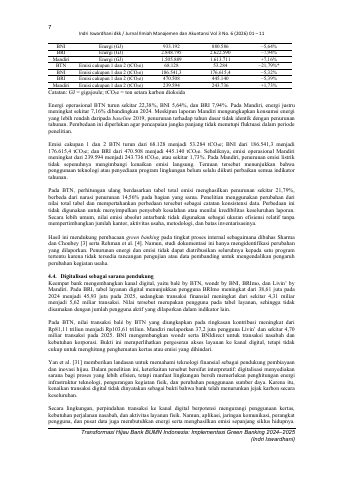
- Mandiri's operational energy use and scope 1 and 2 emissions rose, while the other banks reported declines.p.7
- PROER disclosures show that monitoring exists but do not prove that all credit meets environmental standards.p.8
- Banks are advised to separate green and social financing, define emission boundaries and report traceable environmental results.p.9
Pages
 p.1
 p.2
 p.3
 p.4
 p.5
 p.6
 p.7
 p.8
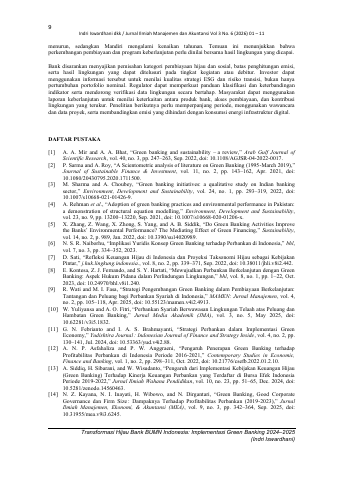 p.9
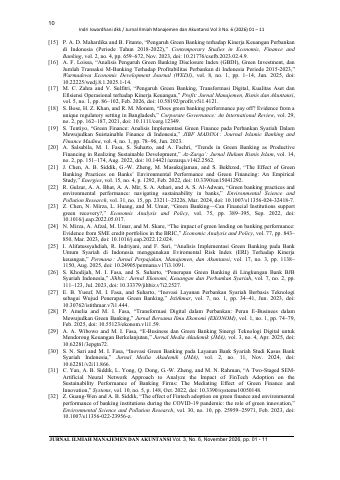 p.10
 p.11
Funders mentioned
Topics and entities
Summary and figures generated from the document and checked automatically: every number shown appears on the cited page. Publishers can request removal.