Financial Management Practices in Textile Firms of the Central Valleys of Oaxaca (Revista Hambatu Science)
SaveSummary
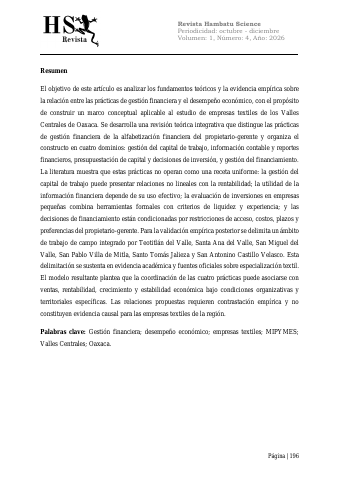
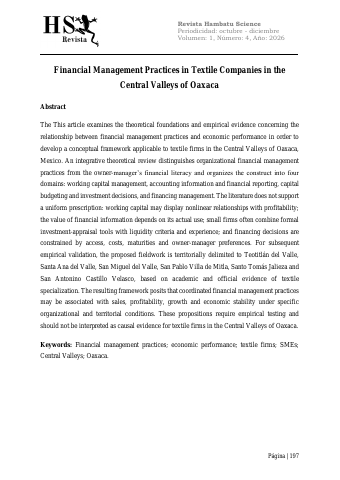
- The article reviews theory and evidence on financial management practices and economic performance to build a conceptual framework for textile firms in the Central Valleys of Oaxaca.p.3
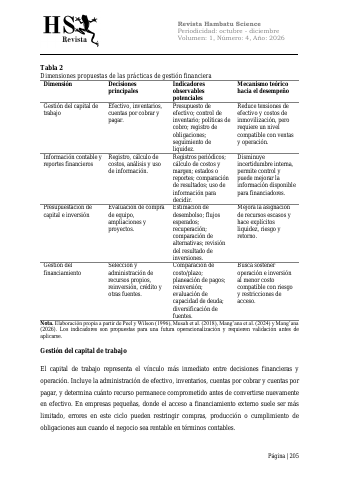
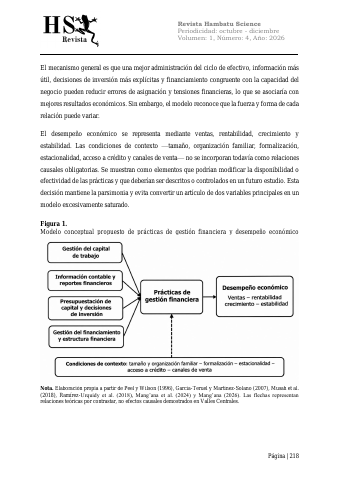
- The framework organizes financial management into four domains: working capital, accounting information and reporting, capital budgeting, and financing management.p.3
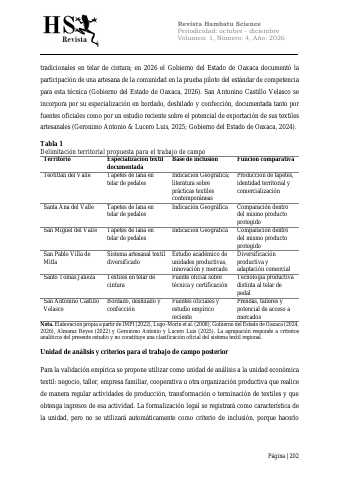
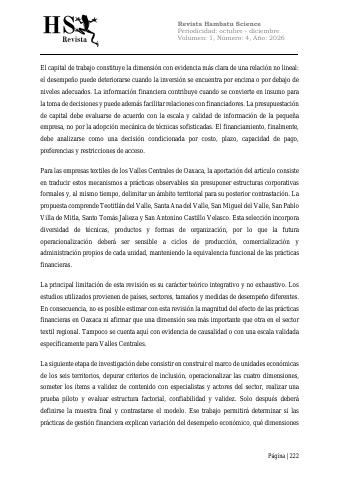
- Fieldwork is proposed in six territories, including Teotitlán del Valle, San Pablo Villa de Mitla and San Antonino Castillo Velasco.p.8
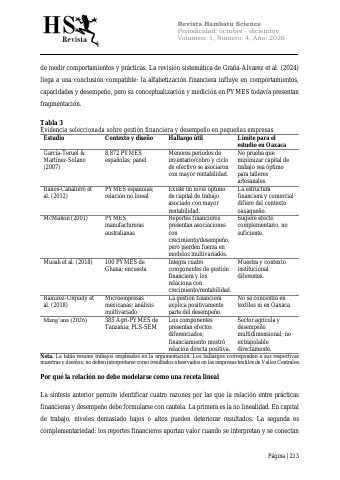
- A panel of 8,872 Spanish SMEs found that shorter inventory and receivable periods were associated with higher profitability.p.13
- Later studies found a concave, non-linear relationship between working capital and profitability, implying an optimal level.p.13
- The propositions require empirical testing and should not be read as causal evidence.p.4
Key insights
- In small firms financial management is concentrated in the owner-manager, so formal practices coexist with rules of thumb and experience.p.5
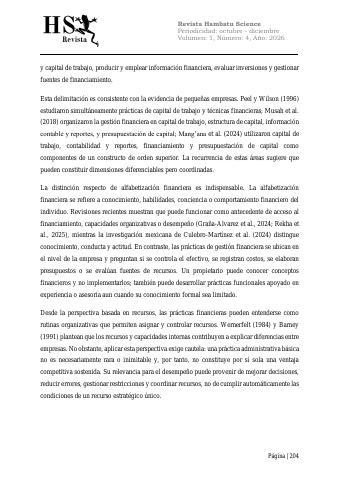
- The framework distinguishes firm-level financial management practices from the owner-manager's financial literacy.p.11
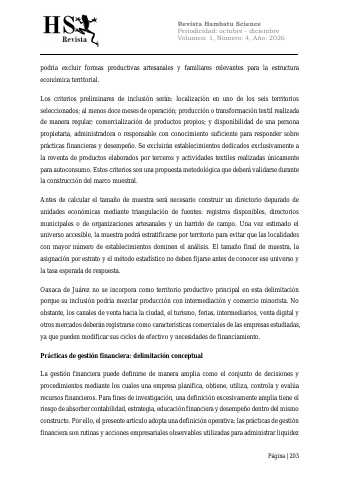
- Textile firms in the region include family workshops, artisanal units, formalized businesses and cooperatives, so a textile firm should not be equated with an industrial factory.p.8
- A proposition such as less inventory improves performance would be conceptually weak for textile workshops, which need wool, thread and finished goods to meet orders.p.13
- The presence of accounting records is not equivalent to their managerial use.p.14
- Small firms often rely on payback period or owner judgment rather than discounted cash flow techniques when appraising investments.p.15
- Financing decisions combine objective constraints with managerial preferences, and the absence of credit should not automatically be scored as a deficiency.p.22
Pages
 p.1
 p.2
 p.3
 p.4
 p.5
 p.6
 p.7
 p.8
 p.9
 p.10
 p.11
 p.12
 p.13
 p.14
 p.15
 p.16
 p.17
 p.18
 p.19
 p.20
 p.21
 p.22
 p.23
 p.24
 p.25
 p.26
 p.27
 p.28
 p.29
 p.30
 p.31
 p.32
 p.33
 p.34
Funders mentioned
Topics and entities
Summary and figures generated from the document and checked automatically: every number shown appears on the cited page. Publishers can request removal.