Financial Inclusion and Household Savings Behaviour in Semi-Urban India (International Journal of Advanced Research)
SaveSummary
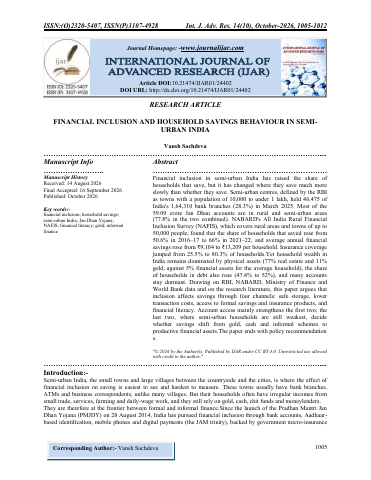
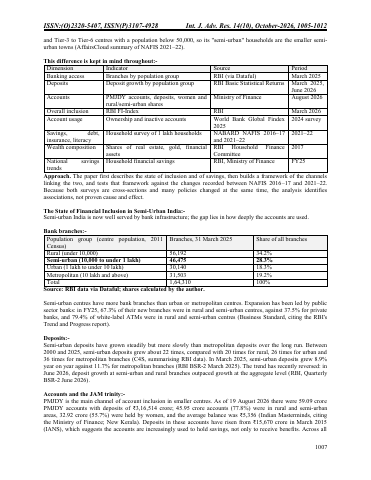
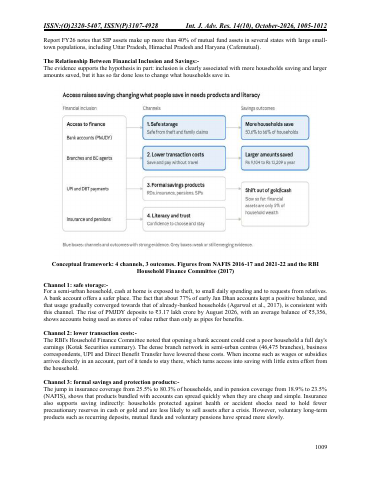
- Semi-urban centres held 46,475 of India's 1,64,310 bank branches (28.3%) in March 2025.p.1
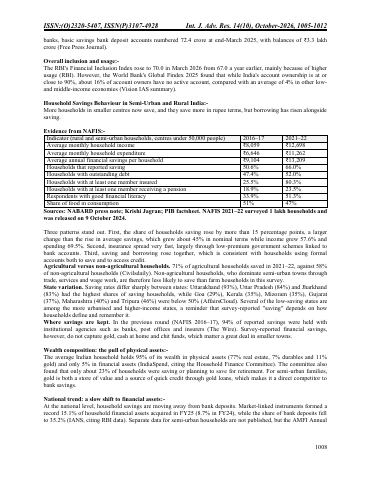
- NABARD's NAFIS found the share of households that saved rose from 50.6% in 2016–17 to 66% in 2021–22.p.1
- Average annual financial savings rose from ₹9,104 to ₹13,209 per household.p.1
- Insurance coverage jumped from 25.5% to 80.3% of households.p.1
- Household wealth remains dominated by physical assets: 77% real estate and 11% gold, against 5% financial assets.p.1
- The RBI Financial Inclusion Index rose to 70.0 in March 2026 from 67.0 a year earlier, mainly because of higher usage.p.4
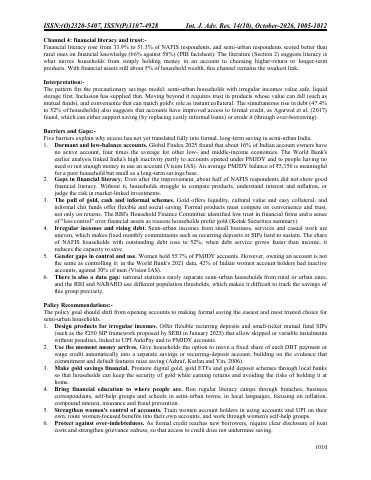
- About 16% of Indian account owners have no active account, compared with an average of 4% in other low- and middle-income economies.p.4
Key insights
- Most of the 59.09 crore Jan Dhan accounts are in rural and semi-urban areas (77.8% in the two combined).p.1
- The share of households in debt also rose, from 47.4% to 52.0% in NAFIS.p.4
- Average savings grew about 45% in nominal terms while income grew 57.6% and spending 69.5%.p.4
- Households with at least one member receiving a pension rose from 18.9% to 23.5%.p.4
- PMJDY deposits rose to ₹3.17 lakh crore by August 2026, with an average balance of ₹5,356, showing accounts used as stores of value.p.5
- Financial literacy rose from 33.9% to 51.3% of NAFIS respondents, and is seen as the weakest link for moving households into higher-return products.p.6
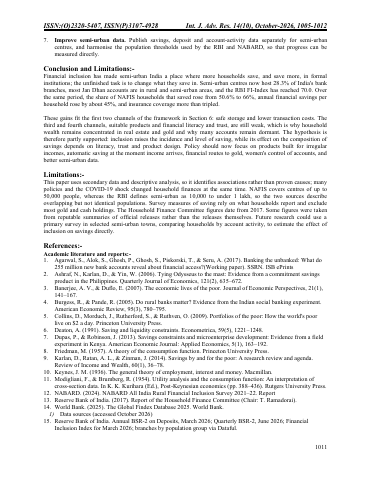
- The paper finds inclusion raises the incidence and level of saving, but its effect on the composition of savings depends on literacy, trust and product design.p.7
Pages
 p.1
 p.2
 p.3
 p.4
 p.5
 p.6
 p.7
 p.8
Funders mentioned
Topics and entities
Summary and figures generated from the document and checked automatically: every number shown appears on the cited page. Publishers can request removal.