Ethereum Value Formation as a Feedback System: An Integrative Causal-Loop Framework (Frontiers in Blockchain)
Summary
- A targeted database search on Scopus using valuation and platform terms yielded 411 initial records.p.3
- The literature synthesis covers research published between 2015 and 2026 to analyze Ethereum value formation.p.3
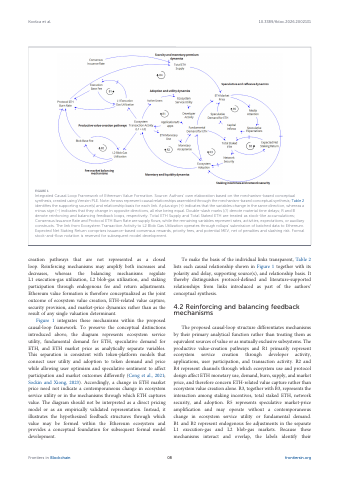
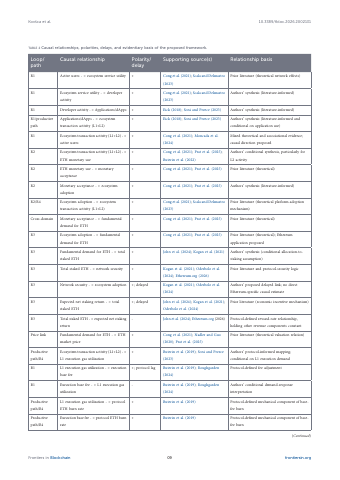
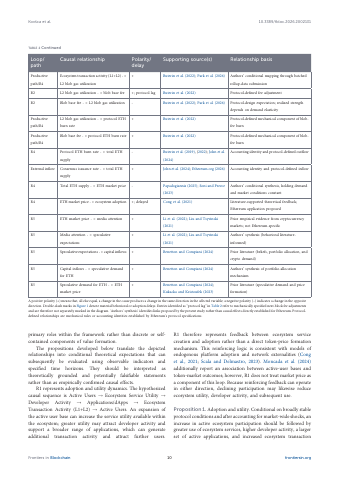
- The conceptual framework integrates 5 reinforcing feedback loops and 3 balancing feedback loops to explain token value dynamics.p.1
- The systematic literature search was executed on 23 July 2026 across Scopus and Web of Science Core Collection.p.3
- EIP-4844 was implemented on 13 March 2024, creating a separate blob-gas fee market for Layer-2 rollup data.p.13
- The paper structures its systemic inquiry around 2 explicit research questions regarding valuation mechanisms and feedback loops.p.2
Key insights
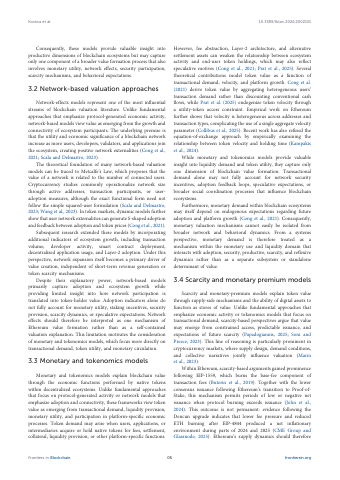
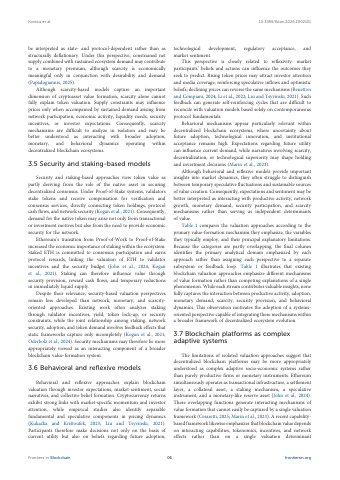
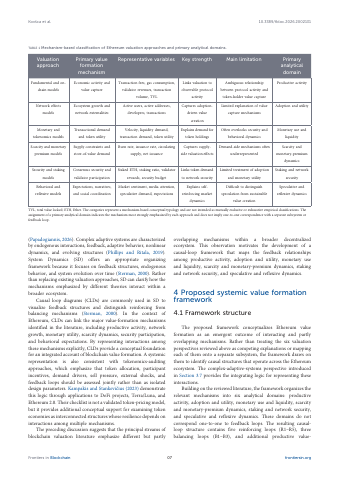
- Existing Ethereum valuation literature is grouped into six main perspectives: fundamental/on-chain, network-based, monetary/tokenomics, scarcity-oriented, security/staking-based, and behavioral/reflexive.p.1
- No single valuation model independently explains the multi-faceted interactions between productive activity, adoption, token scarcity, and network security.p.1
- The framework establishes analytical distinctions between overall ecosystem value creation, native ETH value capture, and market price formation.p.1
- Staking dynamics combine a reinforcing security-adoption loop (R3) with a balancing return-adjustment loop (B3) as total staked ETH increases.p.11
- EIP-4844 demonstrates that Layer-2 transaction growth does not mechanically increase Layer-1 execution fees or ETH burn rates.p.13
- Speculative dynamics (R5) can self-reinforce market price movements through investor attention and capital inflows independently of contemporaneous network utility.p.12
- Traditional discounted cash flow (DCF) approaches capture productive activity but provide an incomplete picture of holistic token value formation.p.13
Pages
 p.1
 p.2
 p.3
 p.4
 p.5
 p.6
 p.7
 p.8
 p.9
 p.10
 p.11
 p.12
 p.13
 p.14
 p.15
 p.16
Topics and entities
Summary and figures generated from the document and checked automatically: every number shown appears on the cited page. Publishers can request removal.