ESG and M&A Valuation in Regulated Industries: The Case of Bridgepoint's Acquisition of Cherry AB (Advances in Economics Management and Political Sciences)
Summary
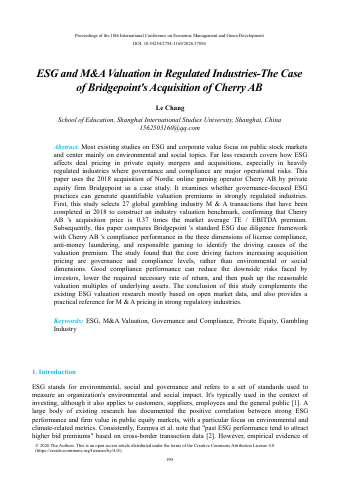
- In late 2018, private equity firm Bridgepoint acquired Nordic online gaming operator Cherry AB in a public-to-private transaction valued at SEK 3.5 billion.p.3
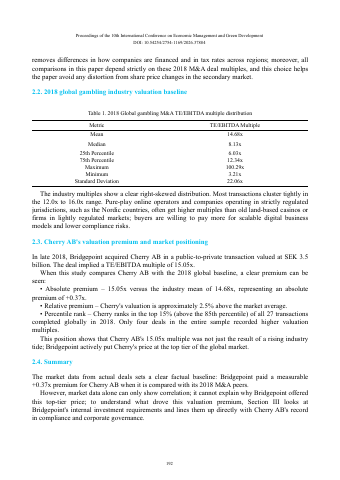
- The transaction implied a TE/EBITDA multiple of 15.05x, exceeding the 2018 global gambling industry M&A baseline mean of 14.68x.p.3
- Bridgepoint paid an absolute valuation premium of +0.37x TE/EBITDA for Cherry AB, representing a relative premium of approximately 2.5% above the market average.p.3
- Cherry AB's acquisition valuation ranked in the top 15% (above the 85th percentile) of 27 global gambling sector M&A transactions completed in 2018.p.3
- The study demonstrates that governance and compliance factors, rather than environmental or social dimensions, were the primary drivers of the valuation premium in heavily regulated sectors.p.1
- Strong compliance performance lowers downside operational risks, reducing the required risk-adjusted discount rate (r) in discounted cash flow valuation models.p.6
Key insights
- Governance and compliance levels serve as the core drivers increasing pricing in private equity buyouts within highly regulated industries.p.1
- The benchmark sample of 27 completed global gambling M&A deals in 2018 yielded a mean TE/EBITDA multiple of 14.68x and a median of 8.13x.p.3
- Only four transactions out of the 27 completed global deals in 2018 recorded higher valuation multiples than Cherry AB's 15.05x TE/EBITDA.p.3
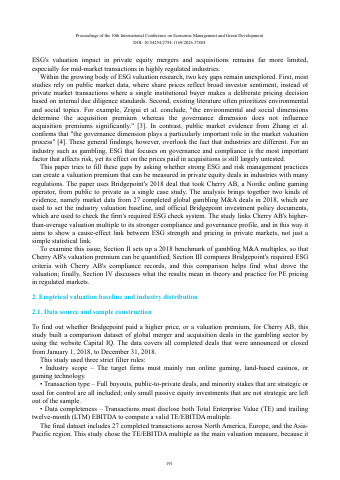
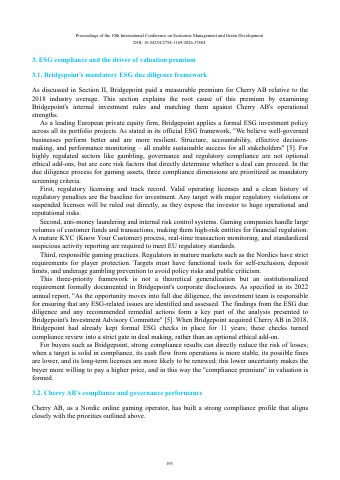
- Bridgepoint's mandatory ESG screening focuses on three core priorities: regulatory licensing track record, AML risk controls, and responsible gaming practices.p.4
- Pre-existing maturity in compliance infrastructure avoids post-acquisition integration costs and extra one-off regulatory compliance spending.p.5
- Unlike public equity markets where ESG influences general market sentiment, private equity buyers evaluate compliance to price asset downside risk directly.p.6
- Investment in compliance infrastructure operates as a value-creating asset rather than a cost burden for companies in regulated markets.p.7
Pages
 p.1
 p.2
 p.3
 p.4
 p.5
 p.6
 p.7
 p.8
Topics and entities
Summary and figures generated from the document and checked automatically: every number shown appears on the cited page. Publishers can request removal.