Digital Trade Financing and SMEs Export Intensity in the Economic Community of West African States (ECOWAS) (British Journal of Contemporary Research)
SaveSummary
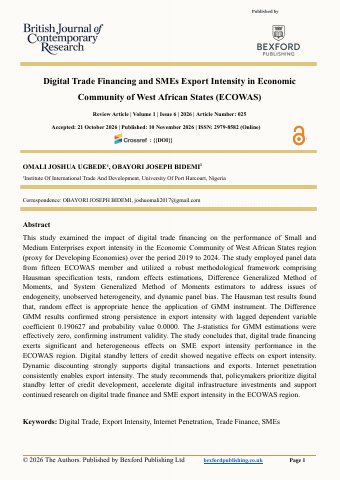
- The study uses panel data from fifteen ECOWAS members over 2019 to 2024.p.1
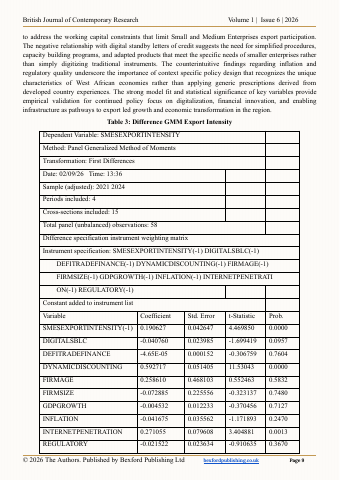
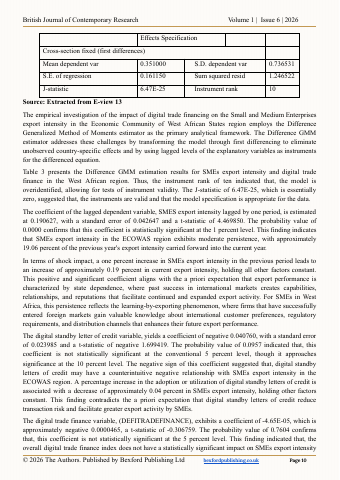
- The lagged dependent variable coefficient in Difference GMM is 0.190627 with probability value 0.0000, showing persistence in export intensity.p.1
- Approximately 19.06 percent of the previous year's export intensity is carried forward into the current year.p.10
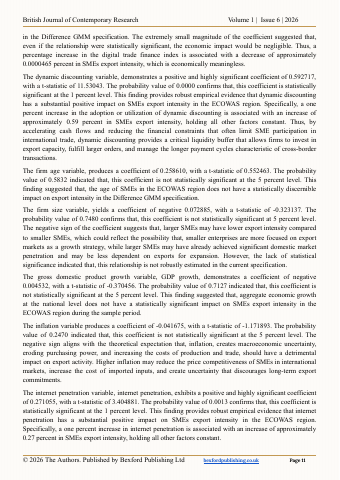
- Dynamic discounting has a positive and highly significant coefficient of 0.592717 in the Difference GMM results.p.11
- A one percent increase in dynamic discounting is associated with an increase of approximately 0.59 percent in SME export intensity.p.11
- Prior studies report that digital trade finance raised SME export intensity by 19% in South Korea, 31% more for Chinese platform financing users and 18% higher export-to-sales in Ghana.p.4
Key insights
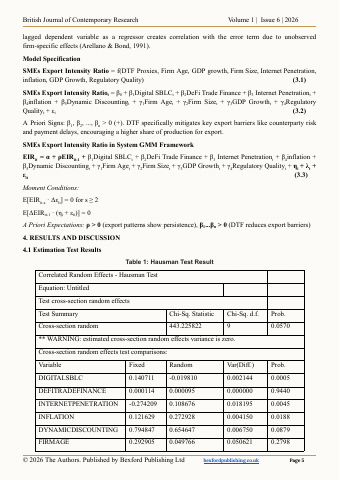
- The Hausman test supports random effects, so GMM estimators are applied to address endogeneity.p.1
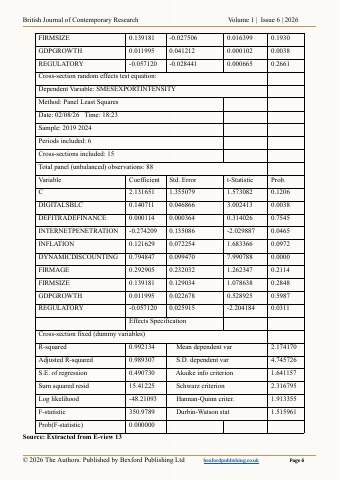
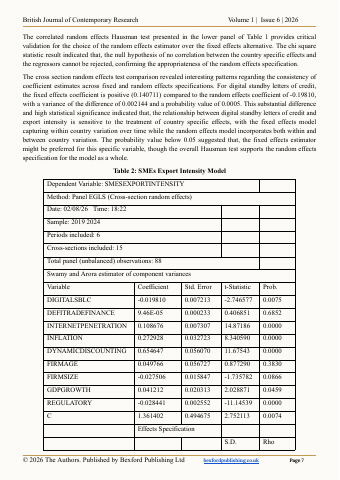
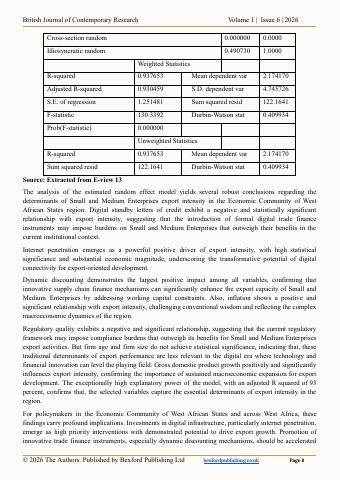
- Digital standby letters of credit show a negative and statistically significant relationship with export intensity in the random effects model.p.8
- Dynamic discounting demonstrates the largest positive impact among all variables in the random effects model.p.8
- Internet penetration emerges as a powerful positive driver of export intensity.p.8
- The Difference GMM instrument rank of 10 and a J-statistic of 6.47E-25 indicate valid instruments.p.10
- The DeFi trade finance coefficient is negligible in Difference GMM, a decrease of approximately 0.0000465 percent.p.11
- Policy should favour simplified procedures and products adapted to smaller enterprises rather than simply digitizing traditional instruments.p.9
Pages
 p.1
 p.2
 p.3
 p.4
 p.5
 p.6
 p.7
 p.8
 p.9
 p.10
 p.11
 p.12
 p.13
Funders mentioned
Topics and entities
Summary and figures generated from the document and checked automatically: every number shown appears on the cited page. Publishers can request removal.