Determinants of Digital Wallet Adoption among Electronic Money Users in Metro Manila (International Journal of Global Goals and Sustainable Development)
SaveSummary
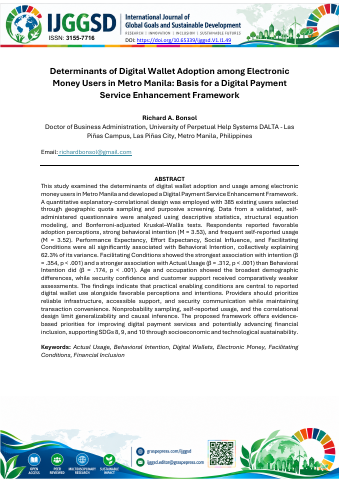
- The study surveyed 385 electronic money users in Metro Manila; four adoption determinants together explained 62.3% of the variance in Behavioral Intention.p.1
- Facilitating Conditions showed the strongest association with intention (β = .354) and a stronger association with Actual Usage (β = .312) than Behavioral Intention did (β = .174).p.1
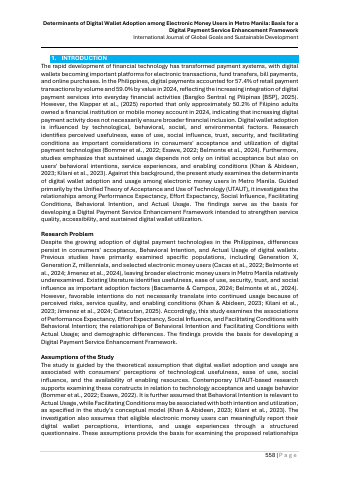
- In the Philippines, digital payments accounted for 57.4% of retail payment transactions by volume and 59.0% by value in 2024.p.2
- Only approximately 50.2% of Filipino adults owned a financial institution or mobile money account in 2024.p.2
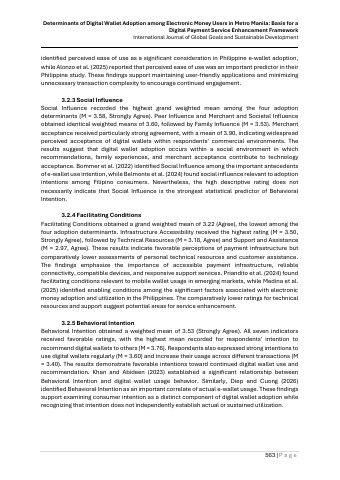
- Social Influence recorded the highest grand weighted mean among the determinants (M = 3.58), while Facilitating Conditions had the lowest (M = 3.22).p.7
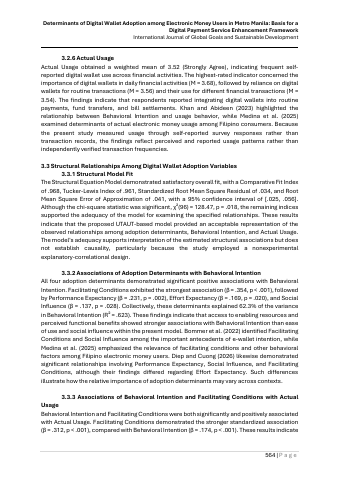
- Actual Usage obtained a weighted mean of 3.52, with daily financial importance the highest-rated indicator (M = 3.68).p.8
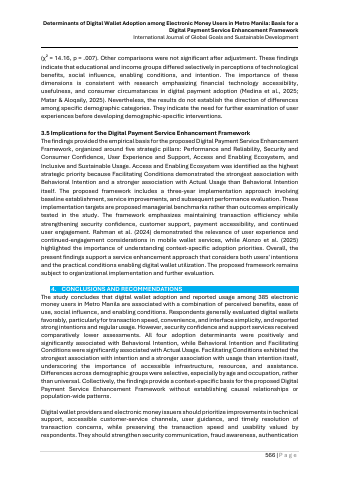
- Access and Enabling Ecosystem was identified as the highest strategic priority among five pillars of the proposed framework.p.10
Key insights
- Performance Expectancy, Effort Expectancy, Social Influence and Facilitating Conditions were all significantly associated with Behavioral Intention.p.1
- Respondents reported strong behavioral intention (M = 3.53) and frequent self-reported usage (M = 3.52).p.1
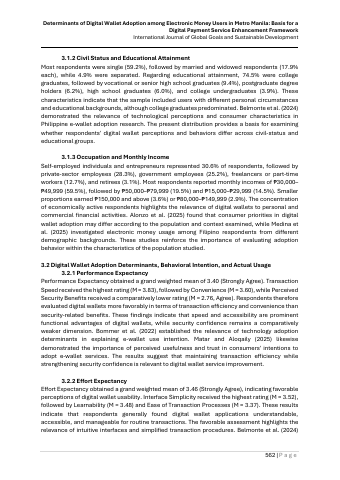
- Most respondents were single (59.2%), and 74.5% were college graduates.p.6
- Most respondents reported monthly incomes of ₱30,000–₱49,999 (59.5%).p.6
- Merchant acceptance received particularly strong agreement, with a mean of 3.90.p.7
- A high descriptive rating for Social Influence does not mean it is the strongest statistical predictor of Behavioral Intention.p.7
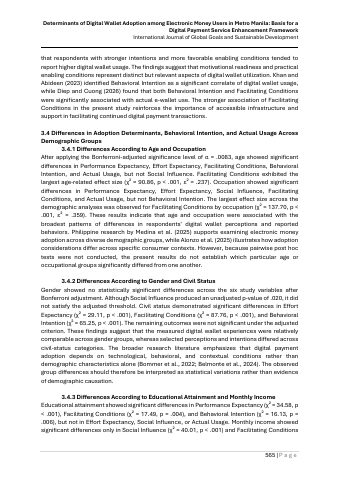
- Facilitating Conditions exhibited the largest age-related effect size (χ² = 90.86).p.9
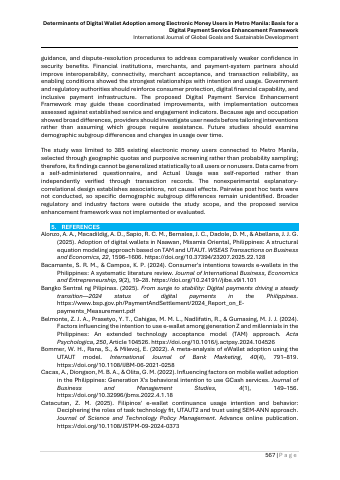
- Providers should improve interoperability, connectivity, merchant acceptance and transaction reliability, since enabling conditions showed the strongest relationships with intention and usage.p.11
- Actual Usage was self-reported rather than verified through transaction records, and the design establishes associations, not causal effects.p.11
Pages
 p.1
 p.2
 p.3
 p.4
 p.5
 p.6
 p.7
 p.8
 p.9
 p.10
 p.11
 p.12
Funders mentioned
Topics and entities
Summary and figures generated from the document and checked automatically: every number shown appears on the cited page. Publishers can request removal.