Crowdfunding, Blockchain, and Smart Contracts in Islamic Finance: Evaluating Compliance with Maqasid al-Shariah (Elicit Journal of Economics and Management Studies)
SaveSummary
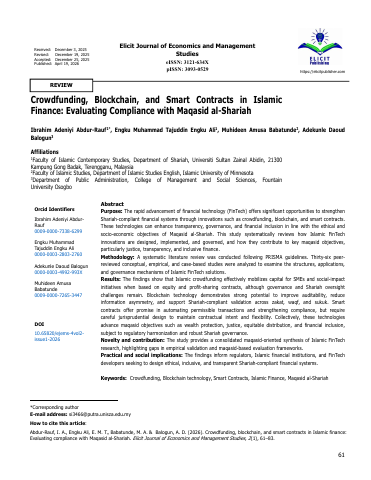
- The review applies PRISMA guidelines to a systematic literature review of Islamic crowdfunding, blockchain and smart contracts.p.1
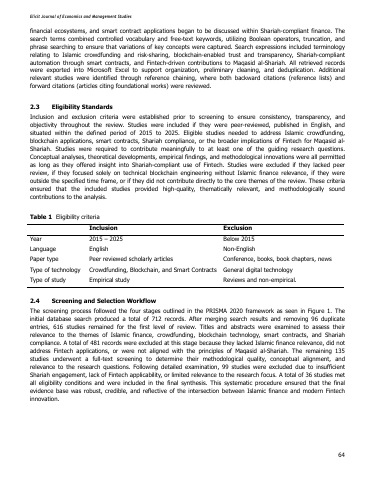
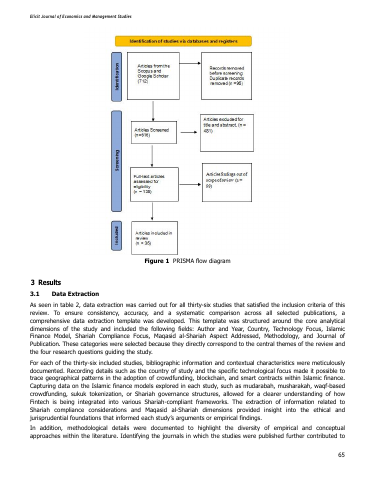
- Eligible studies were peer-reviewed, published in English and situated within the period of 2015 to 2025.p.4
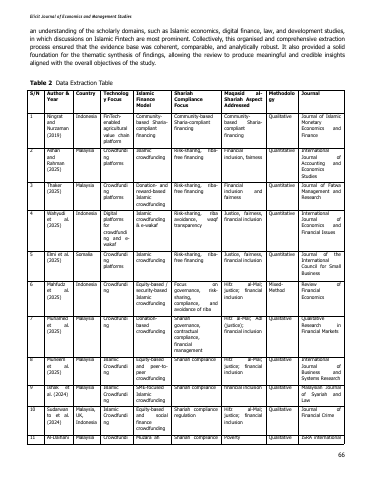
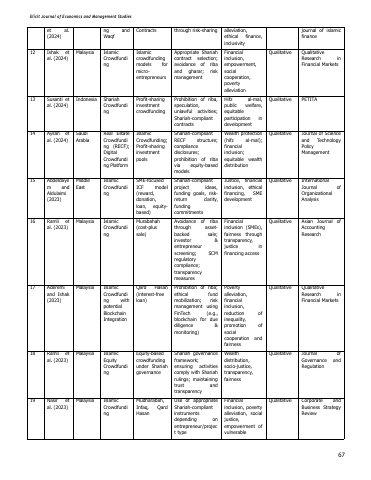
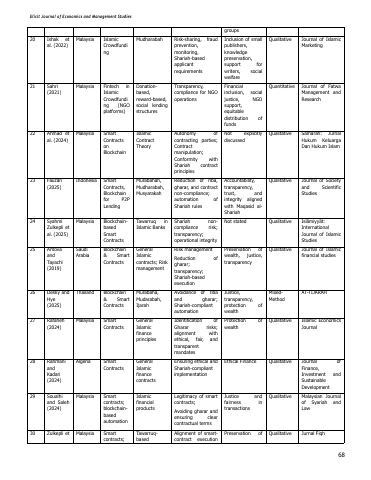
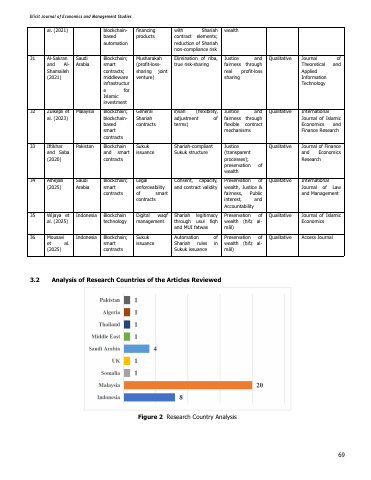
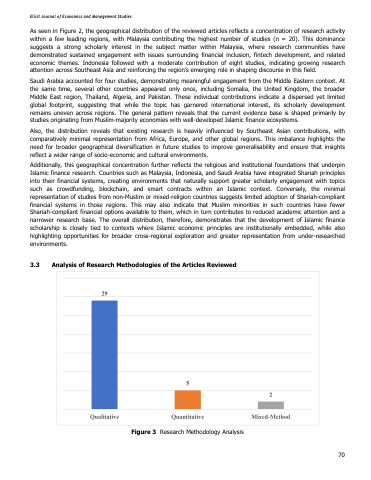
- Malaysia contributed the highest number of studies (n = 20).p.10
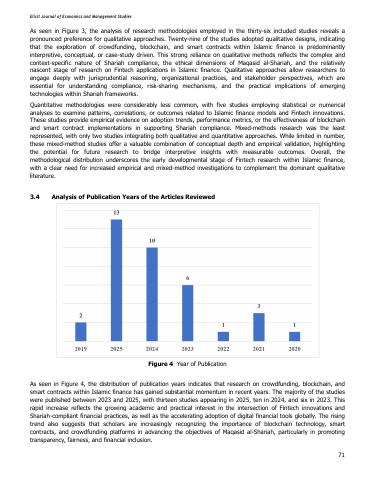
- Twenty-nine of the studies adopted qualitative designs, five used quantitative analyses and only two used mixed methods.p.11
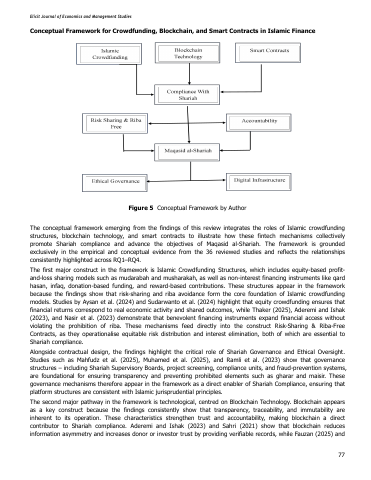
- The conceptual framework is grounded exclusively in the evidence from the 36 reviewed studies.p.17
- Findings across the 36 studies indicate that blockchain, smart contracts and Islamic crowdfunding advance justice, fairness, financial inclusion and protection of wealth.p.19
Key insights
- Islamic crowdfunding platforms maintain Shariah compliance through risk-sharing mechanisms, riba-free contracts and strong governance frameworks.p.14
- Profit-and-loss sharing structures such as mudarabah and musharakah let investors and entrepreneurs jointly bear risks and share outcomes.p.14
- Blockchain-supported smart contracts produce auditable and tamper-resistant records that reduce manipulation.p.15
- Blockchain-based Sukuk issuance improves transparency, reduces operational costs and enhances verifiability for regulators and investors.p.15
- Malaysia contributed the highest number of studies (n = 20), showing a concentration of research in Southeast Asia.p.10
- Twenty-nine of the included studies were qualitative, reflecting the nascent stage of research.p.11
- Smart contracts show substantial capability to automate and enforce Shariah-compliant agreements, but full adoption requires preserving human agency and continuous scholar and regulator oversight.p.16
- Immutability and excessive automation may restrict permissible renegotiation or compassionate contract restructuring.p.18
Pages
 p.1
 p.2
 p.3
 p.4
 p.5
 p.6
 p.7
 p.8
 p.9
 p.10
 p.11
 p.12
 p.13
 p.14
 p.15
 p.16
 p.17
 p.18
 p.19
 p.20
 p.21
 p.22
 p.23
Funders mentioned
Topics and entities
Summary and figures generated from the document and checked automatically: every number shown appears on the cited page. Publishers can request removal.