Credit Risk as a Moderator of the Influence of Capital Adequacy, Credit Disbursement, and Financial Inclusion on Bank Profitability (Jurnal Aplikasi Manajemen dan Bisnis)
SaveSummary
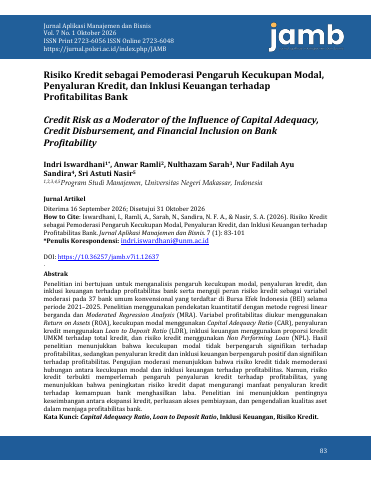
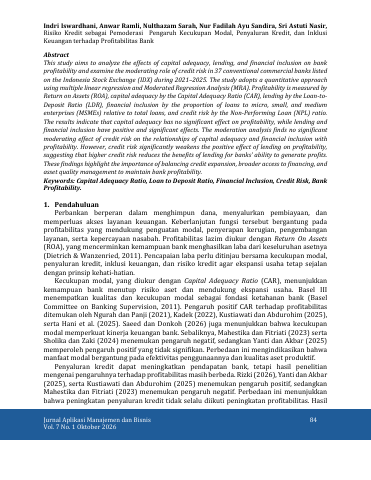
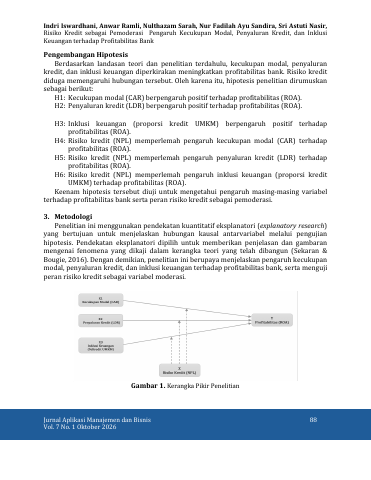
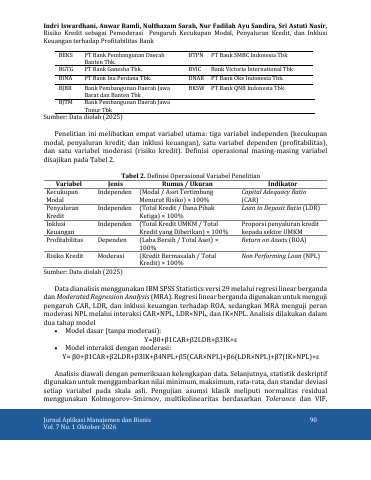
- This study analyzes 37 conventional commercial banks listed on the Indonesia Stock Exchange (BEI) over the period 2021–2025 using multiple linear regression and Moderated Regression Analysis.p.1
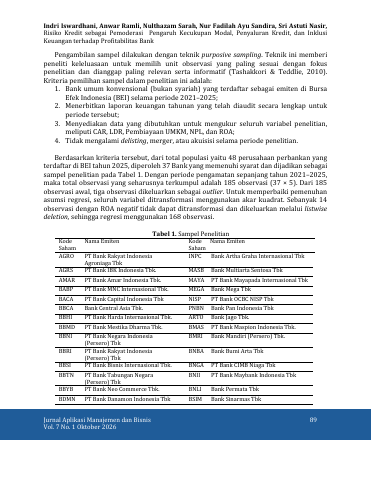
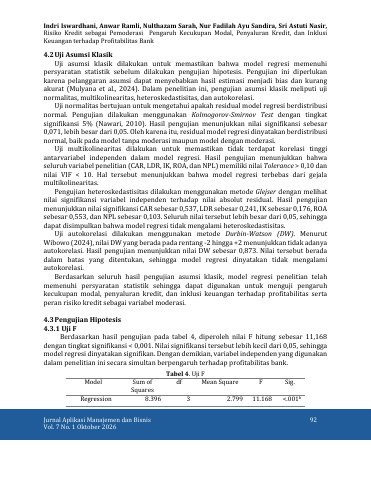
- Out of an initial 185 observations across 37 banks over 5 years, 3 were removed as outliers and 14 negative Return on Assets observations were dropped, leaving 168 final observations.p.7
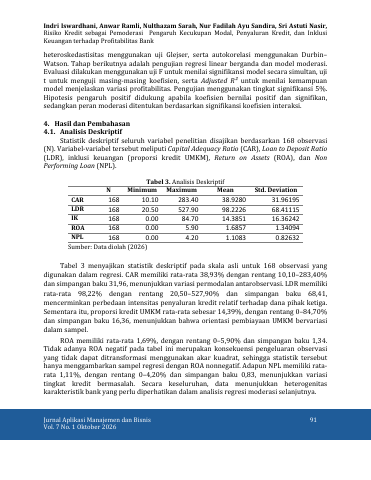
- Capital Adequacy Ratio (CAR) averaged 38.93% across the sample, but showed no statistically significant effect on bank profitability as measured by Return on Assets (ROA).p.9
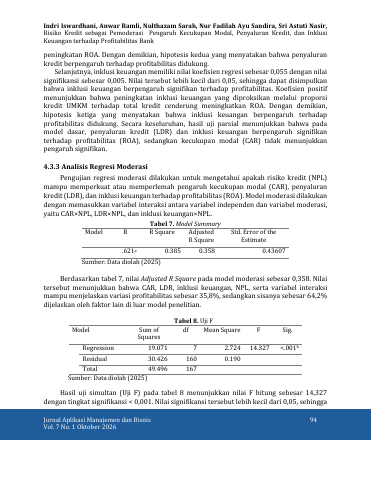
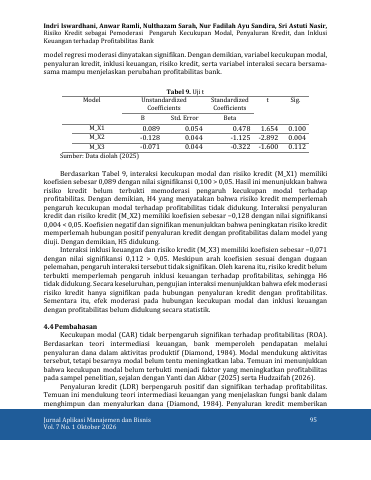
- Credit risk (Non-Performing Loan / NPL) significantly weakened the positive effect of credit disbursement on profitability with an interaction coefficient of -0.128.p.13
Key insights
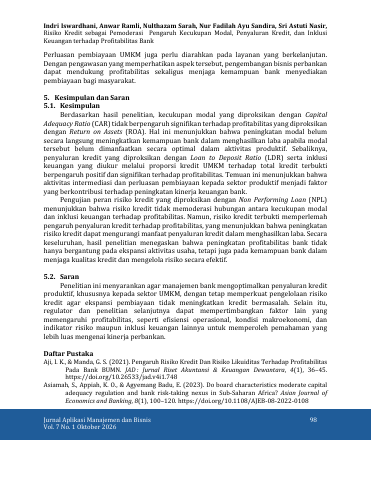
- Capital adequacy (CAR) alone does not guarantee higher bank profitability unless capital is effectively allocated into productive assets.p.16
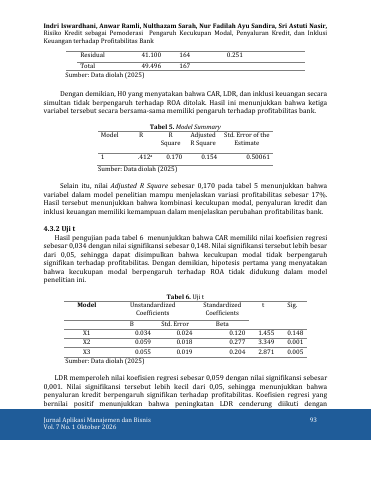
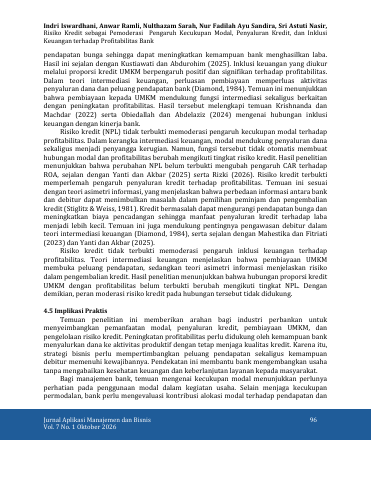
- Credit disbursement (LDR) generates interest income that directly boosts Return on Assets (ROA) for conventional commercial banks.p.14
- Expanding credit access to micro, small, and medium enterprises (MSMEs) acts as a positive driver of bank profitability.p.14
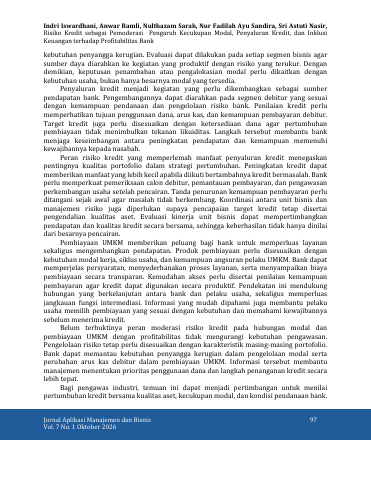
- High credit risk (NPL) actively dilutes the financial profit benefits gained from credit expansion.p.14
- Credit risk does not statistically moderate the relationship between capital adequacy or financial inclusion and bank profitability.p.13
- The moderated regression analysis model including interaction terms explains 35.8% of the total variance in bank Return on Assets.p.12
Pages
 p.1
 p.2
 p.3
 p.4
 p.5
 p.6
 p.7
 p.8
 p.9
 p.10
 p.11
 p.12
 p.13
 p.14
 p.15
 p.16
 p.17
 p.18
 p.19
Topics and entities
Summary and figures generated from the document and checked automatically: every number shown appears on the cited page. Publishers can request removal.