Board Independence and Solvency Risk: The Moderating Role of Non-Executive Directors in Nigerian Listed Firms (Journal of Business Development and Management Research)
SaveSummary
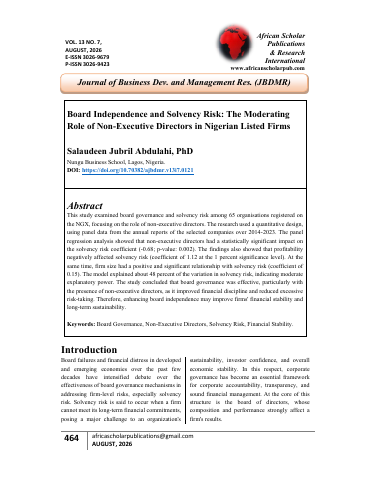
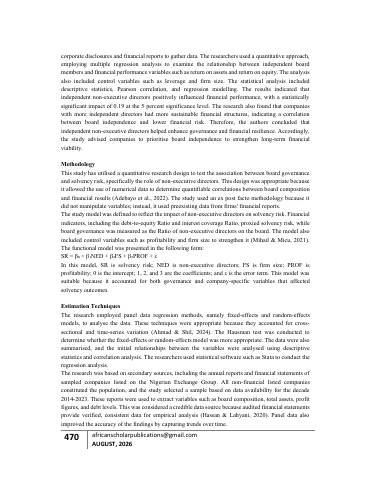
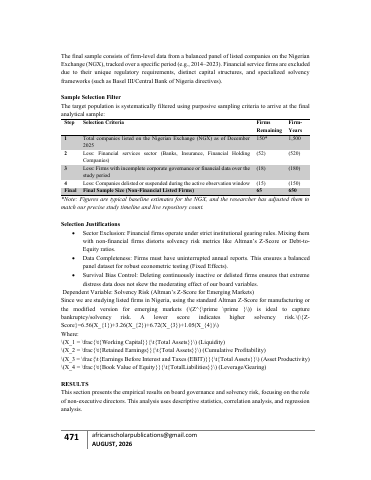
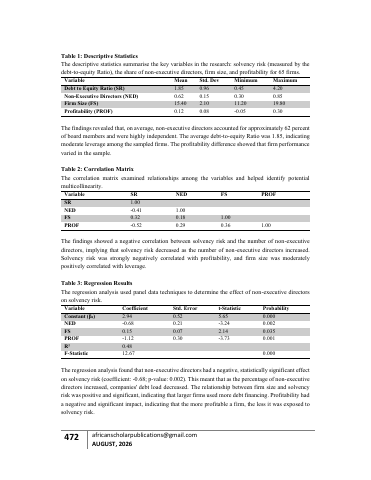
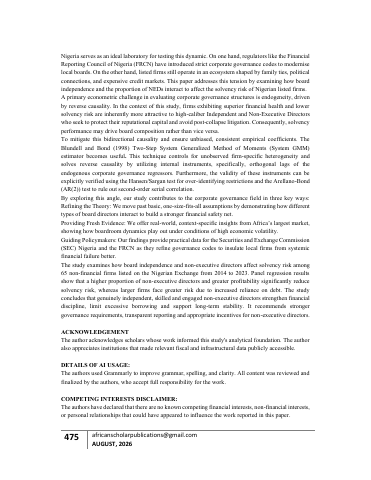
- The study covers 65 organisations registered on the NGX, using panel data from annual reports over 2014-2023.p.1
- Non-executive directors had a statistically significant impact on solvency risk (coefficient -0.68; p-value 0.002).p.1
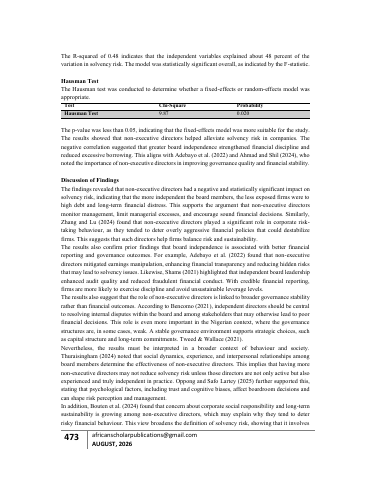
- The model explained about 48 percent of the variation in solvency risk, indicating moderate explanatory power.p.1
- On average, non-executive directors accounted for approximately 62 percent of board members.p.9
- The average debt-to-equity ratio was 1.85, indicating moderate leverage among the sampled firms.p.9
Key insights
- More non-executive directors are associated with lower solvency risk, implying stronger financial discipline and less excessive borrowing.p.10
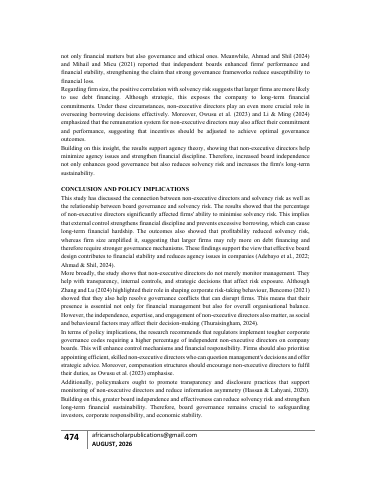
- Larger firms are more likely to use debt financing, which exposes them to long-term financial commitments and makes board oversight of borrowing more important.p.11
- The correlation between solvency risk and non-executive directors is negative, so solvency risk decreased as their number increased.p.9
- The author notes that reverse causality is a challenge and that System GMM could address endogeneity between board composition and solvency.p.12
- The study concludes that enhancing board independence may improve firms' financial stability and long-term sustainability.p.1
Pages
 p.1
 p.2
 p.3
 p.4
 p.5
 p.6
 p.7
 p.8
 p.9
 p.10
 p.11
 p.12
 p.13
Topics and entities
Summary and figures generated from the document and checked automatically: every number shown appears on the cited page. Publishers can request removal.