Assessing the Effects of Tax Compliance on Business Growth: A Case Study Among Selected SMEs in Ndola District, Zambia (Journal of economics, business and commerce.)
SaveSummary
- A mixed-methods study of 50 SMEs in Ndola District, Zambia, assessed how tax compliance affects revenue, sustainability and operational costs.p.1
- Tax compliance was positively associated with revenue, but the relationship was not statistically significant (p = 0.3064).p.1
- Tax compliance had a statistically significant positive effect on business sustainability (p = 0.0002).p.1
- Higher compliance-related operational costs were associated with growth effects (F = 4.35, p = 0.0423).p.1
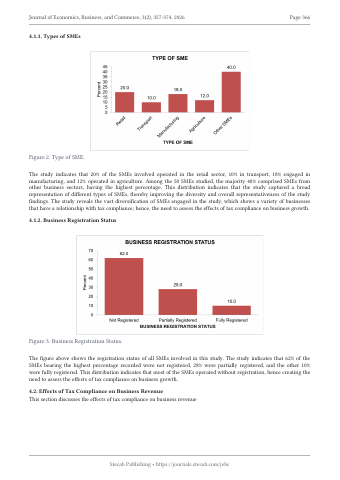
- 62% of the SMEs were not registered, 28% were partially registered and 10% were fully registered.p.11
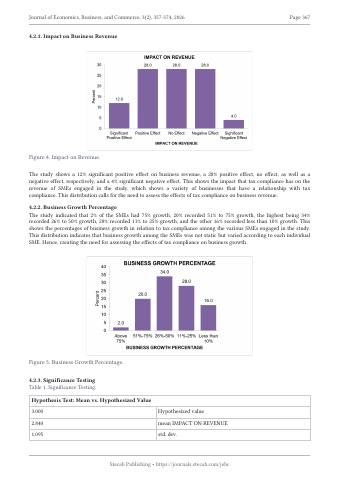
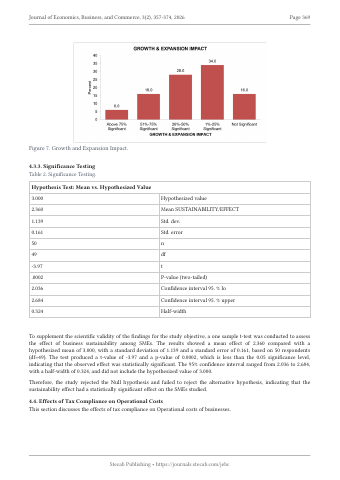
- 34% of SMEs recorded 26% to 50% growth, the largest group.p.12
Key insights
- Developed economies record SME tax compliance rates ranging from 60% to about 90%, with developing economies lower.p.2
- Retail accounted for 20% of the sampled SMEs, manufacturing 18%, agriculture 12% and transport 10%.p.11
- The one-sample t-test on revenue gave a mean of 2.840 against a hypothesized 3.000 and a p-value of 0.3064, so the null hypothesis was not rejected.p.13
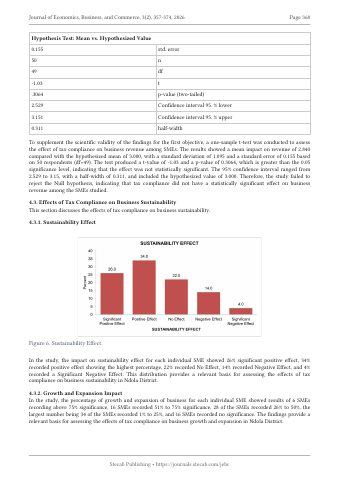
- 26% of SMEs reported a significant positive sustainability effect and 34% a positive effect.p.13
- The sustainability test produced a t-value of -3.97 and a p-value of 0.0002, rejecting the null hypothesis.p.14
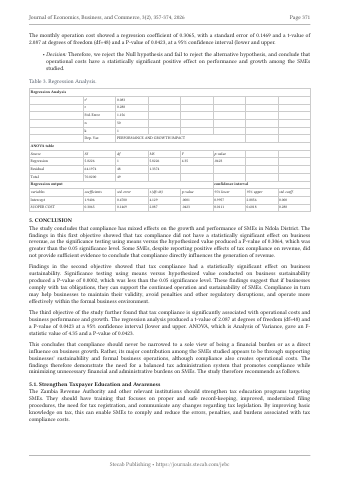
- The regression of performance on monthly operational costs gave a coefficient of 0.3065 and a p-value of 0.0423.p.16
Pages
 p.1
 p.2
 p.3
 p.4
 p.5
 p.6
 p.7
 p.8
 p.9
 p.10
 p.11
 p.12
 p.13
 p.14
 p.15
 p.16
 p.17
 p.18
 p.19
Funders mentioned
Topics and entities
Summary and figures generated from the document and checked automatically: every number shown appears on the cited page. Publishers can request removal.