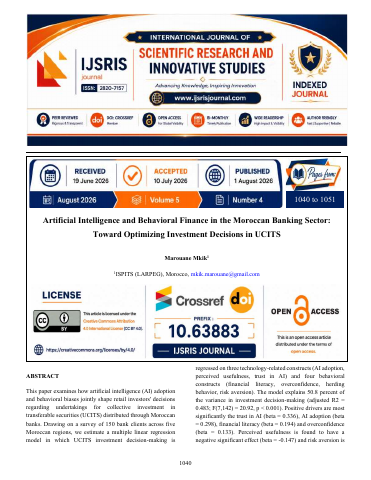
Artificial Intelligence and Behavioral Finance in the Moroccan Banking Sector: Toward Optimizing Investment Decisions in UCITS (International Journal of Scientific Research and Innovative Studies)
Summary
- Net assets of collective investment in transferable securities (OPCVM) in Morocco reached MAD 826.73 billion across 627 funds as of late July 2026.p.2
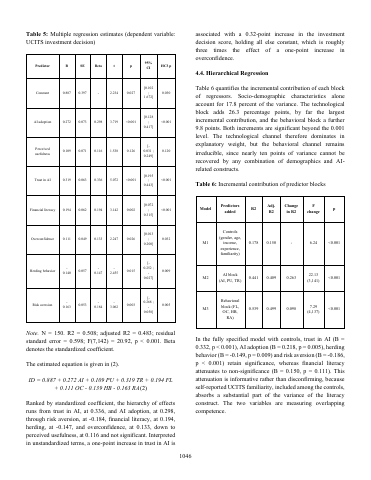
- The multiple linear regression model explains 50.8 percent of the variance in UCITS investment decision-making among retail bank clients.p.1
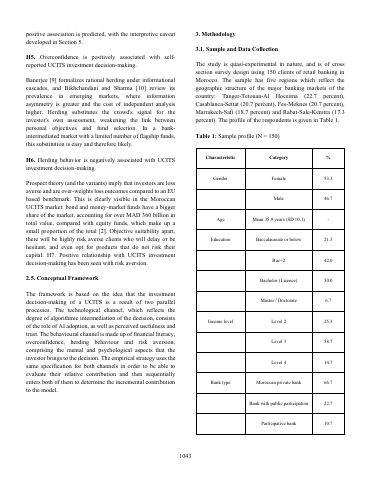
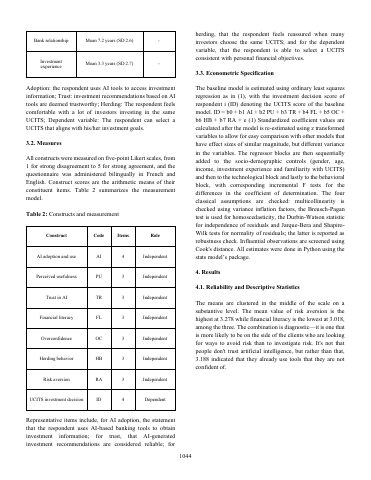
- The empirical study examined a sample of 150 retail banking clients across five geographic regions in Morocco.p.4
- The technological regressor block accounts for an additional 26.3 percentage points of variance beyond socio-demographics.p.2
- The behavioral regressor block accounts for an additional 9.8 percentage points of variance beyond socio-demographic and technological factors.p.2
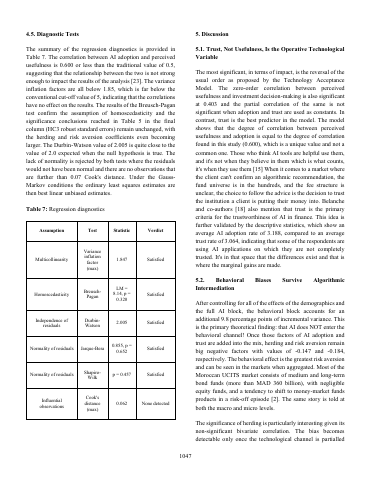
- Moroccan bond and money-market funds make up a major portion of the market, accounting for over MAD 360 billion in total value.p.4
Key insights
- Trust in AI is the strongest positive driver of UCITS investment decision-making with a standardized beta coefficient of 0.336.p.1
- AI adoption exhibits a significant positive effect on investment decision-making with a beta coefficient of 0.298.p.1
- Perceived usefulness has a negative significant effect on investment decision-making in the model with a beta coefficient of -0.147.p.1
- Socio-demographic variables alone account for 17.8 percent of the variance in client investment decisions.p.7
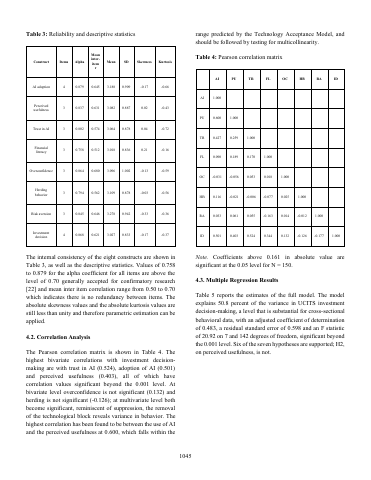
- Financial literacy positively influences investment decision-making in the baseline regression model with a beta coefficient of 0.194.p.1
- Mean investment decision scores were highest among clients of banks with public participation at 3.287.p.9
Pages
 p.1
 p.2
 p.3
 p.4
 p.5
 p.6
 p.7
 p.8
 p.9
 p.10
 p.11
 p.12
Topics and entities
Summary and figures generated from the document and checked automatically: every number shown appears on the cited page. Publishers can request removal.