A Structural Governance Framework for Integrating ERM and COSO Controls: Evaluating Compliance Risk and Financial Resilience in Saudi Insurance Companies (Acta Innovations)
Summary
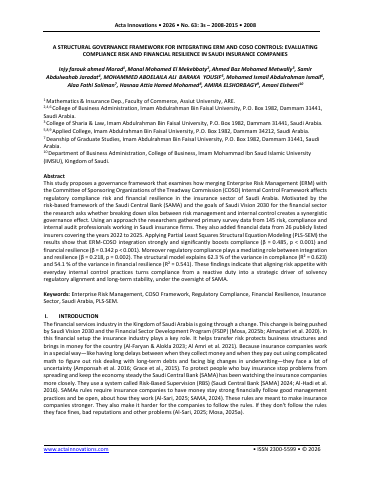
- The study collects primary survey data from 145 risk, compliance, and internal audit professionals across Saudi insurance companies.p.1
- Secondary financial metrics were compiled from 26 publicly listed Saudi insurers across the 2022 to 2025 financial years.p.1
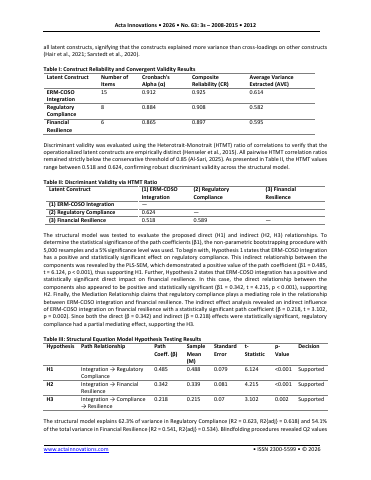
- PLS-SEM analysis reveals that ERM-COSO integration strongly enhances regulatory compliance (β = 0.485, p < 0.001).p.1
- Integrating ERM with COSO controls exerts a direct positive effect on institutional financial resilience (β = 0.342, p < 0.001).p.1
- Regulatory compliance acts as a partial mediator between ERM-COSO integration and financial resilience (β = 0.218, p = 0.002).p.1
- The structural governance model accounts for 62.3 % of the variance in regulatory compliance (R² = 0.623).p.1
- The framework explains 54.1 % of the total variance in financial resilience among Saudi insurance companies (R² = 0.541).p.1
Key insights
- Aligning strategic risk appetite with daily internal controls transforms compliance from a reactive obligation into a strategic driver of financial stability.p.1
- Operating enterprise risk management and internal control systems in isolated silos creates corporate friction, duplicated costs, and control vulnerabilities.p.2
- Hypothesis testing confirmed that ERM-COSO integration has a statistically significant positive effect on regulatory compliance with a t-statistic of 6.124.p.5
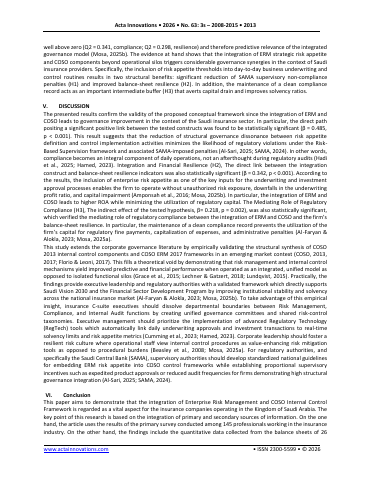
- Blindfolding procedures confirmed the model's predictive relevance with Q² values of 0.341 for compliance and 0.298 for resilience.p.6
- Maintaining a clean compliance record serves as a vital buffer that prevents capital drain from regulatory fines and penalties.p.6
Pages
 p.1
 p.2
 p.3
 p.4
 p.5
 p.6
 p.7
 p.8
Topics and entities
Summary and figures generated from the document and checked automatically: every number shown appears on the cited page. Publishers can request removal.