A Quiet Gap: Why Private Equity in Primary Care Remains Under-Researched in the Global South, and Why That Matters (Frontiers in Public Health)
SaveSummary
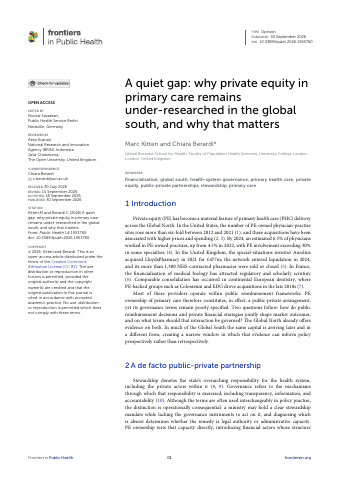
- In the United States, private equity acquisitions of physician-practise sites rose more than six-fold between 2012 and 2021.p.1
- By 2024, an estimated 6.5% of US physicians worked in private equity-owned practices, up from 4.5% in 2022, exceeding 30% in certain specialties.p.1
- Aurelius acquired LloydsPharmacy in 2021 for £477 million, leading to liquidation in 2024 and the sale or closure of more than 1,300 NHS-contracted pharmacies.p.1
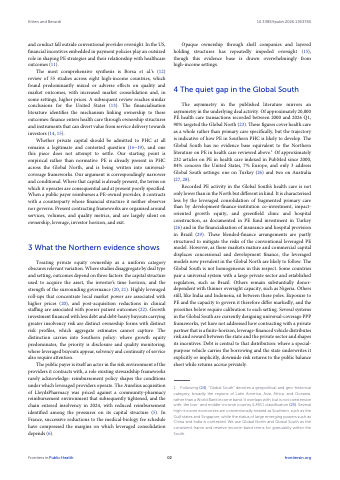
- A review of 55 studies across 8 high-income countries found predominantly mixed or adverse effects of private equity on healthcare quality and costs.p.2
- Out of approximately 20,000 healthcare private equity deals between 2000 and 2026 Q1, 90% targeted the Global North.p.2
Key insights
- Private equity ownership of primary care facilities functions as a de facto public-private partnership operating largely within public reimbursement systems.p.1
- In the US, private equity acquisitions of physician practice sites expanded over six-fold between 2012 and 2021.p.1
- In the UK, investor Aurelius acquired LloydsPharmacy for £477 million in 2021 before entering liquidation in 2024.p.1
- A review covering 55 studies in 8 high-income countries associated private equity ownership with market consolidation and higher healthcare prices.p.2
- Between 2000 and 2026 Q1, 90% of roughly 20,000 healthcare private equity transactions were concentrated in the Global North.p.2
- Healthcare private equity in the Global South relies more on growth equity, development finance, and greenfield clinic construction than on leveraged roll-ups.p.2
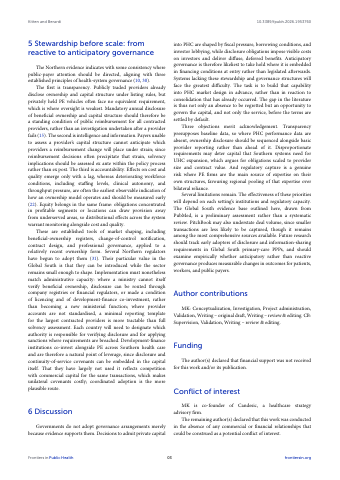
- Policy interventions should mandate ex-ante capital structure transparency and change-of-control disclosures as conditions for public reimbursement.p.3
Pages
 p.1
 p.2
 p.3
 p.4
Funders mentioned
Topics and entities
Summary and figures generated from the document and checked automatically: every number shown appears on the cited page. Publishers can request removal.