Report on the transaction dataset for SWESTR
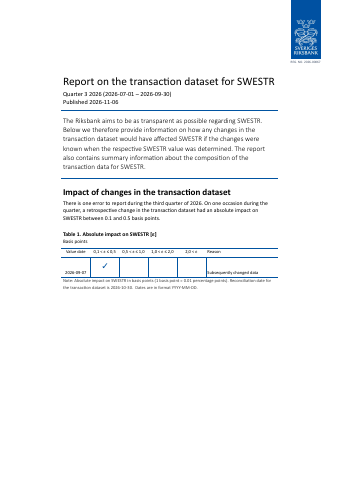
On 2026-09-07, a retrospective change in the transaction dataset had an absolute impact on SWESTR between 0.1 and 0.5 basis points.
Central bank · 15 documents
On 2026-09-07, a retrospective change in the transaction dataset had an absolute impact on SWESTR between 0.1 and 0.5 basis points.
The authors construct an index tracking the European Central Bank's perception of non-bank financial intermediaries using 2,830 speeches delivered between July 1998 and June 2024.
Sveriges Riksbank started publishing values for SWESTR on 2 September 2021 based on transaction data from 9 banks.
In the Riksbank's survey, 91 per cent of respondents used Swish in the past month, making mobile payments increasingly widespread.
Over 90 percent of surveyed central banks are engaged in some form of CBDC work, with more than half involved in experiments or pilot projects.
In a 2023 BIS survey, almost all surveyed central banks reported considering offline CBDC payments to be vital or advantageous.
In a survey of 1,553 small retail and service businesses conducted in autumn 2024, card payments were the most accepted payment method.
In 2023, there were over 8,000 funds globally invested in private equity, managing assets totalling more than USD 7.4 trillion.
Over 100 central banks around the globe are exploring central bank digital currencies to modernize payment systems.
The framework analyzes cross-border retail CBDC payments across 5 core elements: access, communication, currency conversion, compliance, and settlement.
In 2023, 63 per cent of survey respondents paid by debit card for their last in-store purchase, while 9 per cent paid using a card in their mobile phone.
In the 2022 survey, 34 per cent of respondents stated they paid with cash in the past month, down from 50 per cent in spring 2020.
In late 2021, the Central Bank of The Bahamas recorded around 20,000 active Sand Dollar wallets within a population of about 400,000.
Six out of ten respondents used the mobile payment service Swish during the past month in 2018, compared to around 10 per cent in 2014.
The long-term annual tax revenue expected from the proposal is overestimated by approximately SEK 160 million because it relies on a period of unusually high equity returns.