Reform Proposals for Capital Supply to Swedish Companies and Startups
According to Copenhagen Economics analysis, Swedish GDP is currently 0.8% higher than it would otherwise be due to venture capital.
179 documents
According to Copenhagen Economics analysis, Swedish GDP is currently 0.8% higher than it would otherwise be due to venture capital.
The Swedish venture capital market represents 35% of total Nordic exit value and over SEK 35 billion in assets under management.
Greater China accounts for 61% of Asia-Pacific-focused PEVC assets under management, tracked across over 4,600 fund managers and 740 investors.
The estimated $757 billion fresh commitment flows to private capital worldwide in 2018 stands 18% below 2017's record fund raising of $925 billion.
From 2007 to 2015, investors poured around €35 billion into early and later-stage start-ups located in the 28 EU countries.
Private equity investments in India reached $26.3 billion across approximately 793 deals in 2018, making it the second-highest investment year of the last decade.
Venture capital (VC) funds invest in only around 0.2% of new U.S. businesses, yet 43% of U.S. public listed companies founded between 1979 and 2013 were VC-backed.
The long-term annual tax revenue expected from the proposal is overestimated by approximately SEK 160 million because it relies on a period of unusually high equity returns.
Skatteverket estimated that the proposed exit tax would increase annual Swedish tax revenues by around 1 billion kronor starting 1 January 2020.
Stockholm attracted 18% of all European Fintech investments in 2014 and 16% over an 11-year period.
Total disclosed healthcare private equity deal value reached $42.6 billion in 2017 across 265 deals.
Global buyout deal value, including add-ons, grew 19% to $440 billion in 2017, while deal count grew 2% to 3,077 deals.
India's real GDP growth remained stable at 7.1% in FY 2017, primarily driven by growth in services and manufacturing.
Asia-Pacific private equity deal value reached an all-time high of $159 billion in 2017, a 41% increase over 2016.
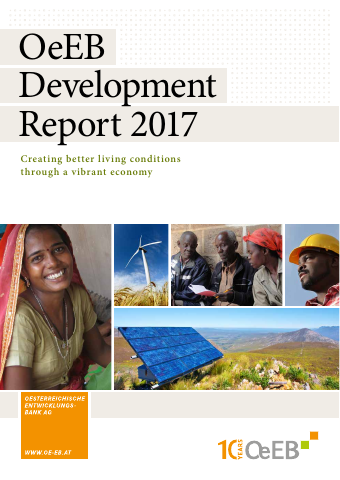
OeEB reached a committed total portfolio of €1.08 billion at the end of 2017, with 90.5% invested in lending projects and 9.5% in equity projects.
The Business Support Services Group brings together SME support agencies operating across 4 countries on 2 continents.
Between 2007 and 2015, VC firms in the EU raised EUR 40 billion, with government agencies contributing more than a fifth of the total funds committed.
OeEB directly (co-)financed projects provided 29,134 jobs, while reaching 38,720 microborrowers and 21,849 SMEs.
In 2014, total invested equity in Swedish companies reached 8 100 billion SEK, with foreign owners accounting for 50 percent of the total.
The study analyzes net performance data for 1,455 European private equity funds from vintage years 1980 to 2013 representing €400bn of total commitments as of 31.12.2013.
Around 70,000 companies are founded each year in Sweden, but only a fraction are suitable for private equity and business angel investments.
The study analyzed 1,416 European private equity funds formed between 1980 and 2012 representing €393 billion in capital under management.
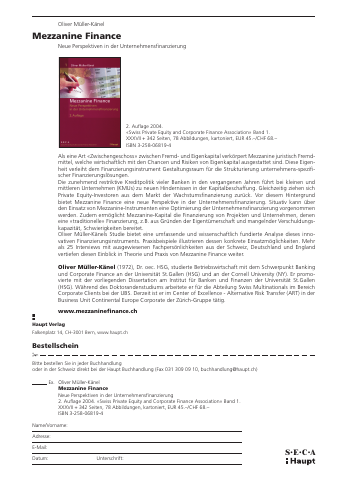
The publication is the 2nd edition released in 2004 as Volume 1 of the Swiss Private Equity and Corporate Finance Association series.
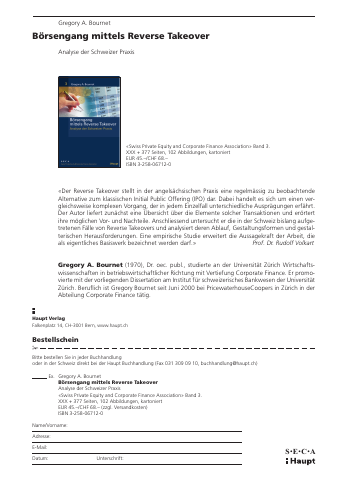
The publication provides an overview and analysis of Reverse Takeover (RTO) transactions as an alternative to classic Initial Public Offerings (IPO) in Switzerland.
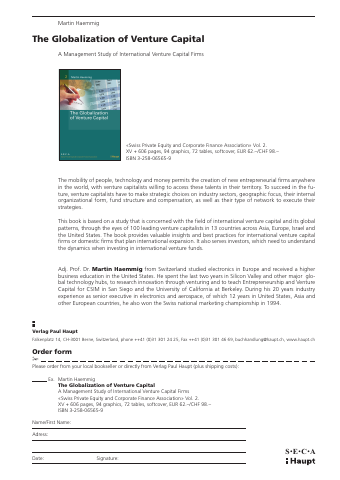
The study volume contains XV + 606 pages detailing global patterns of international venture capital firms.
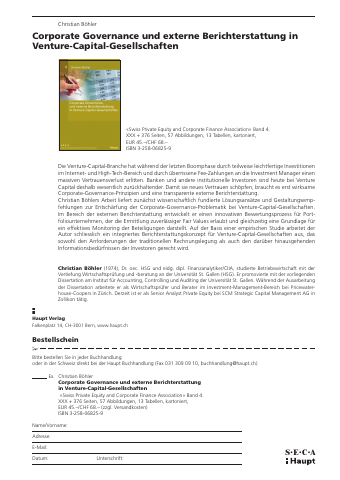
The book is published as Volume 4 of the Swiss Private Equity and Corporate Finance Association series, containing XXX + 376 pages, 57 figures, and 13 tables.
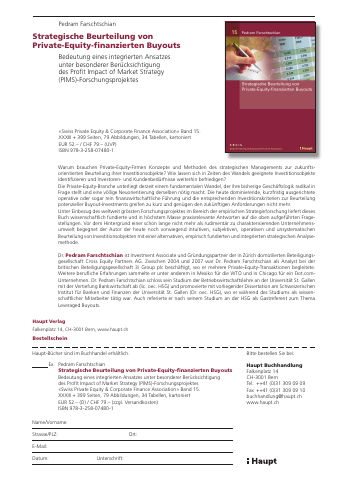
The publication contains XXXIII + 399 pages, 79 illustrations, and 34 tables.
The publication is published as Band 12 of the Swiss Private Equity & Corporate Finance Association book series.
The publication is released as Volume 6 of the Swiss Private Equity & Corporate Finance Association series.