Next Steps for Commercial Variable Recurring Payments
The document outlines next steps for commercial variable recurring payments across a total of 31 pages.
248 documents
The document outlines next steps for commercial variable recurring payments across a total of 31 pages.
The G20 Roadmap for Enhancing Cross-Border Payments (2020 - 2027) focuses on 5 main priority focus areas divided into 19 building blocks.
In 2023, 4.2 percent of U.S. households—representing about 5.6 million households—were unbanked.
In 2023, 4.2 percent of U.S. households, representing about 5.6 million households, were unbanked.
In Nigeria, 98.5 percent of eNaira wallets remained unused one year after launch.
Total global fintech investment across VC, PE, and M&A fell from $62.3 billion across 2,287 deals in H2’23 to $51.8 billion across 2,254 deals in H1’24.
Over 100 central banks around the globe are exploring central bank digital currencies to modernize payment systems.
The framework analyzes cross-border retail CBDC payments across 5 core elements: access, communication, currency conversion, compliance, and settlement.
In 2023, 63 per cent of survey respondents paid by debit card for their last in-store purchase, while 9 per cent paid using a card in their mobile phone.
Thirty of the 33 central banks in sub-Saharan Africa responded to the regional survey on digital currencies and payments.
Central banks are exploring retail and wholesale CBDCs to complement traditional cross-border payment rails and lower transfer costs.
According to a 2022 BIS survey, 93 percent of central banks are actively exploring CBDCs and 58 percent report being likely to or possibly issuing a retail CBDC in the short or medium term.
Central banks must develop a long-term vision for monetary and payment systems spanning a time horizon of at least 5 to 10 years as economic digitalization accelerates.
Financial inclusion is a top priority, with about 60 percent of emerging and low-income countries considering it one of their top three motivations for issuing a retail CBDC.
The IMF mandate is governed by the central banks and finance ministries of 190 member countries.
Tether and USD Coin attempt to maintain a stable value by being purportedly backed one-for-one in value to underlying assets.
In 2021, there were more than 300 million users of digital payments and more than 30 million users of digital banks across Latin America.
Total global fintech investment dropped to $113.7 billion across 4,547 deals in 2023.
In the 2022 survey, 34 per cent of respondents stated they paid with cash in the past month, down from 50 per cent in spring 2020.
By August 2021, total crypto asset volume had grown by 230 percent year over year in Asian emerging market economies.
The global payment system is estimated to consume 47.3 TWh of energy annually, accounting for roughly 0.2 percent of total global electricity consumption.
In late 2021, the Central Bank of The Bahamas recorded around 20,000 active Sand Dollar wallets within a population of about 400,000.
Bitcoin block rewards fell from 12.5 Bitcoins to 6.25 Bitcoins in May 2020.
BigTech firms invested over $2 billion in fintech companies in 2020, with Alphabet generating 23 fintech investments alone.
Financial executive sentiment towards open banking increased from 55% in 2019 to 71% in 2021, with 83% agreeing it is a revolution for the industry.
European ecommerce sales are projected by JP Morgan to reach €940 billion by 2023.
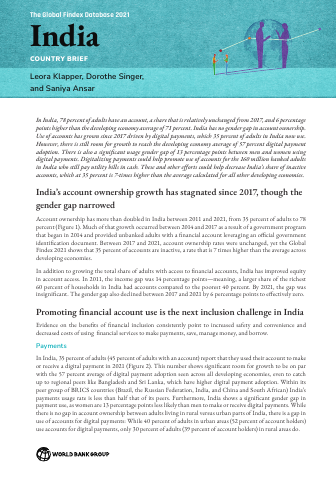
Account ownership in India grew from 35 percent of adults in 2011 to 78 percent in 2021.
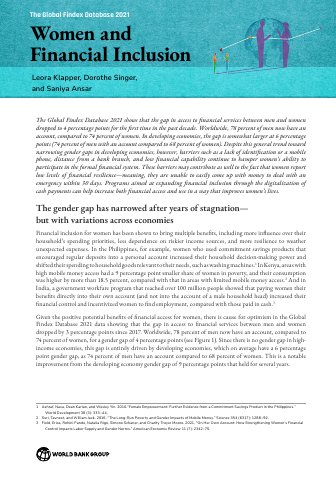
Worldwide, 78 percent of men have an account, compared to 74 percent of women.
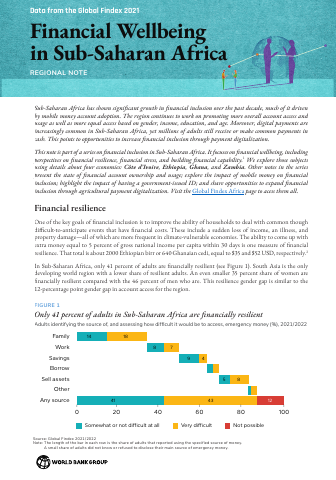
Only 41 percent of adults in Sub-Saharan Africa are financially resilient, defined as being able to access 5 percent of GNI per capita within 30 days.
Microsoft represents c. 55% of total market value among software and cloud companies above $100bn in market cap.