Usage of Blockchain Technology and Working Capital Efficiency: Evidence from Listed Firms in India (International Journal of Business and Management (IJBM))
SaveSummary
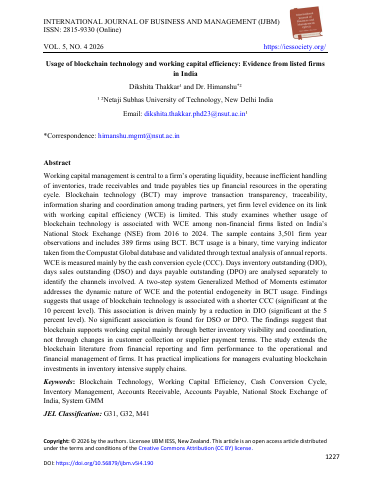
- The study examines whether blockchain usage is associated with working capital efficiency among non-financial firms listed on India's National Stock Exchange from 2016 to 2024.p.1
- The sample contains 3,501 firm-year observations and includes 389 firms using blockchain technology.p.1
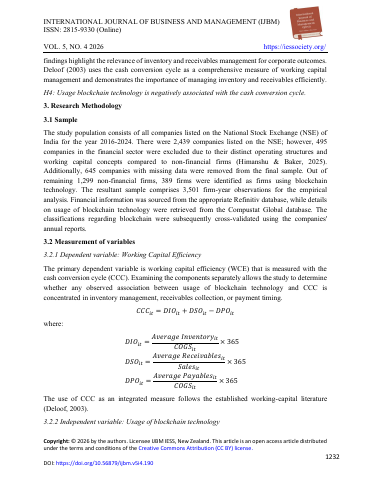
- Of 2,439 listed companies, 495 financial firms and 645 firms with missing data were removed, leaving 1,299 non-financial firms.p.6
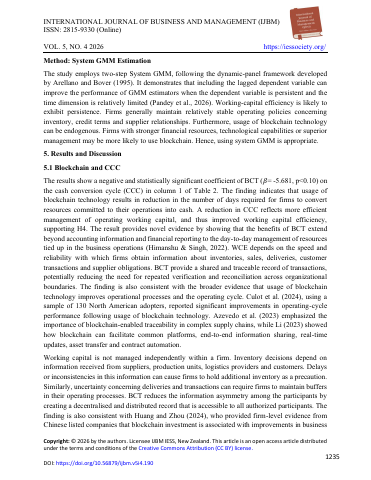
- Blockchain usage is associated with a shorter cash conversion cycle, significant at the 10 percent level.p.1
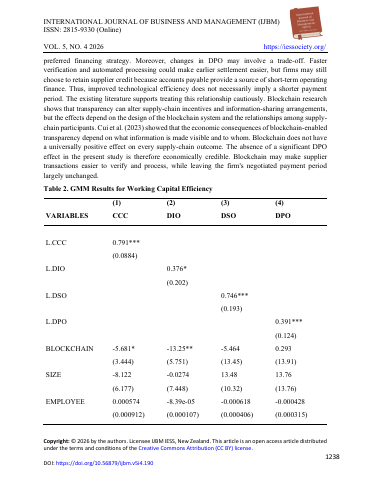
- The coefficient of blockchain usage on the cash conversion cycle is -5.681 (p<0.10).p.9
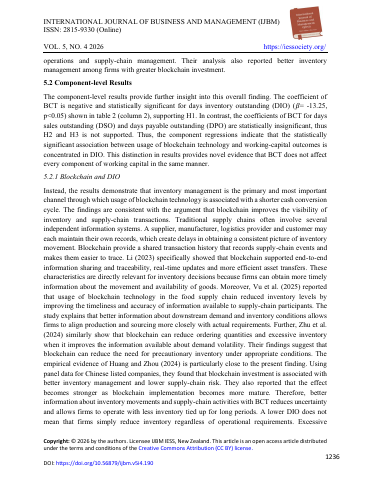
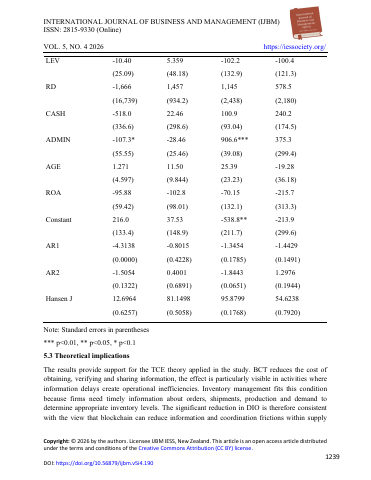
- The association is concentrated in days inventory outstanding, with a coefficient of -13.25 (p<0.05), while DSO and DPO effects are insignificant.p.10
Key insights
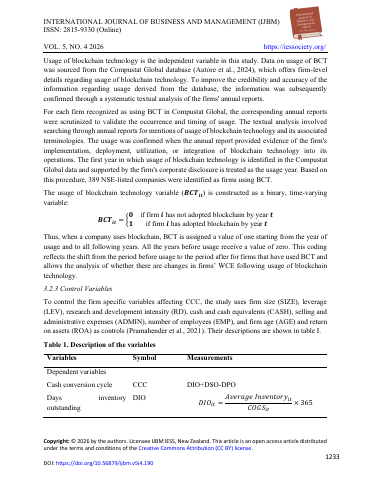
- Blockchain usage is coded as a binary, time-varying indicator from Compustat Global, validated through textual analysis of annual reports.p.7
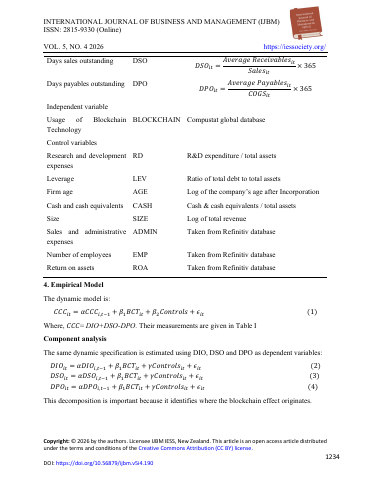
- A two-step System GMM estimator addresses the persistence of working capital efficiency and the potential endogeneity of blockchain usage.p.9
- Blockchain usage is negatively associated with the cash conversion cycle, supporting the hypothesis of improved working capital efficiency.p.9
- Inventory management is the main channel through which blockchain usage is associated with a shorter cash conversion cycle.p.10
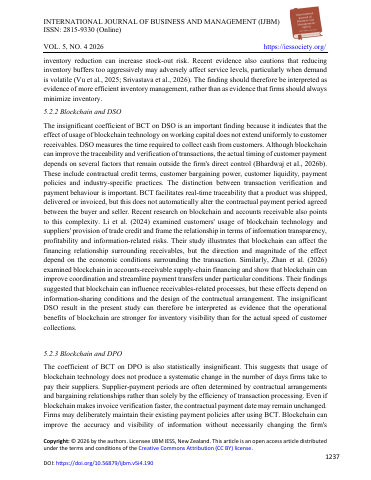
- The insignificant effect on DSO suggests that customer payment timing depends on factors outside the firm's control, such as credit terms and customer bargaining power.p.11
- The absence of a significant DPO effect is credible because blockchain may ease supplier verification while leaving negotiated payment periods unchanged.p.12
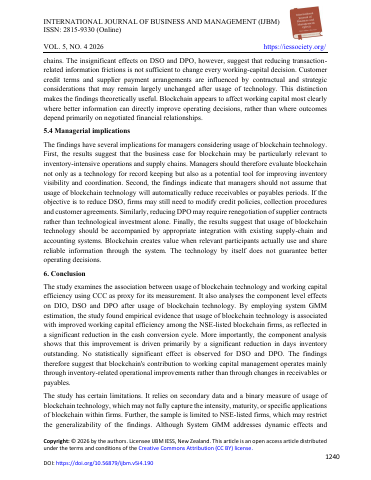
- Managers should not assume blockchain will automatically reduce receivables or payables periods; credit policies and contracts may still need to change.p.14
Pages
 p.1
 p.2
 p.3
 p.4
 p.5
 p.6
 p.7
 p.8
 p.9
 p.10
 p.11
 p.12
 p.13
 p.14
 p.15
 p.16
 p.17
Funders mentioned
Topics and entities
Summary and figures generated from the document and checked automatically: every number shown appears on the cited page. Publishers can request removal.