Understanding Financial Inclusion in Africa: A Multidimensional Banking–Insurance Index and its Key Influencing Factors (International Journal of Economics and Financial Issues)
SaveSummary
- The study builds a financial inclusion index (FII) from banking and insurance data for 14 African countries over 2000-2021.p.1
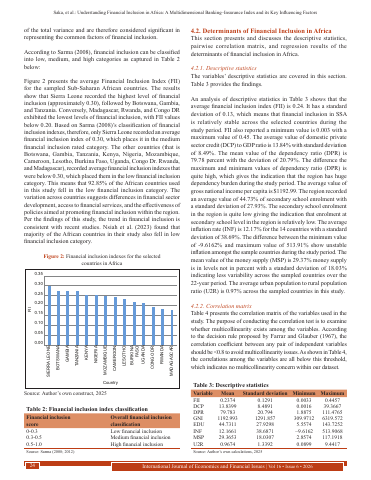
- Sierra Leone recorded an average FII of 0.30, while all other countries had averages below 0.30.p.1
- The average FII across the sample is 0.24, with a standard deviation of 0.13.p.10
- FII ranges from a minimum of 0.003 to a maximum of 0.45.p.10
- Madagascar, Rwanda and Congo DR show the lowest inclusion, with FII values below 0.20.p.10
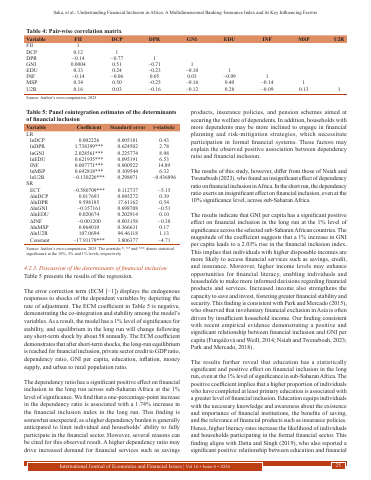
- GNI per capita has a significant positive long-run coefficient of 2.028561.p.11
- Inflation is positively related to financial inclusion, with a one-percentage-point rise linked to approximately a 0.8% rise in inclusion.p.12
Key insights
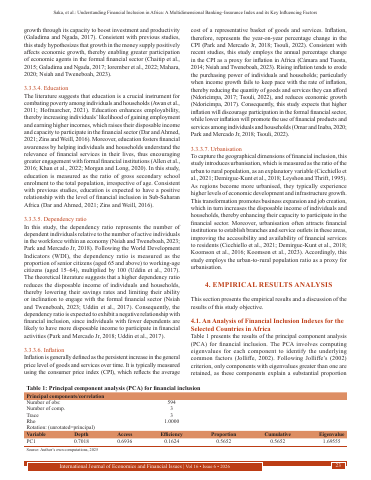
- The index was constructed with Principal Component Analysis using data from 2000 to 2021.p.12
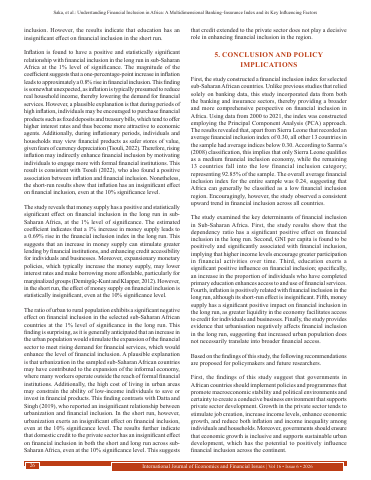
- Inflation has a positive and statistically significant long-run relationship with financial inclusion at the 1% level.p.12
- The dependency ratio has an insignificant short-run effect on financial inclusion even at the 10% level.p.11
- Education has an insignificant effect on financial inclusion in the short run.p.12
- Credit extended to the private sector does not play a decisive role in enhancing financial inclusion in the region.p.12
- A study of 1,000 adults in Ghana found that lack of proper documentation was a significant barrier to inclusion.p.6
Pages
 p.1
 p.2
 p.3
 p.4
 p.5
 p.6
 p.7
 p.8
 p.9
 p.10
 p.11
 p.12
 p.13
 p.14
 p.15
 p.16
 p.17
Funders mentioned
Topics and entities
Summary and figures generated from the document and checked automatically: every number shown appears on the cited page. Publishers can request removal.