The Predictability of the OHADA Legal Framework and the Protection of Foreign Investments: An As Yet Unfinished Guarantee (European Scientific Journal ESJ)
SaveSummary
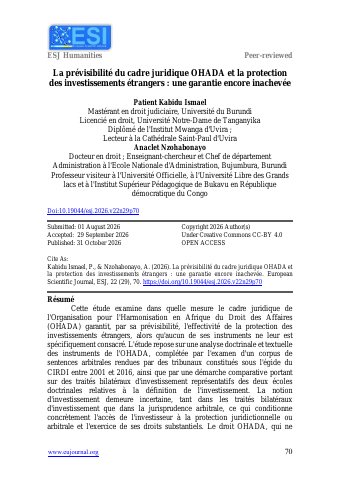
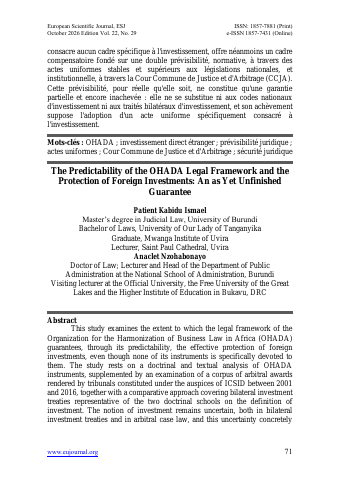
- None of the OHADA instruments is specifically devoted to foreign investment, so the study asks how its predictability protects investors.p.1
- The analysis is complemented by a corpus of ICSID arbitral awards rendered between 2001 and 2016 and by a comparison of bilateral investment treaties.p.1
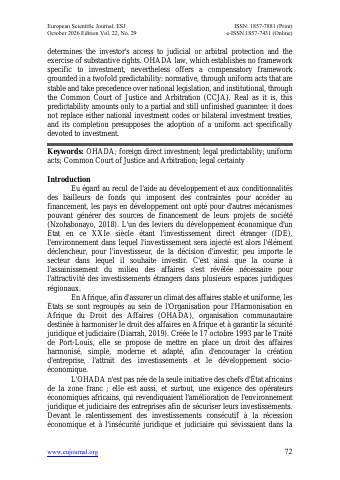
- OHADA offers a compensatory framework based on normative predictability (stable uniform acts) and institutional predictability (the CCJA), which is only a partial guarantee.p.3
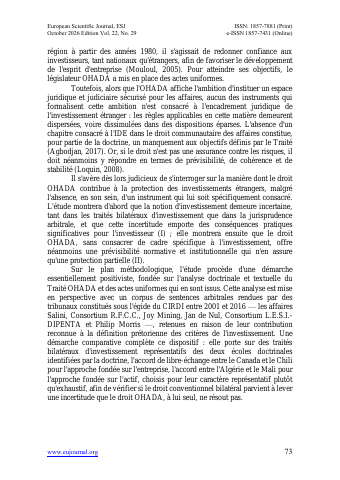
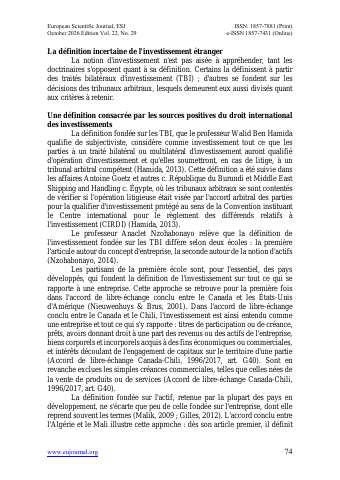
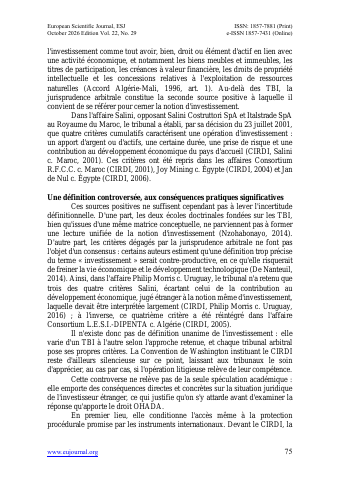
- In the Salini decision of 23 July 2001, the ICSID tribunal set cumulative criteria for an investment: contribution, duration, risk and contribution to development.p.6
- Unlike the ECOWAS investment code, no uniform act is specifically devoted to protecting foreign investment.p.9
- CCJA judgments are enforceable in each member state without exequatur, and mediation was added to its offer in 2017.p.10
- The CCJA suffers from a growing docket backlog and has a single seat in Abidjan.p.11
Key insights
- The notion of investment remains uncertain in both bilateral investment treaties and arbitral case law.p.5
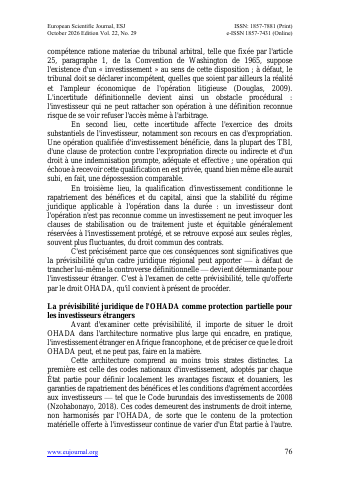
- Definitional uncertainty is a procedural obstacle because an operation not qualified as an investment may be denied access to ICSID arbitration.p.7
- An operation not recognized as an investment loses expropriation protection and fair and equitable treatment clauses.p.7
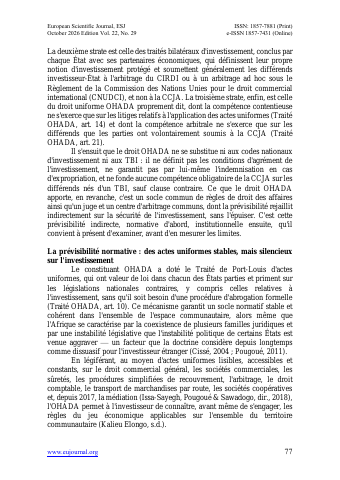
- OHADA law does not replace national investment codes or bilateral investment treaties.p.8
- A uniform act on investment could define investment, guarantee against expropriation and extend the CCJA's jurisdiction.p.9
- Arbitration under the CCJA is conventional, binding only on parties that expressly accepted it.p.10
- The CCJA has no body of substantive investment rules on which to build specialized case law.p.11
Pages
 p.1
 p.2
 p.3
 p.4
 p.5
 p.6
 p.7
 p.8
 p.9
 p.10
 p.11
 p.12
 p.13
 p.14
Funders mentioned
Topics and entities
Summary and figures generated from the document and checked automatically: every number shown appears on the cited page. Publishers can request removal.