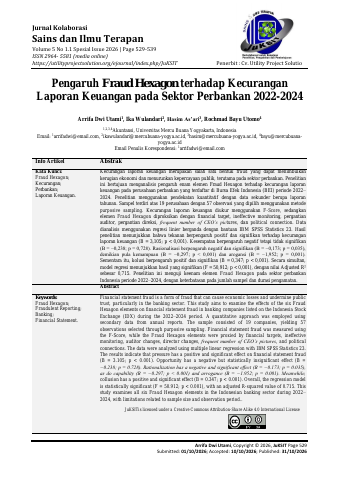
The Influence of the Fraud Hexagon on Financial Statement Fraud in the Banking Sector 2022-2024 (Jurnal Kolaborasi Sains dan Ilmu Terapan.)
SaveSummary
- The study covers banks listed on the Indonesia Stock Exchange, with a sample of 19 companies and 57 observations.p.1
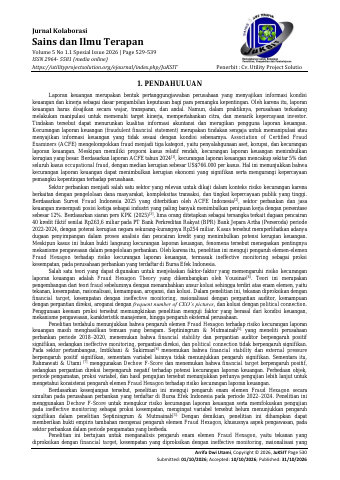
- ACFE data cited by the authors show financial statement fraud at about 5% of occupational fraud cases, with a median loss of $766,000 per case.p.2
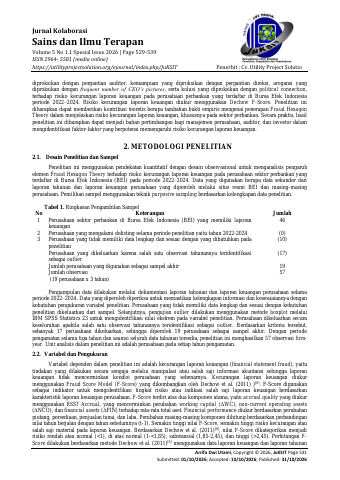
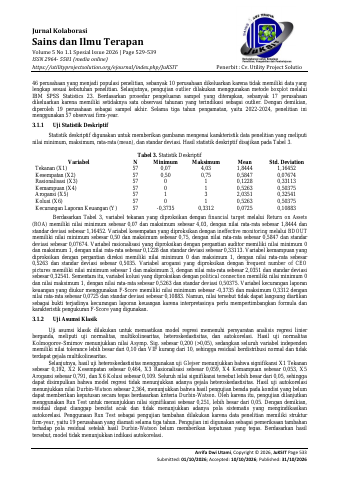
- Of 46 companies in the population, 10 were excluded for incomplete data and 17 for outliers, leaving 19 companies.p.5
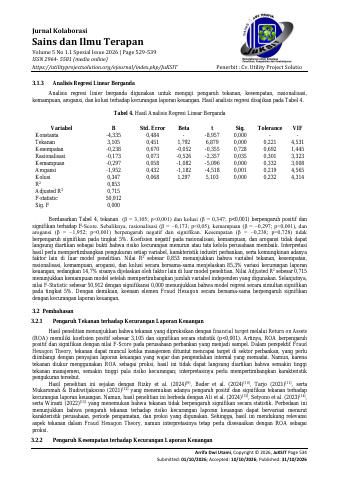
- Pressure (financial target) has a positive, significant effect on the F-Score (β = 3.105; p<0.001).p.6
- Collusion (political connection) has a positive, significant effect on the F-Score (β = 0.347; p<0.001).p.6
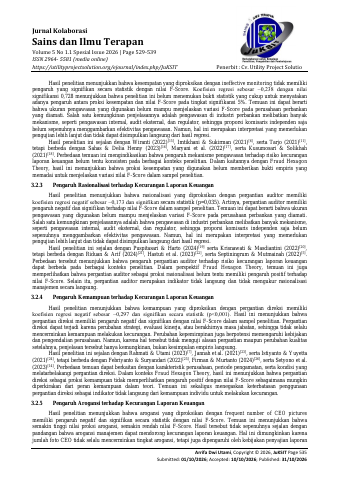
- Opportunity (ineffective monitoring) has no significant effect on the F-Score (β = −0.238; p=0.728).p.6
- The regression reports an R2 of 0.853.p.6
Key insights
- Rationalization (β = −0.173; p<0.05), capability (β = −0.297; p<0.001) and arrogance (β = −1.952; p=0.001) have significant negative effects on the F-Score.p.6
- The authors caution that negative coefficients cannot be read as proof that fraud risk falls or governance improves.p.6
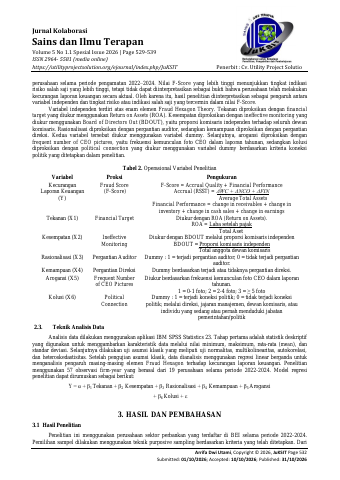
- Higher F-Scores indicate higher misstatement risk but are not proof that fraud actually occurred.p.4
- The insignificant opportunity result may reflect that the share of independent commissioners alone does not capture banking oversight, which involves internal controls, external audit and regulators.p.7
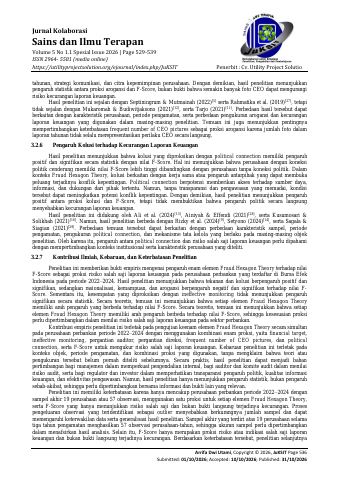
- Firms with political connections tend to have higher F-Scores than firms without them.p.8
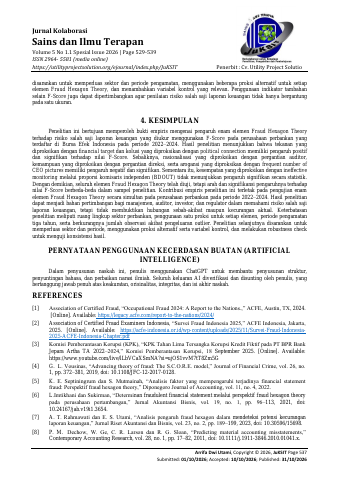
- The authors suggest broadening the sectors and period, using alternative proxies for each element and adding control variables.p.9
Pages
 p.1
 p.2
 p.3
 p.4
 p.5
 p.6
 p.7
 p.8
 p.9
 p.10
 p.11
Topics and entities
Summary and figures generated from the document and checked automatically: every number shown appears on the cited page. Publishers can request removal.